Categories
Book Reviews Non-Fiction

Emotional Vampires: Dealing With People Who Drain You Dry – By Albert J. Bernstein

I knew it even before I picked this book up from McGraw-Hill.  I am an emotional vampire!  Someone who has this tendency to drain the people around me dry, emotionally.  OK.  According to the author, since vampires metaphorically speaking don’t have reflection, they can’t tell if they are indeed an emotional vampire, even after reading this book.  So, in my case, I am either paranoid – unlikely – or lucky enough to recognize my shortfalls.  In the world of psychology, everything is on a continuum.  I hope I am on the milder end of it.

Back to the main purpose of Emotional Vampires.  It is to teach you how to deal with people who drain you dry in your daily life.  Out of eleven different personality disorders according to the manual of the American Psychiatric Association, the author has picked five: Antisocial, Histrionic, Narcissistic, Obsessive-Compulsive, and Paranoid.  They are more common and in 40 years as a psychologist and business consultant, the author has seen these five disorders constantly cause the most trouble for the most people.  At work, at home, or anywhere in between.

The purpose of this book is not to consider the morality of emotional vampires, but to teach you how to spot them in your life and give you some ideas about what to do when you find yourself under attack by the forces of darkness.

Emotional Vampires – while written with humor – is not an easy book to digest.  At least for me.  For the simple fact that if you can relate to the tactics against all five types of emotional vampires, you must be having quite a challenging day-to-day life having to face so many difficult people that drain you dry.  I can at most relate to one or two types of emotional vampires.  Moreover, I doubt all the five chapters of therapy and self-help for each vampire type would be applicable to you either.  Chances are, you may find none of the therapy tips personally relevant.  Or you may pass this book to someone whom you think has a degree of personality disorder and hope that he or she would improve.

Hence, my suggestion would be after reading the introductory chapters, jump to the part that is most relevant to you.  This book tends to describe a more severe end of the spectrum for each vampire type so as to be more encompassing.  Therefore, it can be quite depressing to read through everything at one go.

Emotional Vampires is packed with hands-on information.  It shows that the author has in-depth experience in this field.  Each section begins with a chapter describing what that particular type of vampire is.  Another chapter or two to drill down on the sub-types and how to protect yourself from them.  Next chapter on what to do when you have to live with an emotional vampire, be it as your spouse, your parent, your child, or etc.  In the event whereby through reading this book, you realize that you may be one, fear not.  There is a final chapter on therapy and self-help.

A book on psychology is often dry.  But not this one.  I have chuckled a fair bit while reading Emotional Vampires.  The following – my favorite – may have quoted out of context.  Nevertheless, it shows the lighter side of the materials.  In this excerpt, the author’s intend is to illustrate what a Daredevil is.

Women are socialized to recognize what needs to be done and to do it without being asked.  Lower-order creatures, like men, children, pets, and emotional vampires, cannot be trained to be this perceptive.  They must be given specific instructions.

If a woman sees a sock on the floor, she will pick it up and put it where it belongs.  If a man sees a sock on the floor, he will assume it is there for a reason and step on it.

Any stereotypical statement you might make about men applies to Antisocials, especially Daredevils.  They are masculinity made flesh.  As we will see shortly, Histrionics are the walking, talking personifications of feminine stereotypes.

It is difficult to summarize a practical guidebook that is so full of contents.  Instead, I am going to pick two case studies and share with you how Emotional Vampires benefits me.

Case Study #1: Bullies

I am blessed that my friends and families are not that crazy.  I don’t need to use any of the techniques I have learned to protect myself against them (in retrospect, I think I may want to pass this book to them so that they can protect themselves against me).  At work, it is a different story.  Once in a while, I come across someone who has this anger management issue.  They would yell at people in open office space.  Bang table, even swear at people.  It is impossible to please them.  Anger induces fear and that becomes their one and only modus operandi.  Because things get done when they bang table and scream at people, they continue doing so throughout their career.  If you have not met angry people at work, good for you.  For I have.

What to do about Bullies?  Yield or confront?  Either way, you’ll lose.

Bullies are angry people who have discovered, to their delight, that anger – which they would engage in anyway for its thrill value – also gets them power and control, at least in the short run.  In the long run, Bullies’ anger destroy them.  So what?  Knowing that the vampire who’s browbeating you right now will eventually get his or her comeuppance offers little comfort and no protection.

The hypnotic relationship between anger and fear has stood the test of time, and it will continue until you do something about it.  But what?

The key is to do the unexpected.

The first step is to ask for time to think.  Since Bullies are not normal people, they may want to try other ways to get you back into the battlefield, and not to go through a rational discussion.  There is a good chance that the confrontation may end right there (and you win).  If not, at least you have taken some time to plan the next course of action.

Next is to think about what you want to have happened.  Bullies won’t back down and admit that you’re right.  Would you want to be right or to effectively handle the situation?  Discard any possible outcomes that forces Bully to back down.  They won’t work.

The next step is my favorite: Get the Bully to stop yelling.  It is actually easier than it seems.  First, you should keep your voice soft.  Don’t oblige them by yelling back.  One trick is to say, “Please speak more slowly.  I’d like to understand.”  Reducing the speed will reduce the volume.  No one can yell slowly.  If you are on the phone, there is this ‘uh-huh’ rule.  We usually say ‘uh-huh’ when the other person is catching a breath.  When speaking with a Bully on the phone, stop your ‘uh-huh’.  After a while, the Bully will pause and ask, “Are you there?”  This interrupts the yelling.

Remember, whatever you do, don’t explain.  It is a form of fighting back or running away that fuels the Bullies.  Instead, ask, “What would you like me to do?”  This forces Bullies to stop and think because more often than not, clouded by all the angry emotion, they have no clue what you should do.

The last two tips are (1) don’t take criticism personally and (2) learn from criticism.  These tips aim to make you a better person and deal with the situation with a calm and rational mind.  There is a good chance that by looking from Bully’s perspective, a new solution may emerge.

Case Study #2: Obsessive-Compulsive

In the beginning of this entry, I have confessed that I am an emotional vampire.  I have gone through the checklist in the book and have scored pretty high.  Those who are close to me in real life or in the online gaming world should have no problem observing this aspect of mine.  Over the years, I am fortunate to have met great mentors and loving families who help me mature.  Have I done enough?  How useful is the therapy part of this book?  We are going to find out.

Obsessive-Compulsives see their existence as a battle against the forces of chaos.  Their weapons are hard work, adherence to rules, scrupulous attention to detail, and the capacity to delay gratification into the next life if need be.

Without Obsessive-Compulsives to do the unpleasant and painstaking tasks that make the world go, nations would fall, businesses would grind to a halt, and households would collapse into utter confusion […] Obsessive-Compulsives want to create a secure world by making everybody Obsessive-Compulsive.  Only then can they be safe from themselves.

1. Always Know Your Top Priority – Checked

The author wrote that I should think about what I’d like to have carved on my tombstone, and work toward that.  The other details will take care of themselves.  Coincidentally, the one most life changing book I have read is The Seven Habits of Highly Effective People.  One of the habits is to begin with an end in mind that uses the same technique.  It is the one habit that I remember the most from that book and I use it from time to time.

2. Judge Not.  Lest Ye Be Judged – Checked

During my younger day as a manager, my supervisor – a great mentor – one day summoned me into his room.  He knew that I was a meticulous person and a competent professional.  His only criticism was on my management style.  The way that I always saw the negative attributes in people.  So he said to me, “Exploit others’ strengths, not weaknesses.”

After that day, I seek to recognize good things on people before the negative stuffs.  It helps, a lot.

3. Goof Off – Checked

The books says, I should spend a little time every day just sitting and doing nothing.  Learn to relax.  I knew those moments of I idly waiting for my wife to get off work everyday are in fact doing good to me.

Note to myself: The next time I go for a walk after lunch, stop playing with my phone.

4. Specify Products and Don’t Meddle in Process – Checked

It is true.  People with my kind of unique personality often get lost in the process.  We are famous for not seeing forests because of all the trees.  Once upon a time, my mentor said to me, “Manage the outcomes, not the process”.  That was also the defining moment when I switched out of micro-management style and have a much better life thereafter.

5. Criticize Only on Thursdays

And for the rest of the week, praise others for the things they have done right.  Only criticize on Thursdays, including the things I do.

I suppose I could pay more attention to my inner thought.  Perhaps instead of commenting while driving that “he should signal” or “he shouldn’t speed so excessively”, I should observe the better drivers on the road and say, “look, he gives way” or “look, he signals”.

6. Publicly Acknowledge at Least One Mistake per Day

And two on Thursdays.

You mean I have to admit that I am wrong?!  My friends must be laughing when reading this because I seldom do so.  Maybe I shall put an effort on this.  This seems so … hard.  But I’ll try.

Conclusion

Emotional Vampires was originally published in 2002.  Due to popular demand, the author has released a revised and expanded second edition.  This book is packed with useful tips on how to deal with people who drain you dry.  It is useful to me.  I highly recommend this book for those who wish to live a happier life.  We cannot avoid emotional vampires.  It is best to protect ourselves against them.  And if we can become a better person or help others in becoming one after reading this book, that would be a bonus.

Paperback: 304 pages
Publisher: McGraw-Hill; 2 edition (May 25, 2012)
ISBN-10: 0071790950
ISBN-13: 978-0071790956

Categories
Book Reviews Fiction

Lord of the Clans By Christie Golden

Christie Golden needs no introduction.  She has written tons of books for major fantasy franchises.  I reckon she is one of Blizzard’s favorites.  I may not be agreeable to her writing style, especially her over reliance of the word ”˜had’ (who am I to comment about English grammar anyway, though this habit of hers has been highlighted by other online reviewers as well).  But every book of her so far managed to move me to tears.  If you need someone to thoroughly develop a character and to strike the emotional core of the readers, Christie Golden is the one you shall look for.

Lord of the Clan, in summary, is a story of Thrall.  It is the second book from the Warcraft: Archive series.  The demonic power that corrupted the orcs seems to have receded, leaving the blood eyed orcs docile, incapable to return to their former glory.  For most orcs, their way of life is lost.  The warlocks’ abuse of demonic power has driven the shamanic spirit away.  In this era, orcs who were previously addicted to the demonic power are now willingly imprisoned by the human.  The war is lost.  It is a dark day for the orcs.

Infant orc Thrall, son of Frostwolf Clan’s Chieftain, is left in the wild when his parents are brutally assassinated by their fellow Horde.  During a hunting trip, Thrall is found by a human called Lord Blackmoore who is in command of the encampments where orcs are imprisoned.  Instead of killing the orc baby, Blackmoore has decided to enslave Thrall and train him as a gladiator for his personal gain.  He commands his people to teach Thrall how to read and to fight.  He wants Thrall to learn the human language and master the war strategies.  Life as a gladiator is never easy.  However, Thrall is also blessed with a few friends.  One of them is a human girl called Taretha, who treats Thrall as her little brother.

However comfortable life seems to be as a slave, Thrall’s true destiny is not to be a gladiator.  He must join force with Grom Hellscream of the Warsong Clan.  He must unit with the Warchief Orgrim Doomhammer.  Together, the New Horde must rise.

Lord of the Clan is the first book that is written from the Horde’s perspective.  While the Old Horde that fell under the demonic influence is traditionally viewed as villain and the Alliance is seen as hero, with the rise of the New Horde, the line is no longer black and white.  Orcs can be honorable.  Orcs can be merciful.  And human can also be corrupted by political power too.

Thrall has become a center figure in recent lore development.  Lord of the Clans has shed much insight onto Thrall’s childhood and adulthood.  With Thrall’s unique background – born as an orc and taught by the human – it is no doubt he is where he is today.  The question to all whom indulge in the World of Warcraft is: after Cataclysm and at the end of Mists of Pandaria, will Thrall return as Horde’s Warchief?

Categories
Book Reviews Fiction

Day of the Dragon By Richard A. Knaak

Richard Knaak is one of the few resident Warcraft series writers.  His storytelling style is visibly different from others, more so towards the traditional fantasy genre.  Written in 2001, Day of the Dragon is considered as the first book of the Warcraft series.  It is also the first book of the Warcraft: Archive four-book series.  Warcraft is a fantasy universe I am fond of, dearly.  Hence, I read Day of the Dragon with a high anticipation over my holiday in Bandung, devouring every bit of the lore within.

For those who are familiar with the recent lore development, reading Day of the Dragon is real treat.  Never have we been so close to some of the key figures in recent days.  Imagine reading Deathwing in human form, the Old Horde corrupted by demonic power, and the general mistrust of the use of magic – just to name a few.

Back to the era whereby the day of the dragon has passed, dragonqueen Alexstrasza – one of the five great Aspects of the dragon flights – is captured by the orcs from the Dragonmaw clan and is imprisoned within the caves of Khaz Modan.  Deeply weakened by an artifact called Demon Soul, she resigns to her fate of birthing red dragons only to be trained by the orcs to do evil deeds.

Her consort, Korialstrasz also known as Krasus in his human form, must find a way to free his beloved queen.  And it is no easy task.  Uniting the rest of the weakened dragon Aspects seems impossible.  Malygos has gone mad; Nozdormu is obsessed with collecting artifacts throughout the timeline; and Ysera is lost in her dream world.  Only Deathwing the Destroyer – the black dragon flight Aspect – is not weakened by the Demon Soul.  And he is plotting his sinister moves in bringing the world to an end (you could say again, but this event happens before Cataclysm).

Hope is now placed upon a human mage Rhonin from Kirin Tor of Dalaran.  Krasus sends Rhonin on an observatory mission to Khaz Modan escorted by an elvan ranger Vereesa Windrunner.  During their journey, they have recruited the help of the human paladins as well as the dwarves and their quest has changed.  But is it enough to face the adversities of the orcs, trolls, and goblins?  With the Horde losing ground and the Alliance gathering its forces under a mysterious character called Lord Prestor, how would this ultimate battle play out?

Day of the Dragon answers a lot of questions I used to have.  Locations and characters such as island kingdom of Tol Barad, Gemm Greymane, and Gilneas are not featured in World of Warcraft until 2011.  It appears to me that Day of the Dragon was well ahead of time.  Lore development these days are tightly coupled with the game development.  Deep inside, I am wishing that Blizzard would release new lore that will not be seen in the game till, say, a decade later.  This will give the fans something to look forward to, something beyond what we have anticipated today.

Categories
Book Reviews Fiction

I’ve Got Your Number By Sophie Kinsella – You Know What To Expect, Don’t You?

Chick-lit can be extremely entertaining, even for guys.  None of my guy friends seems to believe me though.  Oh, whatever.  When I saw Kinsella’s new book selling at the airport during my Malaysia business trip, I almost impulsively grabbed a copy.  Almost.  I resisted and reserved a copy at my library online instead.  My patience has been handsomely rewarded and I’ve Got Your Number arrived right before my trip to Bandung, Indonesia.  Hooray!

Note: As you can see, this entry has been written quite some time ago.

At times I wonder: how many different plots one can spin out of women crisis, wedding and engagement, issues with guys and guys’ family, and falling in and out of love.  Surprisingly, the Sophie Kinsella formula still sells.

Poppy, a physiotherapist, loses her engagement ring at a charity party.  To make things worse, she loses her phone too.  How can one live without a phone these days?  Out of nowhere, she has found a phone in a bin, still in working condition.  She then shares this new number with the hotel staff, in case someone finds her ring.  Just when Poppy thinks that she can now focus on recovering her ring, the phone rings.  The phone belongs to the PA of a businessman called Sam and he wants it back.

Poppy does not want to return the phone, yet.  And she makes a bargain to forward any corporate emails and messages to Sam as soon as they arrive.  On several counts, Poppy has proven to be quite a helpful assistant and Sam tolerates this temporary arrangement until Poppy’s ring is found.  Needless to say, this situation turns out to be quite a mess with Poppy’s personal messages mixed with Sam’s corporate messages and the correspondence between the two.  How far can one resist not reading into other people’s messages?  (Not far)  How much can one know about a person by reading others responses about him or her?  (Not much in fact)

I’ve Got Your Number is a fun and light read.  There is a contrast between Poppy’s warm and helpful character to Sam’s curt and business-like character.  Sophie Kinsella’s secret recipe, I believe, is her ability to create an intelligent plot and characters and yet bring it down to a level whereby everyone can relate and laugh about.  This book is slightly different from her previous standalone books in a way that it is full of emails and messages going to and fro between the characters.  It is certainly relevant to our current mode of communication.  I wonder how the readers in the future – say 100 years from now – would react when texts and emails are no longer the norm of communication.  Sophie Kinsella has not fully embraced social networking in her stories yet.  It is going to be a matter of time, I reckon, now that she is pretty active in Facebook.  One of my previous comments about Kinsella’s works is that there is hardly any character development on the male characters.  This book seems to have done a better job in that regard.

While the bulk of I’ve Got Your Number is fun and light, I must admit there is a high dosage of melodramatic moments that only girls can fully appreciate, especially towards the end.  My brain was literally fried with an overwhelming amount of sweetness.  Knowing what genre I am getting myself into, I am not going to complain, not even the slightest.  If you like any of her previous books, especially the standalone ones, this one is not to be missed.  As always, I am looking forward to reading her next book.

PS. What’s up with the footnotes appearing everywhere in the book?  I actually quite like it. Cynthia is having a headache reading them though.  Ha ha ha.

Categories
Book Reviews Non-Fiction

The End Of Cheap China By Shaun Rein – An Insightful Look Into China From The Inside

Before End of Cheap China is released to the Asia market, it is already banned in China.  Why would a subject on economic and cultural trends that may disrupt the world received such treatment?  My contact at Wiley is intrigued.  And she is keen to hear my view.  I too am intrigued.  The author Rein is a mixed heritage of Chinese and Jewish.  He married the granddaughter of 50 most important Chinese Communist party members in history.  Because of his business background, he gets to converse with China’s leading entrepreneurs on a regular basis.  The author practically lives and breathes in China.  End of Cheap China is largely a collection of Rein’s social, economical, and political opinions of China written in a journal style.  Because this is a still business book, at the end of each chapter, there is a short appendix catered for the business readers.  While I may not have a definite answer to why China deems the book unsuitable for her people, let’s take a look at what this book offers.

1998, Rein was in Changchun, a city at the northeast China.  Back in those days, everything in China was cheap.  For US$20, according to his observation during that trip, you could have some ”˜fun’ with a girl in your hotel room.  A girl with a physical outlook that could qualify to be on the cover of Teen Vogue magazine.  Such scene is now unseen of in China.  Why so?  Here is his view on this matter.

China’s economy and job market have seen dramatic changes in the past decade and a half.  As more attractive, better-paying job opportunities increased, pretty young girls took advantage of better options, and the pool of prostitutes got uglier as a result.  The uglification of China prostitutes is part of a boarder trend that is the subject of this book, The End of Cheap China.

It is hard to understand China without an appreciation of Chinese modern history.  Through his personal interaction with his mother-in-law, the author recounts the events and impact of Cultural Revolution (66-76).  Many in China still remember the pain and suffering.  Yes, to the Chinese people, free speech is great but not if it threatens stability.  According to Rein, Chinese people support the central government.  What they often protest against are the local officials who are given the flexibility to implement the policies set by the central government.  In this complex political landscape, the author examines the root of corruption that is often found at the local level.  Local officials in China are poorly paid, not allowed to travel or retire to the private sector once they have reached a certain rank.  This leads to local officials being more susceptible to accepting bribes.

Officially, prostitution is illegal in mainland China.  But why is it practiced openly?  Again, this points to the political makeup of the country.

For ordinary Chinese people, vices like drugs and violence are intolerable due to the immediate impact on their every lives, but often they will tolerate prostitution as long as it is kept behind closed doors and distant.  Here we see the divide in thinking between levels of government: Local officials and people confront prostitution pragmatically, whereas the central government upholds a more morality-based approach.

To examine the economic trends, Rein visited Laura furniture factory in Shanghai.  There are 10,000 workers on the working floor and the environment appears decent.  Because of the high demand in Chinese skilled workers, the factory (and many others) is facing the challenge of keeping the workers.  This drives up workers’ salary and in turn drives up business cost.  The factory could pass the cost back to American consumers and Laura may have to consider moving the factory to countries such as Vietnam or Indonesia in order to cut cost.  However, this is not desirable because the skill of Chinese workers and infrastructure of China cannot be met by these countries today.  What should Laura do?  Rein’s advice to the factory’s manager is that instead of exporting all the furniture to America, create a market share in China.  Leverage on China’s domestic market to sustain or even grow the business.  In fact, that is what the current trend is: Market the products back to China consumers.  Branding then becomes the next challenge because these foreign brands are going to compete with the local household brands.

You may have heard that because of China’s one-child policy and Chinese’s desire to have sons, this leads to an imbalance to the gender ratio.  In the past, for practical reasons, when many were farmers, sons were preferred.  In the past decade and a half, the role of Chinese women has changed.  Take Laura furniture factory as an example, women are paid more because of the skill involved in, say, sewing the sofas.  Men are paid lesser comparatively because labor type of work is less valued.  Moving away from the factory and into the cities, the same pattern is observed.  Women are flavored in the service industry, especially on the consumer sales.  More often than not, wives earn much more than husbands.  This has an implication to the social trend within China.

The empowerment of women is one of the great developments of modern Chinese society.  Women are becoming the key drivers of spending; they are beacons of optimism in the country, and a major force behind China’s transition towards becoming one of the biggest markets in the world.

When it comes to food, foreign brands seem to do well in China due to local food-supply problem.  The recent baby formula episode is a good example of why Chinese people are especially careful on food consumption.  Kentucky Fried Chicken is considered as ”˜healthy’ because many Chinese trust that the food from these foreign brands is safe to eat.  While on the topic of food, the author observes that China import over $15b in food products from America in 2011, up from $6.7b in 2006.  This trend will continue to go up.  What is the implication to the world?

I suppose for those who are outside China, we often wonder: Is China really doing well?  The author examines the topic of real estate from various angles – the policy flaw in terms of favoring the commercial zone as it is easier to obtain construction loans compare to residential and Chinese’s preference to hold tangible asset rather than stocks.  The author also examines GDP in China and he argues that unlike Japan, China’s infrastructure spending is more efficient and it helps to jump start the economy growth in the cities.  On the education front, Shaun highlights the classroom overcrowding issue (imagine a class size of 1,500) as well as the fact that the Chinese education system is not producing enough creative thinkers.

The topic interests me most is on China’s foreign policy.  Because of the need for natural resources, China has been actively expanding the influence to countries like Africa and Pakistan.  Different cultures adopt different policies when investing overseas.  When Chinese companies financially takes over a foreign company, the existing management team is often left intact.  Yet, not all countries trust China’s non-interference approach.  Some countries do not welcome China’s money.  Some struggle to accept China’s financial help.  Now I know why as a Chinese, I bond well with Pakistanis here in Singapore.  They seem to have a good impression of Chinese people, thanks to China’s friendly investment in Pakistan.

End of Cheap China is a good read, for those who wish to learn more about China from the inside.  The journal writing style makes it easy to follow.  Because the content of this book is filled with the author’s criticisms and opinions, it could get a bit disoriented.  This book at times appears to be written for the Western businessmen who are investing in China.  In other chapters, the author seems to address to the US government, to the Chinese government, to other governments, or to the Chinese people in China, on what they should or should not do.  Each target audience – I would presume – has different agenda and potentially conflicting interests.  It is unclear if Rein’s goal is to advocate a win-win situation.  Personally I would prefer a straightforward journalistic approach such as Nothing to Envy (a book on North Korea).  Having said that, End of Cheap China is also a business book and it is packed with action items for those who are doing business in China.

I do not know how a book get banned in China.  I admire the author’s boldness in analyzing China at the ground level, talking to commoners in China as well as to the Chinese billionaires.  To be fair, some of his criticisms go beyond China and are directed towards America.  Maybe it is the book title.  Or the prologue when he was approached by a young prostitute in 1998.  Maybe it is his account of Cultural Revolution.  My question to the writer would be: If he was to know the ban, which bits would he rewrite or censor, if at all?

Hardcover: 240 pages
Publisher: Wiley; 1 edition (March 27, 2012)
ISBN-10: 111817206X
ISBN-13: 978-1118172063

Categories
Book Reviews Non-Fiction

Boundless Potential By Mark S. Walton – Midlife Onwards Is Going To Get Better!

This book I received from the publisher McGraw-Hill surprised and inspired me at the same time.  Boundless Potential is a perfect book for those who are crossing or have long crossed midlife.  Even for the younger crowd, it is always good to read ahead and have an end in mind.  Before I go into the specifics, here are some questions for you.

  1. Do you feel unchallenged at work?  As in, work no longer taps onto your full potential.  You feel as though there is so much more you could do, although you are finding it hard to pinpoint what that is.
  2. Would you like to retire early so that you do not need to work but rather enjoy doing things that you like instead?
  3.  BIG question here: Do you believe that our brain, like other human organs, is fated to wear out over time?  That is, to lose its resilience and the ability to function as we get old, really old?

If your answers are yes, you and I are on the same boat.  In contrary to common beliefs, our brain works in a different way once we pass our midlife.  In fact, a better way.  The key is to reinvent ourselves in order to recognize and unlock our potential.  What is shocking to me is that I have this wonderful picture of what retirement is.  No more work.  No need to get up for work, and I can indulge in any hobbies – old or new.  Even travel around the world sounds like a good plan.  Have you dreamed about what your retirement is?

Now, what if I am to tell you that you should continue to work for as long as you can, be it as seventies, eighties, nineties, and beyond? And that retirement to pleasure alone could possibly kill you faster (curiously, my mother once told me about her concern over my dad’s retirement)?  Boundless Potential is packed with tons of real life stories on how people reinvent themselves towards the second half of their lives.  How they found a sustainable mean to pursue their dreams, and be happy ever after.  In fact, it appears to me that because these people are happy with their work and the positive contribution to the society and those around them, they live longer.  And they live a much fulfilled life possibly than those who sip beer over sunset at a farm populated by sheep (that is my dream retirement before reading this book).

Some of you may be skeptic.  How to reinvent?  What is my hidden talent?  After all, while there are pages and pages of success stories, majority of us may well have an unproductive or unfulfilled retirement.  To answer that question, the author presents a three-step approach.

First, you have to discover your fascination, your dream so as to speak.  It is not an easy task.  For some, this discovery journey may take place in a much later part of life, if at all.  A fascination is a direction that pulls you forward, regardless of the obstacles ahead of you.  It is something that both your heard and mind want.  No one can tell you what that is.  It may be something you chance upon if you open your eyes wide enough.  I am the optimistic one.  To me, finding your fascination is like finding your soul mate.  Those who are singles are often worried that they would never find that someone to spend the rest of their lives with.  But yet, many people are getting married or are living together.  Do some soul searching along the way: Where is my fascination?  I don’t know what yours is.  I am quite sure I haven’t found mine yet.  It is unlikely that I know the answer today.  But I shall keep this at the back of my head, just in case I stumble upon my answer.

Second, once you found your fascination, it is time to find your flow.  What is a flow?  It is the highest level of human happiness that is generated when fascination is translated into action.  The paragraph below best illustrates the concept.

Contrary to what we usually believe […] the best moments in our lives are not the passive, receptive, relaxing times.  The best moments usually occur when a person’s body or mind is stretched to its limit in a voluntary effort to accomplish something difficult or worthwhile.  Optimal experience is thus something we make happen.

With this specification, I can probably look back on my life thus far and identify a few flow moments.  When I was a consultant before my major career switch five years ago, I used to give training workshops and facilitate focused group discussions for the senior officers of my clients’ organizations.  It can be extremely stressful because while what I preached was derived from a defined framework, no two audience groups are the same.  Different corporate or team culture may require different means to unlock their enthusiasm so that they are more receptive to the training materials.  It is an art.  I have to observe on the spot and talk to people during breaks in order to understand how best to engage them.  For those highly intelligent groups, challenging questions that are new to me may come my way.  Teasing out ideas may not be easy.  Looking back, those were my happy moments.  And I reckon I did quite well because our team constantly received praises and recognition from our clients.  Could I reverse engineer my fascination knowing what my flows are?  Maybe I am fascinated by training and learning with people?  What about those moments when I played music with my band at Orchard for charity?  Could music be my calling instead?

Back to the reinvention framework the author has proposed, the third and final step to this process is to envision your structure.  A structure that is created by you for success in midlife and beyond.  Is it going to be a project, a role, a career, a business, or a nonprofit? Whatever the structure is, it is certainly required in order to sustain and grow your fascination.  It is probably something so new and different that you have to sell the idea to those around you and to establish one yourself.

Boundless Potential is written in a highly readable form.  It is not possible to summarize all the inspiring case studies in one blog entry.  Since I love reading this book (and for my future reference), here are some of my favorites.

An interview with Marion Rosen who was nearly 95 when the author conducted the session.

When we are at the height of our knowledge and the height of our lives, why should we give that up?  Why should we not use what we have gotten in 60, 70, 80, 90 years?  And hand it on to where it is wanted?  It seems ridiculous to me.

If you don’t use your potential, it hits back at you.  It strikes back, because it works on you, it wants to come out.  And in order not to come out, you have to hold it back. And that is very bad for your health, very bad for your personality, very bad for your relationships. It doesn’t work!

The second quote would take a while to explain (that can be found in the book of course).  It has something to do with our wisdom deriving from our maturity, experience, and the changes to the brain.  It does sound convincing.  I don’t need to see further but looking at my dad to know that this much is true.  My father has recently reinvented himself into someone who produces beautiful Chinese Calligraphy (previously he was giving Tai Chi lesson to the folks in Hong Kong and making training videos).

State-of-the art neuroscience has determined that the human brain was never designed for decline or retirement but for continual reinvention and success.  In fact, extraordinary powers become available to us in the second half of life that were not available in the first  […]  The mature brain, when properly maintained, has the potential to be continually transformed – to draw upon and synthesize its vast storage banks of knowledge and experience in ways that can be downright startling.

Another big question for you: What is the secret of living happily ever after?  The answer could be as simple as play hard, so that you can work hard (not the other way round!), and pay it forward.

Unlike “simpler” animals, [the Athenians] reasoned, we humans are “composite creatures” who want more than to eat and sleep our lives away.

Thus, attaining genuine happiness – eugeria – requires a full-out lifelong pursuit of worthy goals through the three components of our humanity: body, mind, and soul.

This ongoing quest, they believed, was “the meaning and the purpose of life, the whole aim and end of human existence.”

Hardcover: 262 pages
Publisher: McGraw-Hill; 1 edition (March 16, 2012)
ISBN-10: 0071787852
ISBN-13: 978-0071787857

External Link: McGraw-Hill Asia

Categories
Book Reviews Fiction

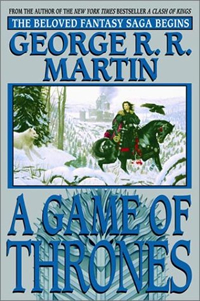
A Game of Thrones by George R. R. Martin: Gruesome, with No Black and White

I did not choose to read this book.  Not exactly.  During my holiday in Bandung, I have finished the books I have intended to read.  I suppose I could start reading yet another Warcraft story.  Having read four in a roll, I need something more, shall I say, hardcore.  A Game of Thrones lies in Cynthia’s library.  I said to myself, why not?  HBO adapted the saga as a TV series.  It cannot be that bad.  So I dived into this mightily thick book of fantasy, without knowing what I was getting myself into.

I think, or rather I would advocate that in front of every book cover, there should be an advisory sticker like a film rating for movies or ESRB rating for video games.  This book, in my opinion, is unsuitable for the young adults.  It is bloody violent.  Children wield swords to kill (and then I watched The Hunger Games on a big screen wondering where this world is heading).  There are orgies, rapes, and prostitution.  Underage girls having sex.  Sibling having sex.  The most amazing thing is, there is no moral compass or whatsoever in A Game of Thrones.  There are no heroes, no villains.  Seldom characters are rewarded by doing the right things in life, nor they are punished to do the otherwise.  In fact, most of the time, it is the other way round.  Each chapter is filled with drama.  You could almost smell something bad, I mean really bad is going to happen.  Initially, there were surprises.  Then came the predictability.  Soon, I was numb.  I read somewhere that blood, sex, and money always sell on TV.  This book has them all.

Now, if I may accept a story that is so uniquely set up, in a fantasy world that has no black and white, a realm whereby treachery and brutality is the mean to survival, A Game of Thrones is a masterpiece.  So much details being poured into creating a world filled with a massive number of interlinked living and breathing characters.  Each character comes from a unique background.  Not only that, a history is crafted alongside with the main story.  On top of that, this first book of A Song of Ice and Fire saga to me read like a very long prologue.  In this Seven Kingdoms of Westeros, a major conflict is brewing.  This realm is slowly pushed into war from within, a war fueled by vengeance, jealousy, and ambition.  At the same time, there is subtle politics in place that shapes the events.  And, there is something strange happening beyond the realm’s wall in the north.  Creatures unfamiliar to this realm are emerging.  Myths of the dragons start to appear.  Something is brewing.  Something big.  Something mysterious.  But you won’t find the answers in this book.  Because this book is the first of a long saga that is still work in progress.  You have to keep reading to find out more.

Unique to this book, the story is told from a set of characters’ viewpoints.  Each viewpoint corresponds to one chapter.  There are three major Houses in conflict.  House Baratheon, where King Robert belongs.  House Stark, where the king’s right hand man Eddard leads.  And House Lannister, descendants of the blood of Andal adventurers.  The viewpoints are presented by Lord Eddard and his wife Lady Catelyn.  Their daughters Sansa and Arya.  Their son Bran.  Eddard’s bastard son Jon.  Tyrion Lannister, a dwarf who is the brother of the queen (who is nothing like a dwarf).  Finally, Princess Daenerys Targaryen who is the daughter of the previous king and is now in exile.  The initial chapters were a torture to me.  Because I was not used to the shear number of characters and the strange tone used that is specially tailored to suit the lore of the realm.  After I got over the hurdle, I was not able to put the book down.  Switching from viewpoint to viewpoint makes the narrative refreshing, keeps the plot in suspense.  It is a slow and satisfying buildup to the final ecstasy.  The endings are shocking.  They open up more questions than providing the readers with answers.  I am eager to take on the next volume in this series to see more blood, more violence, more sex, and more shame and glory.

When you play the game of thrones, you win or you die.

The above quote is in essence what this book is about.  After reading A Game of Thrones, I can understand its popularity.  I must admit, I have not read something quite like this before.

Categories
Book Reviews Non-Fiction

Night and Low-Light Photography by Alan Hess – Packed With Good Tips For Beginners

Normally, I prefer not to review non-fiction books on my holidays.  However, it is good to hear that Wiley publishes photography books as well.  So I grabbed a copy sent by my contact earlier on and was eager to read more on a topic so close to my heart.

For new photographers, night photography, especially under low-light condition, is likely one of the toughest challenges faced.  Our human eyes adapt to low-light well.  More often than not, as a beginner, what you see from the LCD screen at the back of your camera under these conditions seldom resembles to what your eyes see.  Many I know of struggle with flash photography so much so that they would rather not to use a flash at all.  I too have gone through that journey of frustration and experimentation.  I would say Alan Hess has done a good job in explaining the basic mechanics in Night and Low-Light Photography.

What I like about this book is that it reads more like having someone talks me through the basic, and not a book full of theories.  The author takes his time to explain the different gears required getting the job done.  Hess also in multiple instances explains the fundamental variables and their relationship such as ISO, shuttle speed, and aperture.  Other important topics such as exposure, white balance, metering, and digital noise are covered as well.  I often find myself having to explain the same set of attributes when approached by new photographers.  Hess’s explanation is clear and he uses plenty of illustrations to drive home his points.

The first three chapters of Night and Low-Light Photography talk through the basic.  The last chapter on digital postproduction is useful if you use Adobe Lightroom or Photoshop Elements.  Bear in mind that the chapter on postproduction mainly focuses on night and low-light photography.  Postproduction workflow, for instance, is not covered in this chapter.  Although I don’t use either tool for postproduction (I prefer using Nikon digital filters instead), it does read a bit too simplistic for me.  Maybe it is good for a start.  You may need another book to study the topic better.

Between the first three chapters and the last are chapters devoted to different scenarios.  Scenarios range from indoor shots (people, weddings, and concerts) to sport photography, from nighttime sky to outdoor shots (city and landscape).  For each scenario, the author shares with us many tips cumulated from – I assume – his personal experience.  He also details out the recommended settings and steps used.  Like where you should stand and what moment you should capture if you are a wedding photographer.  Like how your model should pose.  And much more.  I enjoy reading the chapter on Light Painting the most.  Perhaps because it is something I have yet to try (hence I presume the rest of the chapters may well be an enlightening read if I was a new photographer).  I am not a big fan of HDR photography.  But that is also covered briefly in this book, in case if HDR is your cup of tea.

There are a few photographs printed in this book that are inspiring.  I like the Ferris Wheel the most, and some of his concert photographs.  Most of the photographs, though, appear a bit bland to me.  Some, I wish the photographer would stand and point the camera slightly differently so as to get a more symmetric shot, or compose the picture better.  One photograph of a moon, the photographer used a setting of 1/400 second, f/8.0 and ISO 500.  Maybe he did not use a tripod.  Since the moon is pretty bright in nature, I would think that it is possible to use a different setting with a better ISO (for example, see my moon photograph here that uses the same f-stop).  Granted, perhaps the author’s intend is to illustrate his technical points, rather than articulating the art within.  There are other photography books that are full of inspiring printings (such as books by Scott Kelby).  This book does not appear to be so.  Having said that, the most important thing is for you to grasp the fundamental of night and low-light photography.  So that you can go out there and confidently create your beautiful shots.

ISBN-10: 1118138228
ISBN-13: 978-1118138229

Categories
Book Reviews Fiction

The Night Circus By Erin Morgenstern – A Truly Magical Read Like No Others

Do you dig magic?  Do you dig love?  In a circus setting?  If yes, look no further.  Grab a copy of The Night Circus and start reading.  Like now.  You won’t find anything quite like this one.  You see, I have joined millions others to Take Earth Back, writing my own galactic story based on my decisions and actions.  To be able to distract me away from the highly anticipated video game Mass Effect 3, this book has got to be good.  Real good.

Well, it is.

I will not go beyond telling you what the excerpt says.  Because I want it to be a magical read to you, as it was to me.  In 1886, a mysterious traveling circus pops out from nowhere.  Tangled within this circus are two young magicians locked in a competition.  Celia is the enchanter’s daughter and Marco is the sorcerer’s apprentice.  Where does the circus come from?  What is the competition about?  What is at stake?  Where does magic come from?  What does magic do?  In retrospect, the answers hardly matter.  Because there is so much details on the journey itself, one could easily lose oneself devouring every single image, every little scent.  Every tent in the circus, every magical moment, the author turns words into something so surreal that you feel as though you are inside those tents, experiencing the shows in a time before you were born.

Majority of the materials are narrated in present tense.  Each snippet starts with a date and a location.  And the snippets are not arranged in a chronological order.  The time dimension plays a part in the story telling.  It may seem messy and disorienting initially.  But it works amazingly well going back and forth in time, juxtaposing the snippets and bringing out the essence of cause and effect.  Underlying to the story is a simple message: everything in life has its time and place.  If I am to read this book again, I would make a catalog of time and location of each chapter.  I would then attempt to read the story in a chronological order and see how a different experience it would be, reading the story from a different perspective so as to speak.

A small part of the book is written is second person, ‘you’.  It is unusual and rare.  It works well.  If you love magic like I do, chances are, you will be drawn into the story, materializing the circus inside the boundary of your imagination.  When that happens, you know the author has done something remarkable.  The Night Circus will capture your imagination.  Be fascinated.  Go ahead and try it out today.

Categories
Book Reviews Non-Fiction

What Matters Now By Gary Hamel

“What Matters Now” calls for a deep reflection on where your organization is, and to be.  And as a leader, what you should do now.  This book is divided into five sections: value matters now, innovation matters now, adaptability matters now, passion matters now, and ideology matters now.  Each section contains five articles that offer different perspectives under the same topic.  Each article is packed with relevant case studies to illustrate where the pain points and pitfalls are, the success stories, and how organizations can do better.  Some ideas are so bold that it may require a drastic change in the entire organization in order to make it happens.  It is as though the author is challenging us to aim higher.  Perhaps Hamel is right.  In today’s world, there is no place for an average performing organization.  Our organization has to beat the market or our competitors so as to survive and thrive.

Using the bankers, legislators, and regulators as a case study and recounting the major events happened during recent financial crisis, the author highlights that when a leader sacrifices long term goals with quick payout, people would not see them as trustworthy.  The author appears to feel strongly against corporation’s erosion of moral.  Hamel uses farmers as an example to contrast these highly paid leaders.  Here is the “Farmer’s Creed” for sharing.

I believe a man’s greatest possession is his dignity and that no calling bestows this more abundantly than farming.  I believe hard work and honest sweat are the building blocks of a person’s character.  I believe that farming, despite its hardships and disappointments, is the most honest and honorable way a man can spend his days on this earth …

Would you trust your life with a company’s CEO or would you trust the nurses or the farmers instead?  The author suggests that it is a high time for leaders to regain moral high ground and to embrace what Socrates called the good, the just, and the beautiful.  In short, value matters now.

When it comes to innovation, it should come as no surprise that Apple is used as a case study.  The author examines how Apple becomes one of the most profitable companies in the world today.  Hamel makes a detail listing of Apple’s success, from design innovation to passion within the organization.  Does your company often analysis the trade-offs and compromise?  Or is your organization as unreasonable as Apple so as to transcend trade-offs?

On adaptability, are we changing as fast as the world does?  Under the section of “Adaptability Matters Now”, there is a chapter on how decline can be diagnosed and another chapter on how your company can be future-proofed.  To make a company adaptable, the author has outlined six critical factors: anticipation, intellectual flexibility, strategic variety, strategic flexibility, structural flexibility, and resilience-friendly values.  In my opinion, to achieve this is no easy feat.  It depends on how entrenched your organization are with the existing processes and policies.  The paragraph below sums up the concept.  Ask yourself one question: how close is your organization to the following dream state?

We can dream of organizations that are forever looking forward and jump at every opportunity to better the human condition.  We can dream of organizations where the enthusiasm for change is palpable and pervasive, where individuals, ennobled by a sense of mission and unencumbered by bureaucracy, rush out eagerly to meet the future.  We can dream of organizations where the fearless renegades always trump the fearful reactionaries, where the constituency for the future always outguns the constituency for the past.  We can dream of organizations where the drama of renewal occurs without the trauma of a turnaround.  And, if we’re daring and inventive and determined, we can build these organizations.  That’s what matters now.

On passion, Hamel looks inside the Facebook generation for inspiration.  On how we as a community interact in an online environment where the hierarchy does not exist.  Everyone can contribute, anyone can lead.  No one can dictate or kill a good idea.  Ideas built upon ideas and excellence usually wins.  The author also brings up Christian community as an example, that the Church’s followers are on a decline nowadays.  Lesser and lesser people visit a Church these days.  But does that mean people do not believe in God?  The question is, how to bring these people back to the rhythm of visiting a Church?  The solution lies in the ignition of passion within the community.  When left without formal control and discipline and given a freedom to pursue their goals, people do rise up to the occasion and leaders do emerge.  Smaller groups can be formed and everyone contributes in accordance to their strength.

The last section “Ideology Matters Now” is, for lack of a better word, radical.  If not for the case studies of W. L. Gore, Morning Star, and HCLT, I would not be convinced that self-management works.  Imagine a company that has a flat organization chart.  Imagine the only way to lead is to gather enough supporters around you.  Imagine there is no top down authority, and there are no defined roles.  Imagine everyone is accountable for the decisions they are empowered to make, that anyone can be a decision maker.  Can your organization escape the management tax?  This book spells out the things we should do in order to reach the goal of self-management.  While this model may have its challenges, it has made organizations successful.  I guess, that is all that matters.

What matters now, more than ever, is that you question your assumptions, surrender your conceits, rethink your principles, and raise your sights – and that your challenge others to do the same.  We know broadly what must be done to create organizations that are fit for the future.  The only question is, “Who’s going to lead and who’s going to follow?”  How you answer that question matters most of all.

ISBN-10: 1118120825
ISBN-13: 978-1118120828