Categories
Book Reviews Fiction

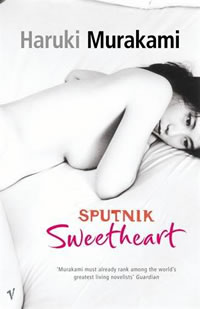
Sputnik Sweetheart by Haruki Murakami – That Sense of Loneliness, That Unattainable Love

I have come to the realisation that perhaps there is no such thing as which is my favorite Haruki Murakami novel (my 6th so far).  Even though my familiarity to his style has led me to half-expecting what “Sputnik Sweetheart” would become, there is still this element of freshness that kept me from putting the book down.  And I finished reading it in one day, wanting more.  The opening paragraph would be the best way to introduce the story.

In the spring of her twenty-second year, Sumire fell in love for the first time in her life.  An intense love, a veritable tornado sweeping across the plains – flattening everything in its path, tossing things up in the air, ripping them to shreds, crushing them to bits … In short, a love of truly monumental proportions.  The person she fell in love with happened to be 17 years older than Sumire.  And was married.  And, I should add, was a woman.  This is where it all began, and where it all ended.  Almost.

The theme of “Sputnik Sweetheart”, from what I observe, is loneliness, riding onto the framework of unattainable love.  That strong sense of loneliness!  The narrator – a man – falls in love with a lesbian who falls in love with a married woman.  True to Murakami’s style, this book is full of metaphors (“did you see anyone shot by a gun without bleeding?“), dualism that leads to surrealism, and characters that come alive in their very own unique style.

What stands out in “Sputnik Sweetheart” is the way the story is narrated and told.  Timeline is shifted to and fro to suit the narration.  Focus is shifted from one character to another and back to the narrator without the readers noticing the change, encouraging us to want to learn more about the characters’ way of thinking and their way of life.  And then, something strange happens to these characters.  The author spends the second part of the book pasting bits and pieces of information together – some from interview, some from his observation, and some from the journals left behind.  Distinguishing what is real from what is not is often not easy, as it is with all of Marakami’s works.  Even as I devoured the very last paragraph of the book, these thoughts lingered: Could this be real?  What happened next?  And in my dreamy state, inside an English cottage at Fraser’s Hill, the follow paragraph from the book has made the most impact to me.

Lying there, I close my eyes for a while, then open them.  I silently breathe in, then out.  A thought begins to form in my mind, but in the end I think of nothing.  Not that there was much difference between the two, thinking and not thinking.  I find I can no longer distinguish between one thing and another, between things that existed and things that did not.  I look out of the window.  Until the sky turns white, clouds float by, birds chirp, and a new day lumbers up, gathering together the sleepy minds of the people who inhabit this planet.

The rate this is going, Haruki Murakami could well be one of my most read author, after Milan Kundera and Italo Calvino.

Categories
Book Reviews Non-Fiction

Numbers Rule Your World By Kaiser Fung – With Depth, And Figures To Support

It is hard not to make the comparison between “Numbers Rule Your World” and “Freakonomics”.  Even the book has made a reference once.  Ten real life case studies are used, paired up in five chapters, to illustrate how different aspects of statistics affect our lives.  Blogger statistician Kaiser Fung has made the topic surprisingly accessible, narrated in an engaging manner.  Each chapter, the author picks two contrasting statistically related topics, juxtaposes them by taking turn to have the story told, and arrives at a conclusion.  The narration is honest, impartially inquired from different angles.  One of the author’s objectives – besides convincing us that like it or not, numbers play a major role in our world today – I believe, is to expand our mind and horizon when interpreting certain situations as numbers are presented.  And to appreciate what goes on behind the scene in your everyday life.

To impart the various aspects of statistical thinking upon his readers, the author uses the case studies of highway engineers versus Disney ‘Imagineers’, epidemiologists versus credit modelers, insurers versus test developer (education), anti-doping agencies (sport) versus polygraph (lie detector), and the chances of jet crashes versus jackpots.  Each case study – unlike Freakonomics – is backed up sufficiently by figures and facts.  At times, I have to slow down my reading and think through the numbers, which I do greatly appreciate.

In practical term, how would reading “Numbers Rule Your World” help your work and life?  For one, when you take in the news around you, you may wish to see things in a different perspective.  Should you take in the reported figures on the papers as they are?  Why are things or processes made that way?  Some see an imminent risk, others do not.  Should you follow the crowd?  At the end of the book, the author has made a bold statement that if you know how to use numbers in making everyday decisions, you rule the world.  While I am unsure if most of us has the ability and even access to a reliable data-set in using numbers in making decisions, this book does change the way how I see this world operates when it comes down to numbers.

External Links: Purchase This Book from Amazon.com, the Author Kaiser Fung’s Website.

Categories
Book Reviews Fiction

鐵凝《永遠有多遠》- “How Long Is Forever” by Tie Ning

A 2009 English publication by Tie Ning

While I have read this book in its original language – Chinese – I have found a English translation selling at Amazon.com.  It is refreshing to read the work of a China writer in Traditional Chinese because given my very limited exposure to Simplified Chinese, my reading appetite is often confined to either authors from Hong Kong or Taiwan.

During this brief period of my renewed interest in reading in my first language, I have realized and begun to internalize the subtle differences in the choice of words and phrases amongst these three different locations – China, Hong Kong, and Taiwan.  In terms of language readability, of course reading works of a Hong Kong writer has always been a breeze to me.  Since I was born there.  Interestingly, I often have this impression that Taiwanese books are easier to read compares to books from China.  But it doesn’t appear so.  Perhaps it is because modern Chinese does not deviate too much from the not-so-modern Chinese that I have spent many years learning in school.

Tie Ning (鐵凝), the author of this book, has come with a long list of credential.  She is the current president of the Chinese Writers Association, the first woman taking on that post.  She has published close to 60 books, some of her works are translated into multiple languages, and some of her works have won awards.

The Chinese version of “How Long Is Forever (2007)” comprises of two novellas 《對面》,《永遠有多遠》 and four novelettes 《孕婦和牛》,《馬路動作》,《瑪克力手印》,《暈厥羊》 (Note: ‘novella’ and ‘novelette’ are borrowed terms to describe the relative length of the story and not the actual word count as defined given the fact that these terms are used to measure English literature, not Chinese).  The English version (2009) seems to have the two novellas – “How Long Is Forever” and “Woman Opposite” – and not the rest.

I would describe Tie Ning as a realism writer.  Her characters and stories come alive through the day-to-day routines at the minute detail – intriguing, not mundane.  To borrow one of the critics’ observations from the book’s appendix, in our recent time, it is rare to see someone writing about the good people.  Not perfect, but good.  Like the narrator’s cousin in the novella “How Long Is Forever” who has endured and taken advantage by her ailing grandma, her boyfriends who needed a place to stay, and her own brother.  In the eyes of others, she has always lost out.  But all she does is to always think of others before herself.  Or like the pregnant woman in the novelette “Pregnant Woman And Her Cow”.  The main character is worry free, often take her cow for a walk.  One day she passes by a collapsed pillar that is of heritage value to the village.  The stones are engraved with words but she is illiterate, so is her husband and her husband’s family.  What if her child in the future asks her the meaning of these words?  Quickly she borrowed a pen and a piece of paper from a group of students nearby and started – first time in her life – to write.  And she intends to consult the wise people of the village later.  Such determination!  Tie Ning’s work is almost like a celebration of the not-too-perfect lives of the common people without dwelling into death, depression, desperation, delusion, and evil deeds – themes that could be more popular in today’s world.

In the preface penned by Tie Ning, she wrote that to her, ‘novelettes’ are like scenery.  ‘Novella’, on the other hand, are like stories.  And ‘novels’ are destinies.  I am certainly looking forward to reading the next book of hers.  Perhaps a novel for a change.

PS. Why would Singapore library classifies this book under romance?  I have no clue.

Additional Info and Links: Singapore library tag is TENG, ISBN is 978-962-8958-31-3, publisher’s website is here, and you can buy the English version from Amazon.com by clicking here.

Categories
Book Reviews Non-Fiction

Superfreakonomics By Levitt And Dubner – Good Conversational Materials (And It Stops There)

Although this book is not going to change the world – at least I do not think so – like its predecessor “Freakonomics”, “Superfreakonomics” is an entertaining read, full of good conversational materials.  That is, if you can remember the numbers and details.

Backed by numerous reports (the note section alone takes up 36 pages) and the authors’ personal interviews, “Superfreakonomics” does appear as a credible read.  Some parts, yes.  Others, draw criticism from others.  I personally find some of the topics non-conclusive.  Like the car seat experiment that the authors that have personally paid for.  If the conclusion is that Americans should not waste money in equipping car seats for children who are beyond a certain age, that message does not seem to come out clearly, from what the authors appear to lead me in believing with numbers and statistics.  And when the authors write on the topic of climate change, even I as someone not from the field nor has studied economy, I smell something not right.  Indeed, that chapter alone comes under fire from fellow economists and scientists.

All these aside, “Superfreakonomics” is a good effort in making cold hard numbers that the micro-economists study highly readable.  Some topics, I have already known.  Others, I thought I have known.  As random as the layout of the topics as it may seem, “Superfreaknomics” does start with [human] prostitution and end with [monkey] prostitution.  Below are my chapter-by-chapter thoughts.

Putting The Freak In Economics

An interesting introduction setting the stage of using observable statistics to look through the lens of an economist.  Walk drunk is more dangerous than drive drunk, more people are killed by elephants than sharks.  These are interesting topics.  But to single out one particular race and comment on their penis size not able to fit into the condoms?  My inquisition mind would direct to the investigation on why World Health Organization specs do not take that into account.  Instead of writing “penises too small … to fit” that set some readers’ minds wild (it is always fun to laugh at other people’s penis size without thinking that yours doesn’t enter into the Guinness Book of Record either), I would – if I have to – write, “The condoms are manufactured with the wrong specs that do not fit well.”  Then again, with such a non-sensational piece of writing, I doubt if it would fly as far as book sales is concerned.

Now, why am I so passionately defending another race?  I do not think that it is the right thing to write.  And I am pretty sure that my race does not enter into the Guinness Book of Record as the largest penis size on average either.

How Is A Street Prostitute Like A Department-store Santa?

I am not sure if I am 100% comfortable reading a chapter on the the pricing plan for the different tricks prostitutes turn nor the discount they give for various incentives.  If you are genuinely interested in this topic, I would strongly recommend books that are written from the sociology instead of the economics perspective.  I have read a few in the past.

Why Should Suicide Bombers Buy Life Insurance?

I see a subtle linkage between the topics on Islamic terrorists and the higher birth defect rate due to Ramadan (an Islamic tradition), innocent as it may seems.  While I am not entirely convinced on the latter, this chapter is an interesting read on how one’s birthday – from the cold eyes of the statisticians – affects one’s destiny significantly.  There is also a good write-up on the emergency room too.

I sincerely hope that terrorists will not pick up this book and read.  Ideas to more efficiently carry out terrorist acts and more effectively hide the identity?  Do we really need a book on “Terrorism For Dummy”?

Unbelievable Stories About Apathy And Altruism

I enjoy reading this chapter.  People may not be as altruistic as we think we are, nor with such apathy as we are told we are.  Some of the experiments are not new to me.  In Malcolm Gladwell’s “Tipping Point”, a case study is used to illustrate the power of tipping point.  It is a well known news – or so we think – that a number of witnesses in an American suburb failed to report a murder happened in their very street.  Malcolm Gladwell’s theory is that because people think that others would pick up the phone and call the police – since it was obvious that someone should because the murder happened just outside their houses – no one picked up the phone.

Now, if Levitt and Dubner is right that someone did and we are not as cold hearted as we are told we are, this would make the book “Tipping Point” looks really bad.

The Fix Is In – And It’s Cheap And Simple

I enjoy reading this chapter too.  Some fixes are indeed cheap and simple.  It is true that we love to complain, particularly about how terrible the modern world is compared with the past.  Many times in the past, we thought the situation was doomed and we managed to find a fix, much cheaper and simpler than what we would have imagined.  This gives hope and encouragement to today’s world of course.

What Do Al Gore And Mount Pinatubo Have In Common?

This chapter draws fire from the critics.  I can understand why.

If I read this chapter right, global warming is not as doomed as we think it is due to the followings.  First, every hundred years of so, a major volcano eruption sets the world back to global cooling, hence reverses the global warming effect.  Second, carbon dioxide is not the right villain (and immediately disputed by the source of that claim after the book is published).  Third, there is a cheap and easy way to send sulphur dioxide to the stratosphere high up in the sky using lightweight pipes supported by hot air balloons in order to cool our planet.  Is it necessary to spend trillions of dollars to tackle the global warming issue?  The authors appear to say no.

That, I have my doubt.

Monkeys Are People Too

A short chapter on how in an experiment, monkeys can be taught to use money to purchase food and services.  What does it really mean?  I do not know.  It is a great conversational material nonetheless.  Like the rest of the book.
Categories
Book Reviews Fiction

夢枕獏《香魚師》- “Master Ayu Fisherman”, I Know Nuts About Fishing But I Enjoy Reading This

A Japanese novel in Chinese

It is only a matter of time before I revisit my childhood passion of reading Japanese novels translated in Chinese.  I read Japanese novels translated in English, such as Haruki Murakami.  Maybe there is a certain proximity between the two languages – Japanese and Chinese, I suspect that the Chinese translation is probably closer to the original flavor than English.  I do not read Japanese.  And hence, purely my speculation.

I know nuts about fishing.  I did fish once, or twice when I was young.  That was all the experience I have.  《香魚師》, which I would translate the title to “Master Ayu Fisherman” for reference here, is a fictional work that is all about fishing.  Not any kind of fishing, but a specific fish specimen – Ayu (you could read more about Ayu in Wikipedia here).  The preface has done a great job in giving an introduction on Ayu, the different kinds of fishing tackles – the fish hook that is called “hair rig” – and the environmental impact that affects the habitats of Ayu.

Each chapter of “Master Ayu Fishman” begins with a special title given for a particular “hair rig”.  The writing style consists of lots of paragraphs of short sentences and the translator or editor (茂呂美耶) has done a fantastic job in footnoting the novel at places that may cause confusion if you are  not a Japanese.  As I read the book, I suspected that it was originally published in newspapers or magazines and I was right (magazines indeed).  That are repeated references to previous chapters that initially I found it odd.  But it is not so odd if the original readers have to wait before reading the next installment.

“Master Ayu Fisherman” is about men’s obsession in fishing.  Ayu is often called “Sweetfish” for its special scent of melon and cucumber and “Year-Fish” for its one year lifespan.  Ayu’s life journey starts near the seashore and ends as they return from the sea to the seashore area and lay eggs.  There are seasonal bans in Japanese on Ayu fishing.  In the periods when the bans are lifted, enthusiasts would put aside their daily activities and fish.  There are various ways to fish Ayu, and many types of “hair rig” developed to tackle different situations.  I am not a fishing enthusiast, but I am intrigued by the passion people have on fishing.  In the story, there is this one particular rare hair rig called 黑水仙 (“Black Narcissus”), the only hair rig that can lure the abnormally huge Ayu that survives more than one year.  It is a story of two men’s obsession to go after that huge Ayu, almost like an addict.  In a strange way, I can relate (close friends of mine would know why).

According to the author, in Amazon, women incorporated their pubic hairs into the hair rig in order to fish a particular type of fish, long time ago.  That rare hair rig in the chapter, “Black Narcissus”, is created by just that.  Now, I have tried Google this bizarre concept.  There seems to be some applications of such setup but I am unable to verify the linkage to fishing in Amazon.  Nevertheless, I think Japanese does have some strange concepts and using pubic hair to create a fishing tackle may well be one of many.

Overall I enjoy reading 《香魚師》.  The Japanese author 夢枕獏 appears to be popular in Taiwan.  And he has spent four to five years in writing this book, being an avid fisherman himself during the period when this book was written.

Additional Info: Singapore library tag is YUMB, YLib official site, author official site and ISBN 978-957-32-6191-9.

Categories
Book Reviews Fiction

Juliet, Naked by Nick Hornby – Been Waited 14 Years For This

A new book by Nick Hornby

I am not sure how many of you have read the book “High Fidelity (1995)”.  The timing could not have been more perfect.  As the main character Rob Fleming recounts his top five most memorable split-ups, that inspired me to secretly write my own.  I was nursing my not-so-whole-heart after a failed relationship back in 1995 and reading “High Fidelity” seemed like a comforting thing to do.  “High Fidelity” is also about top five films, top five records, top five bands, and etc.  I love music, I love films.  That book was like my personal anthem.  Since then, I have kept reading Nick Hornby’s publications but none of them gives me the same level of satisfaction.

Forward to year 2009.  When I learned that “Juliet, Naked” is out and it is a book with the promise – on paper – that it is back to the music, I quickly reserved a copy from our national library.  At the library counter, as I was collecting the book, I nearly fainted when the librarian spoke in her crisp clear voice reading the title from her computer, “So it is Juliet … that you want?”.  I nearly lost my voice, secretly thanked her for skipping the word ‘naked’, and nodded instead.  What a cheesy title Nick Hornby picks.

The story is relatively straightforward.  Duncan is a big fan of the musician Tucker Crowe who has disappeared from the scene after his last album “Juliet”, inspired by his failed relationship with, of course, Juliet.  Duncan has started a website called “Can Anybody Hear Me?” – a title of a track from Tucker’s EP – and together a few other like-minded fans (the ‘Crowologists’), they constantly examine Tucker’s work, visit the ‘historical sites’ that are of significant importance to Tucker’s music career.  Annie works in a museum and has lately started to question why she is still in a relationship with Tucker.  Out of the blue, Tucker has released an acoustic stripped down version of “Juliet” (and hence “Juliet, Naked” versus the original version “Juliet, Clothed”).  Through the only music review Annie has written in the Internet, Tucker from US has made contact with Juliet, who lives in UK.  And then the two worlds separated by an ocean overlap.

It is the same kind of Nick Hornby’s humor.  Subtle and unexpected.  Cynthia, on the other hands, does not seem to have the same level of enthusiasm as I do.  It could be due to: (a) “Juliet, Naked” is a guy-lit, (b) Nick Hornby is a UK writer, or (c) a combination of (a) and (b).

To keep “Juliet, Naked” current, Nick Hornby has incorporated writings in email style, in forum style, and believe it or not, in Wikipedia style.  While I can quite easy overlook the less than epic storyline as compares with “High Fidelity”, I think it would be a better idea for Nick Hornby to out-source Tucker’s emails and dialogs to an US writer because that would have made the book more convincing to read.  As it stands, I cannot quite tell the difference between the tones and the writing styles of the characters of Annie (in UK) and Tucker (in US).

A light and entertaining read, not quite “High Fidelity”.  But maybe, there is only one “High Fidelity”.

Categories
Book Reviews Fiction

王璞《補充記憶》- “Memory Refill” – And My Reading Habit

Another Chinese book I've read

How do you choose what to read from a library or a bookstore full of books?  When it comes to English titles, these days, I have a set of authors that I keep going back to.  As for Chinese titles, it is still this whole new experience of discovery and exploration.  Quite a few I have borrowed were returned to the bookshelf the next day.  One friend once asked, “Do you finished all the books you pick?”  For English books, it is a yes.  Because I often know what I am going into.  Book reviews are everywhere in the Internet.  There is even a great book I have – The Western Canon: The Books and School of the Ages – to help me decide what to read next.

In 1995, Cosmos Books in Hong Kong held a writing competition, on literature.  Not romance, thriller, short stories, or popular fiction.  But on literature.  First of its kind during that era, the book publisher had put aside a budget of US$60,000 to make it happen. 《補充記憶》(a translated title by me would be “Memory Refill”) by an author I have read recently came out as 2nd runner up.  There was no worthy winner so there were two 1st runner up winners instead.  What a strange way to round up the competition.  Nonetheless, the motivation of the competition was to rekindle the passion of  literature writing in mid-90’s Hong Kong.  That gets me thinking.  If the majority of the locals say in Singapore read materials created by the West – an inevitable reality of cultural influence (or shall I say domination?) – who will be there to support the local writing industry that would create works that represent a fragment of our society?

Back to Chinese book selection and this book “Memory Refill”, I pick this book to read because it is a award winning material – however small scale the competition might be – and it is a literature, not a popular fiction.  I would still say the author’s latter work 《嘉年華會》 – “Carnival (2008)” – has a higher literary value. Having said that, those who enjoy reading the short story 《啤酒》 (“Beer”) would enjoy reading 《補充記憶》 (“Memory Refill”).

The main character of the novel is a forty years old doctor Jung-ji 容易 (literally means “Easy”, a comical derivation – I suppose – by her promiscuity, or I would read it as 容兒…’ – a phonetically sounded female name) and her twenty-odd years old patient NO who has suffered memory lost after a car accident.  Is it a blessing in disguise that one losses his or her memory?  Jung-ji ponders.  As the doctor helps the patient to regain his memory, through unconventional means that are no lacking in humor, the doctor herself recollects her painful memory that she would want to lose.  Her failed relationships (or failing as a matter of fact) and men who simply would not stay.  The story development is not linear and it is a pleasure to read, for me that is.

“Memory Refill” is not a love story.  It is a journey of a woman seeking closure to the relationships of the past.

Additional Info: Singapore library tag is WGPU and ISBN 962-950-209-7.

Categories
Book Reviews Coincidence Fiction

張子璇《早苗》- “Zoumiu”, Again, 9 Short Stories

Zoumiu

This has to be a coincidence.  I randomly picked four Chinese novels to read from the library.  The previous book is a collection of nine short stories.  This books is also a collection of nine short stories.  Relationship, especially in the form of divorce, is one of the themes of the previous book.  Same for this book.  The previous book writes in a certain style of surrealism blurring reality with illusion.  This book, same.  And when one of the stories from 《早苗》”Zoumiu” – note that I translate based on the pronunciation because the title is derived from a female name – has a scene of the main character pondering with a glass of cold beer, I flipped.  It was as though I was reading 《嘉年華會》(Carnival”).  The beer, the divorce, the surrealism, the same number of stories – either it is a common trend in today’s Chinese literature bear in mind that “Zoumiu” is written by a Taiwanese writer while “Carnival” by a Hong Kong writer, the coincidence is simply, surreal.

Before I comment on the “Zoumiu”, I would like to write a bit on what I observe on the languages of these two geographic locations (can’t really say countries, can I?).  Hong Kong and Taiwan are most likely the only two places in this entire world that the people still write in Traditional Chinese.  I sincerely wish with all my heart that Traditional Chinese will not vanish, swallowed by the Simplified Chinese so commonly promoted by China.  For those who wonder what the difference between the two is, it is as though “Simplified English” becomes official and words such as ‘wot’, ‘happend’, ‘wif’, ‘btw’, ‘u’, ‘tt’, ‘impresn’ become the endorsed language.  Imagine English classics printed with those simplified forms.  The analogy may be crude and not entirely correct.  But the essence is there.  And that is how I feel when I read Simplified Chinese.

While I was reading “Zoumiu”, I realize that the choice of words between these two places – Hong Kong and Taiwan – can be different.  An analogy could be the subtle difference when you read British novels and American novels.  Both are written in English.  But there are differences between the two.  I, for one, read Hong Kong novels at a much faster pace.

At times, I am not sure which culture is more dramatic in nature – Taiwan or Hong Kong?  “Zoumiu” is prefaced by two I supposed reputable writer and editor in Taiwan.  Full of over-the-top promises that set my expectation sky high on “Zoumiu”, before I have even started reading the book.  The author 張子璇 has won the 1st prize of the Taiwan’s “Save the Literature” award.  “Zoumiu” is a story of love, and death.  Death is the center theme.  The nine stories are: 《早苗》《那個中午》《夜裡》《活著的記憶》《背影》《陌生人》《等待》《嫉妒的漂浮》《緩慢的自由》.  Again, for ease of reference, I would translate the titles to “Zoumiu”, “That Afternoon”, “In the Night”, “Memory of the Living”, “View of the Back”, “Stranger”, “To Wait”, “Jealousy Afloat”, “The Slowness of Freedom”.

“Memory of the Living” has perhaps the most impact on me.  In the story, the main character’s mother often stares outside the window, every passing moment of the day, holding a little black box.  One day, the main character returns home and discovers his mother has committed suicide.  He then opens the box and understands what his mother meant by: “I will tell it to you one day, until you mother is too tired, cannot hold it any longer, and I will pass it to you”.  My heart sunk when I too discovered what it is.

Another favorite story of mine is “Stranger”.  One day, a girl discovers a corpse like stranger appears in her home.  And through interacting with this stranger, conversing on the topic of her first divorce and second marriage, the stranger does not seem that foreign any more.  An extract of the story below (the author puts an extract upfront at the beginning of each story, interestingly).

要不是偶然遇見了陌生男子,今天也不過是如此平常的一天,
回頭看看剛才走過的路,著實讓她安心不少。
那個蒼白得像個死屍的男人,現在想起來也不覺得害怕了。

The rest of the stories, like these two, explore on the decisions people make, on love, at times observed from a distance, almost like reading from a spirit’s view, or indeed from a spirit’s view.  Some stories are inconclusive leaving me to ponder on what is real and what is not.  One story, “Jealousy Afloat”, the main character is obsessed with the memory and illusion of his lost love decades ago, keeps revisiting old places until he sees her, together with the younger him.  The writing style of that story could seem extreme, but I tend to think that the author is gifted in bringing human interactions alive.

Additional Info: Singapore library tag is ZGZL, Wisdom Books official site, and ISBN 978-957-450-508-1.

Categories
Book Reviews Fiction

王璞《嘉年華會》- “Carnival”, 9 Short Stories

Carnival

Almost in a similar period when I appear to have given up eating meat all of a sudden, I have this sudden urge to rediscover my Chinese root.  Reality is, nothing is ‘all of a sudden’.  I have been wanting to give up eating meat for ages.  And I have been wanting to brush up on my Chinese for ages.  Reading Chinese novels is merely a first step of my long term ambition to regain my innate linguistic ability to its fullest and beyond.  I want to be able to read, understand, and pronounce 100% of the words found in a modern novel, able to write in Chinese, and able to create literature in Chinese.  After all, I believe all my friends who remain in Hong Kong are able to do all these.  I am merely playing catchup.

The joy of reading Chinese books is indescribable.  Language-wise, I am able to understand almost all the words and expressions (versus English novels).  But mere understanding is not my primary aim.  I want to be able to pronounce them as well (unlike the Western language, you can’t really pronounce a Chinese word if you don’t know the word).  And that is when modern technology helps a great deal.  I have found a site that helps me to find out how to pronounce a certain Chinese word in Cantonese.  With my mobile phone that allows me to enter traditional Chinese in handwriting mode, I can look for a word wherever and whenever I need to.

Beyond words, I believe some of you who read both English and Chinese literature would agree with me that the ‘feel’ of the two is very different.  It is the vividness of drama and sound, the emotional complexity, the culture and values, and much more that makes reading Chinese such a joyful experience.  One could take a piece of Chinese literature, translate into English, and to me, the essence is simply lost.  How could one translate the literal meaning of “scrap my eyes and see”, “rub in oil and add vinegar”, or “white as the cleanliness of jade and the clarity of ice”?  Sounds so strange when translated literally but sounds so good when read in the original language.

Back to 《嘉年華會》- one of the four Chinese books I have borrowed from the library recently, the author 王璞 is born in Hong Kong, has lived in China, and since 1989, stationed in Hong Kong.  I have deliberately chosen a Hong Kong writer because I reckon I can relate better – both in terms of the writing style as well as the locations and culture. 《嘉年華會》 is a collection of short stories – 《希臘拖鞋》《嘉年華會》《收藏家》《跳房子》《悼念綠牆袍》《河邊少婦》《我的高麗同學》《啤酒》《流氓是怎樣煉成的》.  For the ease of reference, I would translate these titles to: “Greek Sandals”, “Carnival”, “Collector”, “Hopscotch”, “Mourning of the Green Chinese Dress”, “Young Woman by the River”, “My Korean Schoolmates”, “Beer”, and “Thugs are Made of This”.

Some stories such as “Carnival” and “Thugs are Made of This” are rather short, like a few pages.  “Beer” is perhaps the lengthiest of all for it takes up half a book.  If there is a common theme amongst these stories, that would be an attempt to mix the reality with illusion.  Another theme would be the loss of something.  The author would try to convince the reader something exists only to later on blur it into illusion.  Or a relationship that is well and good and then out of nowhere, a huge quarrel breaks out (that reads like watching a typical local TV drama) and the couple parts way.

In most of the stories, divorce seems to be a main topic.  I wonder why.  Relationships do not seem to work out.  In fact, nothing works out in all the short stories.  The story “Beer” is perhaps one of my favorite.  It has the depth and complexity that I enjoy reading.  The story’s main character is someone who has experienced four divorces and a childhood crush on a train that still lives vividly in her.  To chain the plots is her passion to drinking beer.  To add onto the plot is the main character’s mission to locate her missing father.  All these plots are told not in a sequential manner, but rather randomly picked as the narrator recollects her life story.  The most amazing thing is how the main character – a writer – creates and distorts the story of her childhood crush, in the form of short essays.  That creates a story within a story – an exploration of what happens when love in reality meets with love as an illusion.

I am glad that the book ends with “Thugs are Made of This”.  In just 16 pages, the author tells a story of an apartment owner from being Mr. Nice to someone rude and nasty after a series of unfortunate events.  Such quickness in plot development, what a way to end the book.  I will certainly look for more books written by 王璞.  And one quote from the book to end this entry.

即使是像我一個逆來順受的女人,也有一顆跳動的心。

Additional Info: Singapore library tag is WGPU, Cosmos Books official site, and ISBN 978-988-211-977-2

Categories
Book Reviews Fiction

The Memoirs Of A Survivor By Doris Lessing – An Amazing Journey Beyond Survival, Beyond Time And Space

A book by Doris Lessing published in the 70s
I deeply respect Doris Lessing’s ability to breath life into characters, and in “The Memoirs of a Survivor (1974)”, she breathes life into rooms and walls and more.  Doris Lessing is one of the most intelligent writers, certainly one of my favorite.  I wish I could have a glimpse of how she creates her works.  Such coherence and linkages as though the beginning is planned as the ending is written, and vice versa.

For example, the ‘it’.  Only when I re-read parts of the book did I noticed that on page 9, she wrote:

I shall begin this account at a time before we were talking about ‘it’.  We were still in the stage of generalised unease.  Things weren’t too good, they were even pretty bad … But ‘it’, in the sense of something felt as an immediate threat which could not be averted too.

I did not take much notice until I read towards the end of the book, on page 130, she wrote:

Very well then, but what was ‘it’?  I am sure that ever since there were men on earth ‘it’ has been talked of precisely in this way in times of crisis, since it is in crisis ‘it’ becomes visible, and our conceit sinks before its forces.  For ‘it’ is a force, a power, talking in the form of earthquake, a visiting comet whose balefulness hangs closer night by night distorting all thought by fear – ‘it’ can be, has been, pestilence, a war, the alteration of climate, a tyranny that twists men’s minds, the savagery of a religion.

‘It’, in short, is the word for helpless ignorance, or of helpless awareness.  It is a word for man’s inadequacy?

I would have missed that linkage.  Also, only when I re-read from the beginning, I can attempt to understand the concept, her concept of ‘they’ and ‘them’.  Attempt, as this book is anything but an easy read.  On the surface, it is a simple story being told from the eyes of a woman – the narrator.  It is a time of near-future when an unspecified disaster causes our society to plunge into the age of barbarism, when people are constantly on a move based on scarce news to a better and more livable place, when no one possesses anything but to constantly make do with what they come across and pass them on, when there is no law and order, and when survival matters.

One day, a small girl Emily is given to this woman’s care.  And comes with this girl is an ugly dog with the look of a cat.  For that part of the story, it reminds me of her book “The Story Of General Dann And Mara’s Daughter, Griot And The Snow Dog”.  A young girl and her animal companion.  The story spans the several years of the little girl’s growing up, the crowds gather at the ‘pavement’ in front of the house they occupied, the emergence of children from the sewage system not brought up by humans, but rather behave like monsters.  Monsters.  Such ugliness that strongly reminisces of the main character of “Ben In The World”.  How Emily has fallen in love with the young leader Gerald, helping him to build communities, authority, and how Gerald – when everyone has given up on those monstrous children who kill and destroy all that they see – never gives up on these children.  A close reference to W. H. Auden’s ‘We must love one another or die’ (a poem called “September 1, 1939”).  Someone has made a note “Lord of the Flies” in the library book that I borrowed.  It is a classic written by William Golding in 1954.  I think there is a certain level of validity on that association.

Layer on top of this straightforward storyline is how the narrator – the woman – sees the surrounding walls transform into images and messages that transcend space and time.  It is when the woman sees the past of Emily – her father, her mother, her little brother, and the babysitter.  Each past from each room, each wall, comes with different metaphor that explains the certain current state of Emily as the narrator observes.  Emily initially is described as ‘invincibly obedience’.  As the narrator observes, there are more and more flaws, then explained by the visions from the walls.  More and more respectable capabilities are observed, as the story unfolds.  That is what I meant by breathing life into a character that Doris Lessing has done it so well.  The narrator never gets too close to Emily, always observes from a distance.

It is hard to describe how Doris Lessing manages to make the ‘walls’ sound so convincing.  She describes the wall as ‘personal’.  In my limited understanding – perhaps I need to read the book again several more times – in that world, nothing is personal as no one truly owns anything.  The only thing ‘personal’ is our memory and our vision, hence represented by the ‘personal’ wall.  And as dramatic as her stories that I have read, just when I was deeply depressed by the gloominess towards the end of the story, a wall – that the narrator promises to show no more – ‘appears’ in a different capacity, in hope and beauty.  That ending, lifts my soul high.

“The Memoirs of a Survivor” lightly explores the concepts of community, feminism, survival, administration, government, and authority – or simply put, humanity.  The most memorable metaphor is how our next generation take what we have used and discarded and create something of their own, something beautiful and useful.  In the story, the narrator’s job is a news gatherer.  Doris Lessing does not tell the readers how important news is in time of uncertainty.  She starves the readers with meagre amount of news that every little plot she discloses I hold dear to, digest and re-digest again.  But still, what causes the disaster?  Are there really big blue fish in the sea?  Or yellow?  No one knows.

Note: Doris Lessing is the Nobel Prize Laureate in Literature 2007 – “that epicist of the female experience, who with scepticism, fire and visionary power has subjected a divided civilisation to scrutiny”.