Categories
Book Reviews Fiction

Dan Brown’s The Lost Symbol – A Page Turner With Puzzles After Puzzles

Dan Brown's Latest Work

I can’t say that I am a fan of the thriller genre but I do enjoy Dan Brown’s style of puzzles mixing facts and fictions with a healthy or unhealthy – depends on how you see it – dose of spiritual reflection.  Besides, once in a while, it is good to read a page-turner for a change and get entertained.  When I learned from Amazon.com that Dan Brown has kept “The Lost Symbol” under wraps by allowing only a handful of people to have access to the manuscript, I was intrigued.  I hit our national library website 3 times a day to see when this book was open for reservation.  Singapore’s National Library Board has brought in 70 copies of “The Lost Symbol” and I was queue number 3.  Not bad at all compares to how I did for that Kinsella Book (queue number seventy odd of I think forty odd books in total).

I have read almost all his books (except “Deception Point”, I think).  I don’t think I can recall any of the storyline.  What I recall though is that I have always enjoyed how Dan Brown rapidly switches plots, delaying the key story revelation, and keeping us engaged with puzzles after puzzles.  “The Lost Symbol” is no exception.  For maximum enjoyment, I strongly encourage you to refer to the online materials for reference as your read the book.  For example, the painting “Melecolia I” is used as one of the puzzles.  You could read how Dan Brown describes the painting in words.  But nothing beats seeing the painting with your own eyes.

I would not dive too deep into the plot because it is not fun for those who are planning to read this book.  Robert Langdon, a character from “Angels & Demons” and “The Da Vinci Code”, is back for “The Lost Symbol”.  I do not think there is a significant connection with the previous novels  so you do not need to read them in sequence.  And like his previous works, I am often amused by how his characters can sustain such emotional tremor and physical wounds and still able to run around, solve puzzles, and intellectually discuss matters in such a lengthy manner.  Personally, I think his opinion on Christianity is – as always – very thin especially after I have freshly finished reading Karen Armstrong’s latest work.  I would not take his religious view too seriously.  But I suspect his opinion will stir another round of controversy – perhaps lesser in magnitude compares to “The Da Vinci Code” – nonetheless.

Categories
Comedy Movie Reviews

What Do The Stick People Think Of Funny People?

So the movie review squad watched Funny People

Of the few Judd Apatow films I have watched, I like “The 40-Year-Old Virgin” the most.  Simply because I can relate to it, not!  OK, there are certain aspects I can relate and that film is really funny.  I have “Knocked Up” recorded and it is stuck at my to-watch queue.  I think “Funny People” is pretty funny with a somewhat deeper meaning of our minds heal slower than our bodies as well as a behind-the-scene on how jokes are crafted.  Some jokes I find a bit too crude (how come there has to be so many sexual references?).  Some you would probably relate better if you watch lots of TV and entertainment.

TK fell asleep, Cynthia found the film entertaining, and I – as usual – laughed out loud.  Judd Apatow seems to prefer working with a similar set of actors and actresses eh?  Oh, I find the nerdy comedian actress Aubrey Plaza really hot!  Don’t know why.

Categories
Diary

Uff! Massive Jam!

A doodle inspired by traffic jam

I remember vividly the first time I saw the words “Massive Jam” lit up on the highway signboard.  I was driving on the northbound CTE (in Singapore), on a rainy evening, quite a number of years ago.  One tree fell onto the highway that forced all the vehicles to exit at Ang Mo Kio.  Imagine four or five lanes of traffic squeezed into one exit.  Not pretty.  And since then, no jam felt as massive as that mother of all massive jam.  At times I try my luck, enter the highway despite seeing the “Massive Jam” warning sign and it turns out to be just another heavy traffic condition.  Nothing massive.  At times, it is like yesterday morning, when I have to spend more than an hour covering perhaps 10 km on the CTE highway.

2 incidents in 2 different segments of the highway.  I suppose it must be pretty major judging at the amount of debris on the road (no pool of blood, thank God).  One time, I was inside a lift and one foreigner said to another foreigner after showing him a – I suppose – gruesome image of an accident using his phone, “I wonder why such a small island can have so many road accidents.”

I too wonder why.

Categories
Diary

When Size Falls Grossly Under Expectation …

My Tiny Baked Spaghetti

Out of the blue, I wanted to shop for a  TV.  We drove to Katong Mall, paid Mega Discount Store a visit.  We have always wanted to try out the “Hong Kong Tea House” restaurant next to the mall.  The food is indeed ‘pretty’ authentic, as what we’ve been told.  But my plate of cheese baked spaghetti with meat was so much tinier than I thought, like one-third of what I would have expected.  2 main dishes, 2 cups of herbal tea, 3 portions of dessert, total cost was close to S$40.  Sort of expensive for “tea house” food eh?

Categories
Diary

A “Romantic” Diner at Pasir Ris Park

Cynthia and I, Dinning In the Rain

Sunday.  After Mass.  We drove from Ang Mo Kio to Pasir Ris Park.  For dinner.  We chose a bar.  By the sea.  Flashes of lightning from afar.  Watch out, it’s going to rain, said I.  God is taking picture of us, Cynthia smiled.  Food arrived, so was the rain.  Dashed to a partial shelter, we continued our dinner.  Thunderstorm!  Tree weaving.  Shaken by the howling wind.  Rain pouring from the sky.  Splashed onto our table, onto our food, onto our hair, onto my spectacles.  We dined in near dark, marvelled at the force of the nature.  We laughed, longing for that cup of hot chocolate, and a warm bath.  For home sweet home, seemed so far.

Categories
Diary Reflection

A Recollection – How Years Have Vanished!

When I was young ...

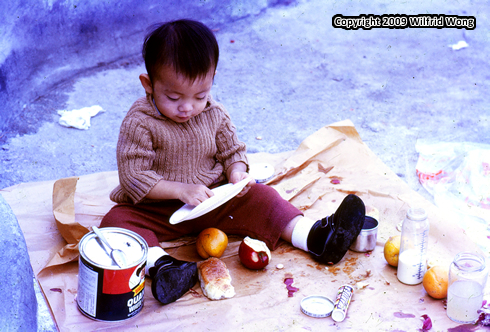
Yep.  That little kid you see in the photo is me.  I have got the confirmation this morning and I will get to that in just a moment.  Like many entries I write, this one started with a concept, a consolidation of ideas for the past few days.  I have got my thoughts linked and drawn out on a piece of paper last evening ready to be put down in words, in a snippet style.  But like many entries you see, I prefer to start each piece of writing with a picture – an anchor to the words that follow.  As I dug deeper into the digital archive my father has recently created for my sister and I finding that one picture that suits the theme, my emotion ran high.  One event led to another and I have decided to chuck most of my initial train of thoughts onto a perhaps a later schedule.  Besides, today is a Sunday.  Sundays are for the family and the pondering of the good old days.

It all started with the 2004 film “13 Going On 30” played on TV one relaxing Saturday night, last night to be exact.  My initial plan was to read a book borrowed from the national library while accompanying Cynthia to be the coach-potato-in-crime.  That did not work out.  I ended up laughing and crying with Cynthia, as we watched “13 Going On 30” together.  For those of you who may not have heard of the storyline, a 13 years old girl wakes up one day as a 30 years old – exactly what she has wished for on her birthday.  And all of a suddenly, there is a memory gap of close to 2 decades.

Yesterday was also the Mid-Autumn Festival.  Traditionally – in Hong Kong as far as I can remember – families carried lanterns lit up using candles joining hands as they walked to a park nearby.  It was a pretty scene to see in the evening.  We would spread a mat onto the ground; my sister and I would place the candles and mark the perimeter of our base; and we would eat mooncakes and pomelo and other munchies as we admired the full moon.  Replenishing the candles around us and inside the lanterns was enough to keep my sister and I occupied throughout the evening.  Occasionally, lanterns would catch fire burned to the core.  That was as close to playing with fire as we could get.

So, it was “13 Going on 30” in the evening of the Mid-Autumn Festival, with I in Singapore, my parents in Hong Kong, and my sister in her new family not too far away from where I live, I could not help but pondered: How years have vanished!  And how I have changed!

In retrospect, I should have gone through the old photos with my parents when they were here in Singapore earlier on this year.  But you know how we always think we have better things to do, I have missed that opportunity, an opportunity of a narration of my very own childhood story.  This morning, as I looked at each photo of my sister and I and our parents – a visual memory of our childhood – there was a surreal feeling of being taken back in time, a time that I have zero recollection.  I was unsure of the location; and I was not even sure if it was me in some of the photos.  Panic struck and I called for Cynthia’s help.  “That should be you, I think,” she replied casually as she continued with her breakfast.  “I think” is not good enough.  I need certainty!

So I called home.  My mother picked up the phone while she was still asleep.  I was so happy to hear her voice.  Describing the photos in detail, one by one, I kept on asking if it was me or my sister or someone else.  I wanted to know where we were and I wanted to know what we were doing.  To be fair, I think my mother must have had a hard time trying to take in what I described and to give a definitive answer.  “That should be you,” said my mother as I described what I wore.  But she added, “Although you sister would be wearing the same too.  You two shared some of the clothes as you were growing up”.

No!

The signboard says Macau, was I there?  The background is a mountain and a lake and there are straws of grass as the foreground, was I the kid in the photo?  That green lion statue, where was it?  It was a picnic, a mat, a half eaten apple, a bottle of milk, a little toddler playing with a plate, was that me?  My dad was half naked, making a face, and the little one with long hair must be my sister; how come I was not in the picture?

I talked non-stop, bombarding my mother who has freshly woken out from the bed with questions after questions.  But like all good stories that ideally should come with a good ending, my dad returned home from fishing.  I could hear our dog scratching the door in anticipation.  “I will ask dad to call you later, OK?” asked my mother.  “Sure,” I replied.  “I will be waiting,” added I.

Ten minutes later, my phone rang.  “That was you in that photo!” exclaimed my mother.  “That was me!” exclaimed I.  Apparently, my parents were watching the DVD – that I too should have a copy – as they commented on the locations and the circumstances of each photo.  That DVD!  I have almost forgotten.  “You dad has sorted the photos nicely on that DVD,” said my mother, “One section for you and another one for your sister.”

I quickly slotted the DVD onto my computer and was surprised to see the following message from my father on the screen.  The title is “回憶”, which means a recollection.  I would have missed his message to me had I not planned to write this entry!

這是一輯舊相片,有少年的我和萍,有幼小時兒女。
舊的相片能引起一些回憶,您們看後,能帶給您多少回憶與共鳴。
舊的相片能保留人和物事,但人,就逐漸老化,
所以它,能給我們回憶當年的甜、酸、苦、辣。

今天,苦盡甘來,
我們能夠歡樂地、幸福地過活,
都是我們共同努力和感謝上天的恩賜!

在我心中,謹記著【知足常樂】,
無貪、無惡、無妒、無恨。

I will not translate the message in full here, unless someone really wants to know.  My dad has a few life mantras that he often shares with me.  One is about the end of bitterness comes the sweetness.  Maybe because his life is full of hardship.  Endurance appears to be one of his strengths and he always works towards that “sweetness”, that reward.  And he often projects that ideal reward onto the success of my sister and I.  Another one is to be happy is to be contented, without greed, without evil deeds, without jealousy, and without hatred.  Maybe because these ideals are imbued onto me since young, they seem to be my personal mantras too.

It was my parents’ turn to describe the photos while watching the DVD thousands of miles away from me.  As I closed my eyes trying to recall the photos that I have spent the entire morning admiring, I imagined I was with my parents in Hong Kong, in our living room, watching and laughing at these visual memories together, as they narrated through the photos.  It has been a while since we laugh, in such openness.  We touched onto the topic that I found it hard to tell between the pictures of my sisters and the pictures of mine.  “When your sister was young, people said that she looked like a boy,” said my mother.  She then paused, a long paused.  And I continued, “And I looked like a girl?”  “And you looked like a girl,” laughed my mother.

It was such a lovely morning, such a sweet morning.

Spend time to make a living if you may, spend time to get entertained if you wish, spend time to read if you want to acquire new knowledge, but don’t forget to put aside some time to document your life or lives of those whom you love (online social networking does not count, unfortunately).  One day you may wish to answer the question on how years have vanish.

Categories
Book Reviews Non-Fiction

Your Next Move by Michael Watkins – A Good Resource For Your Major Career Transitions

A new book by Michael Watkins
I have read Michael Watkins’s “The First 90 Days” quite a number of years ago.  Arguably one of the must-have books for the corporate executives.  In fact, the initial reception was so successful that the author has released a similar book targeting at the public sector.

6 years have passed since the author talked about critical success strategies for new leaders at all levels, what you should do and tackle on the first 90 days in your new role.  Like many I suppose (half a million English copies sold and translated to 26 languages), I have a high anticipation for “Your Next Move”.  Perhaps because I have gone through a few major career transitions in the past, or perhaps I may be anticipating a new move (don’t we all?), “Your Next Move” is an engaging read.  I find myself constantly reflecting on my past transitions as well as reflecting upon what some of my colleagues – my bosses included – have done right or wrong when they first stepped onto their new roles.

While it may take a C-level to fully benefit “Your Next Move” (i.e. CEO, COO, CFO, and etc.), executives in any form of leadership capacity should find the first 5 chapters (out of eight) useful.  Namely, the followings:

  • A promotion up the career ladder.
  • A promotion amongst your peers and now, you are the boss. 
  • A move from the position of authority to the position of influence.
  • Joining a new organization with a new corporate culture.
  • Relocating to a new geographic location and faced with a new culture.

Unless you have freshly graduated from school, you should have experienced at least one of the above transitions.  The author uses real life examples to kick start each chapter (masked by fictitious names of course) and present the unique challenges faced.  Guidelines to overcome the challenges are then presented in concise points that come with graphs, tables, and supported tools.  The materials are practical, down to earth.  One tip off my head is for those who are posted overseas to put family matters as the first priority and perhaps to start a blog to continue having family and friends’ support (!).  It is evident that they are a result of years of dialogue between the author and the leaders.  In several occasions, the author brings in different analogies to illustrate his points.  Such as the organizational resistance to change as compares to the immune system of our human body (that has its merit for being resistance to potentially bad changes).  Or to apply engineer’s thermodynamics concept to an organization environment.

The last three chapters are more for those who are in the position to turnaround an organization in trouble and to realign an organization in dire need for change.  To accomplish that, the author introduces the STARS model – start-up, turnaround, accelerated growth, realignment, and sustaining success.  And for those who are in the field of human resource or organizational excellence, there is also a concluding chapter on the design of “companywide transition-acceleration systems”.  A list of what company can do to help new leaders in transition.

As a final note, “Your Next Move” covers a wide range of topics on career transition that also includes organization politics, which I find valuable as it is not a topic that can be easily dealt with.  Useful tools aside, it is certainly a good set of checklists and tips (or guidelines) based on the lessons learned of many.  Some of which I wish I had a chance to read during my past career transitions.

Hardcover: 256 pages
Suggested Retail Price: S$43.50 (US$26.95)
Publisher: Harvard Business School Press (October 6, 2009)
ISBN-10: 1422147630
ISBN-13: 978-1422147634

You may wish to get this book from Amazon.com.

Categories
Reflection

A Spiritual Reflection – What Karen Armstrong’s Case For God Really Means To Me?

This post is irregular in two ways.  One, I am often – if not always – happy with what I publish here.  Technically speaking, there is nothing wrong with the book summary I wrote on a Sunday morning, 7am to be exact.  But the more I read that post, the more disconnected I feel.  I wish I have exposed more of me.  I guess a book summary is a book summary; a self-reflection is a self-reflection.  Holding back, I was and hence this post – an amendment, an addendum, a companion to that book summary.

Two, I seldom write about my spiritual journey.  Two reasons.  First, I do not consider myself as a spiritual role model.  The topic of God is not something I can articulate well.  My sister Lora, for example, can do it brilliantly.  Too bad, she has taken a break from writing.  I sincerely hope that she will write again soon.  Second, I prefer to embed God’s goodness in the things that I do, things that I write, and things that I create.  I think it is hard to make an impact to people’s lives by talking about God, with my limited articulation skill on this very topic.  It is much easier for me to take an indirect route instead.

Karen Armstrong’s “The Case For God” has much impact to my inner self in various ways.  New knowledge aside – which I have covered in my previous post – my personal spiritual journey suddenly makes so much sense. As my humble tribute to the book and to the gifted author, here are what I have interiorized, thus far.

  1. My First Ekstasis
  2. My Religious Upbringing
  3. Finding God
  4. Where Do I Go From Here?

My First Ekstasis

I suspect ‘that’ was my first ekstasis, now that I have read the book.  I do not remember much about my childhood.  But of the few scenes that I remember, this one in especially leaves a deep impressive.

When I was young, perhaps less than ten, I would sit somewhere in the living room and start to ponder, by asking a series of simple questions that lead from one to  another.  I would look at a nearby object and ask: where does the table come from?  A tree.  Where does a tree come from?  The Earth.  Where does Earth come from?  The Universe.  Where does the Universe come from?  Or I could ask: where do I come from?  My mother.  Where does my mother come from?  My mother’s mother.  Where does she come from?  So on and on, searching for that one answer beyond words.

Bear in mind that I was very young, with little knowledge in my head, I wasn’t that smart to figure things out (probably still don’t).  But I would expand my questions, till a point whereby everything broke down.  I remember vividly that my mind would go black, I would see the swirling stars.  I would feel as though I had left my body, lost in a spiritual world.  I would lie on the floor with eyes closed.  The more I did it, the longer I would stay in that state.  It was a strange feeling, a very good feeling.  One day, I was scared.  What if I could not come back?  And then I pondered lesser and lesser.  All of a sudden, I lost that ability, that out-of-the-body experience.  I miss those swirling stars a lot.  Till this day.

Could this be my first ekstasis?  To go beyond myself and transcend the normal experience?

My Religious Upbringing

I studied in a Catholic school, brought up in – I suppose – a Taoism (Daoism) family.  During one class, our teacher asked each of us which religion we belong to.  When it came to my turn, I had no clue how to answer that question.  In Chinese, what my parents did was called “Worshipping God”.  But “Worshiping God” is not a religion, is it?

So we had a family meeting.  And have decided that it was Taoism.  Next day, I had an answer to my teacher.  And to all whom asked.

As I grew up, there are more who tell me that Taoism equals to idol worshiping (which is bad) than those like Karen Armstrong who thinks that the religion does have something we can learn from.  And probably due to the influence I had in school, one day I asked my parents a deeper question on what Taoism is?  Where is the Taoism ‘scripture’?

Those questions shocked my mother a bit.  Or it could be a great deal as I often find it hard to fully measure her emotional intensity until it erupts.  As my parent attempted to explain, I gathered that different deities are being worshipped upon.  Each comes with a legend of its own.  The Chinese are familiar with the associated folk stories.  When I insisted on the ‘scripture’, my father started to recite passages written by the ancient Chinese.  For example, there is one passage that is structured in words of three, full of morale codes, how the Universe was created, the philosophy of mankind, and etc.  I asked my father if there was a book somewhere in the house and he said none.  His parents recited these passages to him when he was young and he – like all those before him I suppose – learned the passages verbally.

Fascinated with Chinese literature I was, I did not go far with the study of the myths of the Chinese legends.  Nor did I go far with the study of those passages, which I still think they are beautiful to recite.  After I have read “The Case For God”, something struck me.  Folk Taoism it may be, this ancient religion contains the mythos (myths), morale codes and stories to ponder upon, and a ritual that my parents – together with many Chinese – regularly do.  The religion is still a living one, helps to construct meaning in face of our hardship.  And liberating as it sounds, there is nothing wrong with the religion I was brought up with – I realized.

Finding God – Part I

Till today, I am still proud that as a then-non-believer, I could score an A for Religious Studies prior to moving to UK for my A-level study.  Many of my classmates in Hong Kong struggled.  But to me, Religious Studies was one of the most enjoyable subject.  Examination questions often came in the form of: this and this happened as written in the Bible, what does that mean?  What are the implications?  If it is a question that worth a score of 20, you need at least 20 points based on your interpretation that in turn, based the various quotations from the Bible.  For me, I would provide not 20, but 40 points.  Because I knew even if I missed half of the number of points as required by the question, I would still score full mark.

That worked of course.  But how did I find that many interpretations to start with?  The good news is that Bible is a highly structured highly cross-referenced set of materials.  The four Gospels tells a similar set of stories in slightly different perspectives.  And within the Gospels as well as other texts in the Bible, it is easy to find linkages to expand your interpretation.  No doubt I had to get some basic concepts right (like what is the Trinity).  But I had no problem in interpreting the Bible as far as the examination is concerned.

My journey to find God has been a bumpy one.  Just as Karen Armstrong mentioned, I too have gone through the stage whereby I used science to find God and to find God in science.  What is God?  Where is He?  Surely God has to be observable.  Or are we created by aliens instead?  And I have also gone through the stage whereby I read the Bible literally and started to have found more and more things that did not make sense.

Throughout the years of frustration, I have finally decided that a free thinker was probably best to describe who I was.  Yes, there must be a God somewhere because in no way we could explain nature’s design if otherwise.  But I did not go further than that.

Finding God – Part II

Looking back – especially after reading the book – I think it is the rituals and the myths that brought me [back] to Catholicism.

Many times, a friend would approach me and ask what he or she should do to convert his or her partners into the same faith.  I wish there was an easy answer.  But here is my brief story.

Cynthia has never put pressure on me to be a Catholic like her.  When we first started as a couple, I often accompanied her to Churches and sat in through the Mass.  It didn’t bother me to the least.  I often find Churches and Cathedrals a serene place to be at.  Besides, it never failed to amaze me how persistence Cynthia wanted to attend a Mass, regardless of the weather, or even the fact that we were in a foreign city.  Each time I attended the Mass, I observed the ritual.  The more I read about what is behind each ritual, the more meaningful the Mass is to me.  Soon, I wanted to participate in the process, to have that moment of divinity.  It was no swirling stars for sure.  But of the many moments I experience in the Mass, that moment of offering a piece of me and to take in a piece God – as my godmother once told me – is still the defining moment every time I receive the Communion (after I have baptized).  We humans need the physical touch in order to communicate feeling and love.  Hence we hug, we hold hands, we kiss, and etc.  And that piece of God, in the form of a host received during our Communion, is as physical as it can get.

But that host is just …

OK, I have tossed science out of the way long time ago.  A little bit of faith – as a matter of commitment and practical living according to Karen Armstrong – is all I need.

I went through an accelerated baptism course, delivered inside a priest’s office with he and I and Cynthia as my support.  When the priest asked me if I believe in the garden of Eden, that God took a rib from Adam and created Eve, in less than a heartbeat I replied, “Yes, I believe.”  I took a leap of faith, literally.

The priest laughed and told me that, “No, it is a story, a myth.”  In fact, many times, when we studied the scripture in detail, he would say, “This is a mystery”.  How can God work in such a mysterious way?  Back then, I have accepted this mystery mentality.  A mentality that apparently did not sit well with some of my Protestant friends.  We could have an open dialog one day, ended the night with some open questions.  And the next day, my friends – with their network of Protestant’s support – would return with a long list of answers, the counter-arguments.  It was as though the scripture has answers for everything.  Even on the question why Catholicism is not part of Christianity.

I am not an articulated theologist.  And I often retreat from these long list of canned Q & A and fall back onto what I am comfortable with – a standardized Mass from any given Catholic Church all over the world that has the very same prayers, the very same scriptural readings, on any particular day; that we may not have answers to everything in life; and there are more than one way to interpret the scripture, as Karen Armstrong says.

Later, as I read “The Case For God”, I have come to the realization that God is unknowable.  But that doesn’t stop us from our ritual and meditation.  And to that extend, the mysteries and the standardized Mass works for me.  The eventful (and standardized) Catholic calendar too works for me.

Where Do I Go From Here?

I agree with Karen Armstrong.  We cannot find God using science.  Nor any religion today has a final say.  Personally, I have deep respect to other religions.  And I have read into some of them too (for it is hard to accept and respect other religions if you don’t know what they are).  I can also understand where atheists or free thinkers come from.  Maybe the gap between the not so devoutly faithful and the free thinkers is not really as much as we think it is.  As for my personal development, I shall take Karen Armstrong’s advise that religion should be a constant practice, an ability that is built over time.  One day, the intensity of those swirling stars may return.  Perhaps not in the exact form.  But ekstasis in experiencing God, I hope, no less.

Categories
Book Reviews Non-Fiction

The Case For God By Karen Armstrong – What Religion Really Means?

A new book from Karen Armstrong

Karen Armstrong is right.  Any book about God is not going to be an easy read.  At least she put it upfront via one of her readers’ feedback.  Compare “The Case For God” to her shorter books I have read “Islam” and “The Bible”, this book is an intense read for two reasons.  One, the variety of topics.  Not only is she well versed in the three monotheism, but also the ancient religions too.  Theology aside, Karen Armstrong ventures deep into philosophy and science supported by historical events that spans a vast timeline of 30,000 BCE to the present.  Two, “The Case For God” requires the readers to think deep into the unfamiliar grounds (unless you are of the author’s caliber) as the author builds up the case that only becomes clear at the second half of the very last chapter: Death of God?

We live in a perplexing time, according to the author.  For the first time in history, many of us (especially in the West I suppose) do not want anything to do with God.  New atheists insist that all the modern world’s problems are entirely due to religion.  At the same time, religious fundamentalists also develop an exaggerated view of their enemy as the epitome of evil.  As for the faithfully devoted, do we have the right concept of what religion really means?  The good news is, as observed by the author, we are currently experiencing a religious revival.  But the question remains: Where shall we go from here?  In what form?

On that end, Karen Armstrong aims to bring something new to the table, in this perplexing time of ours.  Her aim of this book is not to give an exhaustive account of religion in any given period – her other books have taken care of that I believe – but to highlight the trend of the apophatic (of the belief that God can only be known to us as what He is not, i.e. God is unknowable).  This trend speaks highly of our current religion perplexity.

To understand this trend, Karen Armstrong brings us back to the caves of 30,000 BCE where religion was first practiced.  Back in the old days, religion is an attempt to construct meaning in the face of relentless pain and injustice of life.  For our ancestors, to experience religion is like to experience ekstasis (a Greek word ecstasy, literally ‘stepping out’, to go beyond the self and to transcend normal experience).  It is to step out of the prism of ego and experience the divine.  In the beginning, no one knows what God is, set aside God’s existence (more correctly, in the beginning, there was no concept of one God).  When Buddha’s disciple asked was there a God, had the world created in time or had it always existed, Buddha’s reply was: What difference would it make to discover that a god had created the world?  Pain, hatred, grief and sorrow would still exist.  And in the beginning, the two aspects of the religion – logos (reason) and mythos (myth) – coexists.  Mythos is an important aspect as a living religion needs to be practiced upon, via rituals and the various forms of meditation.

Pre-modern religion according to the author has three principles that are of importance to our trend.  First, the nature of the ultimate reality (later called God).  Second, religious discourse was not intended to be understood literally.  And third, the truth of religion are accessible only when you are prepared to get rid of the selfishness, greed and self-preoccupation that, perhaps inevitably, are engrained in our thoughts and behaviour but are also the source of so much of our pain.  Besides exploring in detail of Aryan’s Brahman as an illustration to pre-modern religion, the author also highlighted that religion as defined by the great sages of India, China, and the Middle East was not a notional activity but a practical one.

With the story of Eden came the concept of one God, of which Judaism – and later Christianity and Islam – was born.  As we progressed, we entered the age of reasoning.  Socrates, Plato, Aristotle, and other fellow philosophers all played an important part in shaping our religious trend.  To Socrates, an unexamined life is not worth living.  According to Plato’s The Laws, there are three articles of faith: that gods existed, that they care for human beings, and that they could not be influenced by sacrifice and worship.  And to Aristotle, the life according to reason is best and pleasantest since reason, more than anything else, is man.

Towards the end of 1500 CE, the influx of the new knowledge – of religion and philosophy – sparkled an intellectual renaissance.  We created faith (it was purely a matter of commitment and practical living), doctrines, and we elevated theology to a state of arid theoretic.  What happened to the old mystical theology that had been accessible all the faithful?  As we were reasoning with the unknown, without the discipline of the apophatic, we were in danger of becoming idolatrous.  And with that, Karen Armstrong has ended part one – The Unknown God – and moved onto the era of The Modern God starting 1500 CE.

In modern time, we see a constant conflict between science and religion that it ought not to be.  The two are not supposed to be merged.  According to Augustine’s principle of accommodation, a scriptural text should be reinterpreted if it clashed with science.  Early science was rooted in faith.  Scientists often linked their discoveries to the divinity.  Kepler mentioned that the study of geometry was the study of God, and by studying the mathematical laws that inform all natural phenomena, we communicate with the divine mind.  Similarly, Galileo, Isaac Newton, and many others during that period of time. 

16th century sees the acceleration of Secularisation due to three crucial and formative movements: the Renaissance, the Reformation, and the Scientific Revolution.  And in the mist of all the conflicts of that time, philosopher Descartes attempted to find a truth on which everybody could agree – Catholics, Protestants, Muslims, deists, and ‘atheists’ – so that all people of goodwill could live together in peace.  His most famous phase, I believe, is cogito ergo sum – ‘ I think therefore I am’ – making the experience of doubt the foundation of certainty.

Back then (probably even now), science, and not religion, was the path to the truth.  We examined things of the smallest scale through the microscopes to the things of the largest scale through the telescopes and we could not find God.  Religions in reaction to the attack by science have become more and more rigid.  We have moved into the age of Atheism led by the ideas and discoveries by Karl Max, Charles Darwin, and Sigmund Freud.  God did not exist (Max), God had certainly not created the world exactly as we knew it (Darwin), and God was indeed dead (Freud).

To make things worst, advance in military strength led us to the world wars.  Holocaust survivor and Nobel Price winner Elie Wiesel believed that God died in Auschwitz after witnessing the slow death of a child hanged by a Gestapo in front of all the prisoners.  Where is God in our modern world?

The last chapter of the book “Death of God?” is perhaps the climax of the entire book.  In that chapter, Karen Armstrong highlighted the flaws of the new atheism and pledged for an open dialogue between the theologists and the new atheists.  She also highlighted the origin of fundamentalism, with Islam as the last of the three monotheism to develop a fundamentalist strain.  In this challenging time of ours, not all hopes are lost.  We have advanced science to such a state whereby we know there is always an unknown and whatever we have proved today may not be correct in the future.  We too should stress the importance of the apophatic.  God is unknowable and religion is to be practiced upon, for that ekstasis.  I in especially enjoy reading the epilogue and the following paragraph has much impact on me, a good example of mytho.

One day a Brahmin priest came across the Buddha sitting in a contemplation under a tree and was astonished by his serenity, stillness and self-discipline.  The impression of immense strength channelled creatively into an extraordinary peace reminded him of a great tusker elephant.  ‘Are you a god, sir?’ the priest asked.  ‘Are you an angel … or a spirit?’  No, the Buddha replied.  He explained that he had simply revealed a new potential in human nature.  It was possible to living this world of conflict and pain at peace and in harmony with one’s fellow creatures.  There was no point in merely believing it; you would only discover its truth if you practised his method, systematically cutting off egotism at the root.  You would then live at he peak of your capacity, activate parts of the psyche that normally lie dormant, and become fully enlightened human beings.  ‘Remember me,’ the Buddha told the curious priest, ‘as one who is awake.’

Afterthought: “The Case For God” is certainly no easy read for me.  It took me a long time to read, re-read, make notes, and to get to the bottom of what some of the words mean for this is not a familiar topic of mine.  This book mostly focuses on the theology, science, and the philosophy of the West.  I don’t think it really matters which religion you are from (I am a Catholic).  We live in an extremely connected world today.  And hence, this trend affects you and I, no matter how far apart we physically are.

Categories
Experience Sharing I See I Write

Watching F1 – A Survival Guide (That Gets You Thinking)

F1 Singapore (from official wallpaper)

Formula One is coming to Singapore.  Are you someone who thinks that it is boring to watch cars going around in circle?  Excitement comes only when some cars crash?  You are not alone.  Many of my friends think that way too.

As an avid viewer of the sport, I have put together a small survivor guide in layman terms aiming to enhance your viewing experience.  It is not everyday you get to see cars racing in the streets of Singapore in neck breaking speed.  Trust me, with some basic understanding, you too can enjoy watching the sport, from the first lap to the checker flag.  And if you too are an avid F1 viewer, feel free to drop in some comments for sharing.

To continue reading, please click here.