Categories
Book Reviews Non-Fiction

The End Of Cheap China By Shaun Rein – An Insightful Look Into China From The Inside

Before End of Cheap China is released to the Asia market, it is already banned in China.  Why would a subject on economic and cultural trends that may disrupt the world received such treatment?  My contact at Wiley is intrigued.  And she is keen to hear my view.  I too am intrigued.  The author Rein is a mixed heritage of Chinese and Jewish.  He married the granddaughter of 50 most important Chinese Communist party members in history.  Because of his business background, he gets to converse with China’s leading entrepreneurs on a regular basis.  The author practically lives and breathes in China.  End of Cheap China is largely a collection of Rein’s social, economical, and political opinions of China written in a journal style.  Because this is a still business book, at the end of each chapter, there is a short appendix catered for the business readers.  While I may not have a definite answer to why China deems the book unsuitable for her people, let’s take a look at what this book offers.

1998, Rein was in Changchun, a city at the northeast China.  Back in those days, everything in China was cheap.  For US$20, according to his observation during that trip, you could have some ”˜fun’ with a girl in your hotel room.  A girl with a physical outlook that could qualify to be on the cover of Teen Vogue magazine.  Such scene is now unseen of in China.  Why so?  Here is his view on this matter.

China’s economy and job market have seen dramatic changes in the past decade and a half.  As more attractive, better-paying job opportunities increased, pretty young girls took advantage of better options, and the pool of prostitutes got uglier as a result.  The uglification of China prostitutes is part of a boarder trend that is the subject of this book, The End of Cheap China.

It is hard to understand China without an appreciation of Chinese modern history.  Through his personal interaction with his mother-in-law, the author recounts the events and impact of Cultural Revolution (66-76).  Many in China still remember the pain and suffering.  Yes, to the Chinese people, free speech is great but not if it threatens stability.  According to Rein, Chinese people support the central government.  What they often protest against are the local officials who are given the flexibility to implement the policies set by the central government.  In this complex political landscape, the author examines the root of corruption that is often found at the local level.  Local officials in China are poorly paid, not allowed to travel or retire to the private sector once they have reached a certain rank.  This leads to local officials being more susceptible to accepting bribes.

Officially, prostitution is illegal in mainland China.  But why is it practiced openly?  Again, this points to the political makeup of the country.

For ordinary Chinese people, vices like drugs and violence are intolerable due to the immediate impact on their every lives, but often they will tolerate prostitution as long as it is kept behind closed doors and distant.  Here we see the divide in thinking between levels of government: Local officials and people confront prostitution pragmatically, whereas the central government upholds a more morality-based approach.

To examine the economic trends, Rein visited Laura furniture factory in Shanghai.  There are 10,000 workers on the working floor and the environment appears decent.  Because of the high demand in Chinese skilled workers, the factory (and many others) is facing the challenge of keeping the workers.  This drives up workers’ salary and in turn drives up business cost.  The factory could pass the cost back to American consumers and Laura may have to consider moving the factory to countries such as Vietnam or Indonesia in order to cut cost.  However, this is not desirable because the skill of Chinese workers and infrastructure of China cannot be met by these countries today.  What should Laura do?  Rein’s advice to the factory’s manager is that instead of exporting all the furniture to America, create a market share in China.  Leverage on China’s domestic market to sustain or even grow the business.  In fact, that is what the current trend is: Market the products back to China consumers.  Branding then becomes the next challenge because these foreign brands are going to compete with the local household brands.

You may have heard that because of China’s one-child policy and Chinese’s desire to have sons, this leads to an imbalance to the gender ratio.  In the past, for practical reasons, when many were farmers, sons were preferred.  In the past decade and a half, the role of Chinese women has changed.  Take Laura furniture factory as an example, women are paid more because of the skill involved in, say, sewing the sofas.  Men are paid lesser comparatively because labor type of work is less valued.  Moving away from the factory and into the cities, the same pattern is observed.  Women are flavored in the service industry, especially on the consumer sales.  More often than not, wives earn much more than husbands.  This has an implication to the social trend within China.

The empowerment of women is one of the great developments of modern Chinese society.  Women are becoming the key drivers of spending; they are beacons of optimism in the country, and a major force behind China’s transition towards becoming one of the biggest markets in the world.

When it comes to food, foreign brands seem to do well in China due to local food-supply problem.  The recent baby formula episode is a good example of why Chinese people are especially careful on food consumption.  Kentucky Fried Chicken is considered as ”˜healthy’ because many Chinese trust that the food from these foreign brands is safe to eat.  While on the topic of food, the author observes that China import over $15b in food products from America in 2011, up from $6.7b in 2006.  This trend will continue to go up.  What is the implication to the world?

I suppose for those who are outside China, we often wonder: Is China really doing well?  The author examines the topic of real estate from various angles – the policy flaw in terms of favoring the commercial zone as it is easier to obtain construction loans compare to residential and Chinese’s preference to hold tangible asset rather than stocks.  The author also examines GDP in China and he argues that unlike Japan, China’s infrastructure spending is more efficient and it helps to jump start the economy growth in the cities.  On the education front, Shaun highlights the classroom overcrowding issue (imagine a class size of 1,500) as well as the fact that the Chinese education system is not producing enough creative thinkers.

The topic interests me most is on China’s foreign policy.  Because of the need for natural resources, China has been actively expanding the influence to countries like Africa and Pakistan.  Different cultures adopt different policies when investing overseas.  When Chinese companies financially takes over a foreign company, the existing management team is often left intact.  Yet, not all countries trust China’s non-interference approach.  Some countries do not welcome China’s money.  Some struggle to accept China’s financial help.  Now I know why as a Chinese, I bond well with Pakistanis here in Singapore.  They seem to have a good impression of Chinese people, thanks to China’s friendly investment in Pakistan.

End of Cheap China is a good read, for those who wish to learn more about China from the inside.  The journal writing style makes it easy to follow.  Because the content of this book is filled with the author’s criticisms and opinions, it could get a bit disoriented.  This book at times appears to be written for the Western businessmen who are investing in China.  In other chapters, the author seems to address to the US government, to the Chinese government, to other governments, or to the Chinese people in China, on what they should or should not do.  Each target audience – I would presume – has different agenda and potentially conflicting interests.  It is unclear if Rein’s goal is to advocate a win-win situation.  Personally I would prefer a straightforward journalistic approach such as Nothing to Envy (a book on North Korea).  Having said that, End of Cheap China is also a business book and it is packed with action items for those who are doing business in China.

I do not know how a book get banned in China.  I admire the author’s boldness in analyzing China at the ground level, talking to commoners in China as well as to the Chinese billionaires.  To be fair, some of his criticisms go beyond China and are directed towards America.  Maybe it is the book title.  Or the prologue when he was approached by a young prostitute in 1998.  Maybe it is his account of Cultural Revolution.  My question to the writer would be: If he was to know the ban, which bits would he rewrite or censor, if at all?

Hardcover: 240 pages
Publisher: Wiley; 1 edition (March 27, 2012)
ISBN-10: 111817206X
ISBN-13: 978-1118172063

Categories
Drama Foreign Movie Reviews

House Of Pleasures (Or House of Tolerance) – A Fine Balance Between Art And What Could Have Been Otherwise

Speechless I was at the end of this French movie.  What could I possibly write in order to share my experience with my readers here.  The entire entry could well be summed up in two words: C’est tragique.  Too much to process after the show, my mind just went blank.  House of Pleasures does not glorify prostitution, which is good.  With a group of actresses who are naked or semi-naked most of the time, strange to say, there is nothing erotic about this movie either.  Is it seductive?  Yes.  The costume is beautiful and some scenes are tantalizing.  But there is also enough grotesque and fear that darkens the overall mood.  In this tragic setting, the camaraderie within the group of prostitutes under the same roof is what holding the story together.  Sex is transformed into a pure monetary transaction.  The preparation and after the act routines add much realism to the profession.  And because of that, fantasy and eroticism is diminished leaving behind what it is seen through the eyes of the prostitutes on a day-to-day basis.  House of Pleasures is a movie told from the prostitutes’ perspective.  To them, there is no pleasure about the business.  It is what they do in order to make a living.

The year is 1899.  At the turn of the century, what future does it lie for the brothels that are specially catered for the French aristocracy and the high society?  In this particular brothel run by Marie-France – a single mother with two kids – the courtesans are hygienically cleaned and seductively dressed.  Every evening, inside a luxurious living room, wealthy clients mangle with the girls.  This scene almost viewed like a high society party with free flow of champagnes and cigarettes.  Someone is playing the piano.  Girls entertaining the guys.  There is laughter and small talk.  Some clients like what they see and the business is concluded in the bedrooms upstairs.  Some stay in the house till eight in the morning when the ‘commerce’ hours are long over.  There is this illusion of love.   Most girls dream to have their debt paid fully one day and be free.  The prospect of marriage at the end of their career is non-existence, and the girls know it.  The threat of deadly diseases is real, and it persists throughout the movie.  Each client has his fetish.  Some are deadlier than others.  This bets the questions of: If sex can be paid by money, what else can money buy?  One girl is brutally disfigured by a client she grew to trust.  The landlord’s decision to increase rent threatens the very survival of this brothel.  What can Marie-France do?  Close down the business and sell the girls’ debt to other brothels?  What is going to happen to the prostitutes we as an audience have made a connection with in this two hours long movie?

House of Pleasures has an open ending.  While the backdrop of the movie is set in 1899 and 1900, there is a short clip showing modern day street prostitution.  Perhaps, that is the answer.  The world’s oldest profession never ends.

I have my respect to the director Bertrand Bonello.  This movie could have been watched like a porn movie and it is not.  Because the rest of the film is so much more engaging than the sterile sex scenes within.  The continuous shooting and split screen methods blend the different themes and concepts into one, resulting in a holistic story of: This is prostitution.

Categories
Drama Foreign Movie Reviews Romance

Delicacy (Audrey Tautou) – Love Not At First Sight

In the opening scene, you see the back of a French actress walking down the street of Paris.  The camera stays with her and you wonder, where is she going?  Since you can’t see her face, you further wonder, who is she?  The way she walks seems familiar to you.  You may even recognize her back, her short hair, the back of her ears, and perhaps her rather petite outlook.  Suddenly you gasp, she must be Audrey Tautou!  Seldom have we seen actresses who exude such aura that is instantly recognizable.  Our friend TK recognized the actress before the camera revealed her identity.  He had no idea what movie we have chosen for him.

Delicacy has a slow moving plot.  The overall story is not what I would call entertaining.  It is about coping with losses and starting anew.  Because there is so much realism within, you ought to be someone who appreciates acting in order to enjoy this movie.  If you do, Delicacy is delicious.  Tautou is a talented actress.  We have seen her taking on different types of roles throughout her career.  This time, as a widower, she buries herself in work shutting away from most social interactions.  Can she fall in love again?  As audience, we get to witness how love not at first sight works.  Her counterpart played by François Damiens is worth a mention.  Damiens looks utterly ordinary, awkward in every little move.  He is even balding. And his character Markus has a huge crash on Nathalie played by Tautou.  The way he looks at her, the way he behaves when she is nearby, and the way he spaces out when she is not around – all these moments accentuate how awkward the relationship development is.  But the beauty is that it feels so natural looking at how the two interact and drown in this intolerable awkwardness.  It feels so real.

The soundtrack performed by Emilie Simon is also worth a mention.  The music is dreamy and moody.  It suits the plot well.  Emilie is a French singer who plays electronic music.  If you have a chance to check out her music, I would recommend you to do so.  Her music can be found in SingTel AMPed, arguably the world’s worst designed Android app.  Alternatively, you may check out her official YouTube channel.

Delicacy does not have a thought provoking open ending like many European movies do.  However, it does have a flavor to it.  Perhaps, what the filmmakers want to tell us is that to help someone in overcoming the pain of losses hidden inside, one must relive her past, understand it, only then there is hope to moving on.  On a side note, I think the title is appropriate in every way to describe the movie, especially Tautou’s character.

Categories
Book Reviews Non-Fiction

Boundless Potential By Mark S. Walton – Midlife Onwards Is Going To Get Better!

This book I received from the publisher McGraw-Hill surprised and inspired me at the same time.  Boundless Potential is a perfect book for those who are crossing or have long crossed midlife.  Even for the younger crowd, it is always good to read ahead and have an end in mind.  Before I go into the specifics, here are some questions for you.

  1. Do you feel unchallenged at work?  As in, work no longer taps onto your full potential.  You feel as though there is so much more you could do, although you are finding it hard to pinpoint what that is.
  2. Would you like to retire early so that you do not need to work but rather enjoy doing things that you like instead?
  3.  BIG question here: Do you believe that our brain, like other human organs, is fated to wear out over time?  That is, to lose its resilience and the ability to function as we get old, really old?

If your answers are yes, you and I are on the same boat.  In contrary to common beliefs, our brain works in a different way once we pass our midlife.  In fact, a better way.  The key is to reinvent ourselves in order to recognize and unlock our potential.  What is shocking to me is that I have this wonderful picture of what retirement is.  No more work.  No need to get up for work, and I can indulge in any hobbies – old or new.  Even travel around the world sounds like a good plan.  Have you dreamed about what your retirement is?

Now, what if I am to tell you that you should continue to work for as long as you can, be it as seventies, eighties, nineties, and beyond? And that retirement to pleasure alone could possibly kill you faster (curiously, my mother once told me about her concern over my dad’s retirement)?  Boundless Potential is packed with tons of real life stories on how people reinvent themselves towards the second half of their lives.  How they found a sustainable mean to pursue their dreams, and be happy ever after.  In fact, it appears to me that because these people are happy with their work and the positive contribution to the society and those around them, they live longer.  And they live a much fulfilled life possibly than those who sip beer over sunset at a farm populated by sheep (that is my dream retirement before reading this book).

Some of you may be skeptic.  How to reinvent?  What is my hidden talent?  After all, while there are pages and pages of success stories, majority of us may well have an unproductive or unfulfilled retirement.  To answer that question, the author presents a three-step approach.

First, you have to discover your fascination, your dream so as to speak.  It is not an easy task.  For some, this discovery journey may take place in a much later part of life, if at all.  A fascination is a direction that pulls you forward, regardless of the obstacles ahead of you.  It is something that both your heard and mind want.  No one can tell you what that is.  It may be something you chance upon if you open your eyes wide enough.  I am the optimistic one.  To me, finding your fascination is like finding your soul mate.  Those who are singles are often worried that they would never find that someone to spend the rest of their lives with.  But yet, many people are getting married or are living together.  Do some soul searching along the way: Where is my fascination?  I don’t know what yours is.  I am quite sure I haven’t found mine yet.  It is unlikely that I know the answer today.  But I shall keep this at the back of my head, just in case I stumble upon my answer.

Second, once you found your fascination, it is time to find your flow.  What is a flow?  It is the highest level of human happiness that is generated when fascination is translated into action.  The paragraph below best illustrates the concept.

Contrary to what we usually believe […] the best moments in our lives are not the passive, receptive, relaxing times.  The best moments usually occur when a person’s body or mind is stretched to its limit in a voluntary effort to accomplish something difficult or worthwhile.  Optimal experience is thus something we make happen.

With this specification, I can probably look back on my life thus far and identify a few flow moments.  When I was a consultant before my major career switch five years ago, I used to give training workshops and facilitate focused group discussions for the senior officers of my clients’ organizations.  It can be extremely stressful because while what I preached was derived from a defined framework, no two audience groups are the same.  Different corporate or team culture may require different means to unlock their enthusiasm so that they are more receptive to the training materials.  It is an art.  I have to observe on the spot and talk to people during breaks in order to understand how best to engage them.  For those highly intelligent groups, challenging questions that are new to me may come my way.  Teasing out ideas may not be easy.  Looking back, those were my happy moments.  And I reckon I did quite well because our team constantly received praises and recognition from our clients.  Could I reverse engineer my fascination knowing what my flows are?  Maybe I am fascinated by training and learning with people?  What about those moments when I played music with my band at Orchard for charity?  Could music be my calling instead?

Back to the reinvention framework the author has proposed, the third and final step to this process is to envision your structure.  A structure that is created by you for success in midlife and beyond.  Is it going to be a project, a role, a career, a business, or a nonprofit? Whatever the structure is, it is certainly required in order to sustain and grow your fascination.  It is probably something so new and different that you have to sell the idea to those around you and to establish one yourself.

Boundless Potential is written in a highly readable form.  It is not possible to summarize all the inspiring case studies in one blog entry.  Since I love reading this book (and for my future reference), here are some of my favorites.

An interview with Marion Rosen who was nearly 95 when the author conducted the session.

When we are at the height of our knowledge and the height of our lives, why should we give that up?  Why should we not use what we have gotten in 60, 70, 80, 90 years?  And hand it on to where it is wanted?  It seems ridiculous to me.

If you don’t use your potential, it hits back at you.  It strikes back, because it works on you, it wants to come out.  And in order not to come out, you have to hold it back. And that is very bad for your health, very bad for your personality, very bad for your relationships. It doesn’t work!

The second quote would take a while to explain (that can be found in the book of course).  It has something to do with our wisdom deriving from our maturity, experience, and the changes to the brain.  It does sound convincing.  I don’t need to see further but looking at my dad to know that this much is true.  My father has recently reinvented himself into someone who produces beautiful Chinese Calligraphy (previously he was giving Tai Chi lesson to the folks in Hong Kong and making training videos).

State-of-the art neuroscience has determined that the human brain was never designed for decline or retirement but for continual reinvention and success.  In fact, extraordinary powers become available to us in the second half of life that were not available in the first  […]  The mature brain, when properly maintained, has the potential to be continually transformed – to draw upon and synthesize its vast storage banks of knowledge and experience in ways that can be downright startling.

Another big question for you: What is the secret of living happily ever after?  The answer could be as simple as play hard, so that you can work hard (not the other way round!), and pay it forward.

Unlike “simpler” animals, [the Athenians] reasoned, we humans are “composite creatures” who want more than to eat and sleep our lives away.

Thus, attaining genuine happiness – eugeria – requires a full-out lifelong pursuit of worthy goals through the three components of our humanity: body, mind, and soul.

This ongoing quest, they believed, was “the meaning and the purpose of life, the whole aim and end of human existence.”

Hardcover: 262 pages
Publisher: McGraw-Hill; 1 edition (March 16, 2012)
ISBN-10: 0071787852
ISBN-13: 978-0071787857

External Link: McGraw-Hill Asia

Categories
Book Reviews Fiction

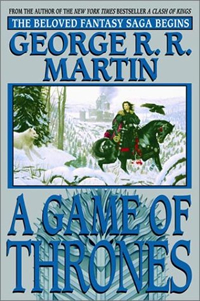
A Game of Thrones by George R. R. Martin: Gruesome, with No Black and White

I did not choose to read this book.  Not exactly.  During my holiday in Bandung, I have finished the books I have intended to read.  I suppose I could start reading yet another Warcraft story.  Having read four in a roll, I need something more, shall I say, hardcore.  A Game of Thrones lies in Cynthia’s library.  I said to myself, why not?  HBO adapted the saga as a TV series.  It cannot be that bad.  So I dived into this mightily thick book of fantasy, without knowing what I was getting myself into.

I think, or rather I would advocate that in front of every book cover, there should be an advisory sticker like a film rating for movies or ESRB rating for video games.  This book, in my opinion, is unsuitable for the young adults.  It is bloody violent.  Children wield swords to kill (and then I watched The Hunger Games on a big screen wondering where this world is heading).  There are orgies, rapes, and prostitution.  Underage girls having sex.  Sibling having sex.  The most amazing thing is, there is no moral compass or whatsoever in A Game of Thrones.  There are no heroes, no villains.  Seldom characters are rewarded by doing the right things in life, nor they are punished to do the otherwise.  In fact, most of the time, it is the other way round.  Each chapter is filled with drama.  You could almost smell something bad, I mean really bad is going to happen.  Initially, there were surprises.  Then came the predictability.  Soon, I was numb.  I read somewhere that blood, sex, and money always sell on TV.  This book has them all.

Now, if I may accept a story that is so uniquely set up, in a fantasy world that has no black and white, a realm whereby treachery and brutality is the mean to survival, A Game of Thrones is a masterpiece.  So much details being poured into creating a world filled with a massive number of interlinked living and breathing characters.  Each character comes from a unique background.  Not only that, a history is crafted alongside with the main story.  On top of that, this first book of A Song of Ice and Fire saga to me read like a very long prologue.  In this Seven Kingdoms of Westeros, a major conflict is brewing.  This realm is slowly pushed into war from within, a war fueled by vengeance, jealousy, and ambition.  At the same time, there is subtle politics in place that shapes the events.  And, there is something strange happening beyond the realm’s wall in the north.  Creatures unfamiliar to this realm are emerging.  Myths of the dragons start to appear.  Something is brewing.  Something big.  Something mysterious.  But you won’t find the answers in this book.  Because this book is the first of a long saga that is still work in progress.  You have to keep reading to find out more.

Unique to this book, the story is told from a set of characters’ viewpoints.  Each viewpoint corresponds to one chapter.  There are three major Houses in conflict.  House Baratheon, where King Robert belongs.  House Stark, where the king’s right hand man Eddard leads.  And House Lannister, descendants of the blood of Andal adventurers.  The viewpoints are presented by Lord Eddard and his wife Lady Catelyn.  Their daughters Sansa and Arya.  Their son Bran.  Eddard’s bastard son Jon.  Tyrion Lannister, a dwarf who is the brother of the queen (who is nothing like a dwarf).  Finally, Princess Daenerys Targaryen who is the daughter of the previous king and is now in exile.  The initial chapters were a torture to me.  Because I was not used to the shear number of characters and the strange tone used that is specially tailored to suit the lore of the realm.  After I got over the hurdle, I was not able to put the book down.  Switching from viewpoint to viewpoint makes the narrative refreshing, keeps the plot in suspense.  It is a slow and satisfying buildup to the final ecstasy.  The endings are shocking.  They open up more questions than providing the readers with answers.  I am eager to take on the next volume in this series to see more blood, more violence, more sex, and more shame and glory.

When you play the game of thrones, you win or you die.

The above quote is in essence what this book is about.  After reading A Game of Thrones, I can understand its popularity.  I must admit, I have not read something quite like this before.

Categories
Drama Movie Reviews Romance

The Vow – What if One is to Lose Years of Memory?

Woah.  Just imagine.  If one is to lose years of memory, how would that change his or her life and those around?  While facts of life like who the parents are do not change over time, our recent hobbies, our career, love life, recently acquired skills, friends, things that we shouldn’t have done but did, and things that we should have done but didn’t  do.

That’s why my friends, blogging is good.  While one may forget where he or she stores the diary (if you have one), a website is [more or less] always there.  I see blogging as an extension of my memory, as well as the memory of some of those who are around me.

I guess reading recent events that one has forgotten is not the same as restoring one’s memory.  It is not the same as living it, is it?  And here we are, a movie inspired by true events.  The Vow tells a story of a married couple.  After a road accident, the wife has lost her recent memory.  To the new her, the husband is a stranger and her ex-fiance still gives her butterflies in the stomach.  The recent life changing decisions, all wiped off from her memory.  Given this unfortunately event, can the husband win his wife’s love the second time?

All along, I thought The Vow was a romance comedy.  OK, comedy or not, it is a technical definition.  At the end of the movie, inside the theater, TK on my left said, “This is not a comedy”.  Cynthia on the right said, “This is not a comedy”.  Fine.  Cynthia did cry.  It is an emotional drama.  There are tons of on-screen chemistry between the main characters, in a moving plot.  We felt the pain and joy, and everything else in between.

I am a fan of Rachel McAdams.  To me, she could well be one of the most charming actresses in Hollywood.  Cynthia seems quite pleased with the rather handsome looking Tatum, whom I wish he would supplement his acting with some danceing (he is good at it I remember).  The Vow is about seeing a glass half empty or half full.  It is a story of a second chance not to be used to wipe off the past, but to relive the good and the bad once again.

Categories
Action & Thriller Fantasy & Sci-fi Movie Reviews

The Hunger Games – Better Than I Expected, Despite Moral Conflict

I thought to myself, so this is one of those ‘reality show’ inspired movies, where audience seeks to be entertained by watching contestants battling each other to death.  Worse still, we are looking at contestants of age between 12 to 18.  Do we need another one of those movies?  And why the children?  Is this social liberation or a download spiral of human morality?  Who would enjoy seeing children of that age bracket killing eliminating each other?  Increasing, media violence has raised concern across the board.  I feel that we are pushing the limit further down.  Movies like Hunger Games.  Books like Game of Thrones where children wield swords and girls under the age of 14 have sex.  Some video games that are violence in nature played by children.  What would the long term repercussion to our future generations be if we endorse violence at that age bracket?  I do not know.

Now, if I may throw my moral hat away, ignore the conflict inside of me when seeing children of age 12 to 18 hacking, shooting, or killing each other with wits, The Hunger Games is a wildly entertaining movie.  It is said that because 12 districts have in the past committed treason against the central government, each year, each district must pick 2 tributes – a young boy and a young girl – to play the Hungers Game.  Only one will survive.  There is an overarching philosophy revolving around this.  Since I don’t quite get it or finding it quite silly, I shall not elaborate here.

24 contestants are placed in a game location and there is only one survivor.  The rest of the 23 contestants would need to die.  Yes, death to them all.  We love it.  There are tons of twists in the plot.  Because it is after all a TV show, it must be entertaining, especially to the ‘sponsors’ who may influence the process.  In short, not only do the children require to kill off each other, they have to do it in style.  They need to, kill to entertain.  The audience, including us, loves watching this.

Jennifer Lawrence plays the main character who represents District 12th.  I did not like her or find her attractive in X-Men: First Class.  Neither do I find her attractive in The Hunger Games.  Having said that, I grow to like her character as the plot unfolds.  She seems rather suited for this movie.  Genuinely innocent, and determined to stay alive.

I found myself shivering throughout the 142 minutes long movie.  The plot is intense.  More so, was the air-conditioning in the theater.

Categories
Book Reviews Non-Fiction

Night and Low-Light Photography by Alan Hess – Packed With Good Tips For Beginners

Normally, I prefer not to review non-fiction books on my holidays.  However, it is good to hear that Wiley publishes photography books as well.  So I grabbed a copy sent by my contact earlier on and was eager to read more on a topic so close to my heart.

For new photographers, night photography, especially under low-light condition, is likely one of the toughest challenges faced.  Our human eyes adapt to low-light well.  More often than not, as a beginner, what you see from the LCD screen at the back of your camera under these conditions seldom resembles to what your eyes see.  Many I know of struggle with flash photography so much so that they would rather not to use a flash at all.  I too have gone through that journey of frustration and experimentation.  I would say Alan Hess has done a good job in explaining the basic mechanics in Night and Low-Light Photography.

What I like about this book is that it reads more like having someone talks me through the basic, and not a book full of theories.  The author takes his time to explain the different gears required getting the job done.  Hess also in multiple instances explains the fundamental variables and their relationship such as ISO, shuttle speed, and aperture.  Other important topics such as exposure, white balance, metering, and digital noise are covered as well.  I often find myself having to explain the same set of attributes when approached by new photographers.  Hess’s explanation is clear and he uses plenty of illustrations to drive home his points.

The first three chapters of Night and Low-Light Photography talk through the basic.  The last chapter on digital postproduction is useful if you use Adobe Lightroom or Photoshop Elements.  Bear in mind that the chapter on postproduction mainly focuses on night and low-light photography.  Postproduction workflow, for instance, is not covered in this chapter.  Although I don’t use either tool for postproduction (I prefer using Nikon digital filters instead), it does read a bit too simplistic for me.  Maybe it is good for a start.  You may need another book to study the topic better.

Between the first three chapters and the last are chapters devoted to different scenarios.  Scenarios range from indoor shots (people, weddings, and concerts) to sport photography, from nighttime sky to outdoor shots (city and landscape).  For each scenario, the author shares with us many tips cumulated from – I assume – his personal experience.  He also details out the recommended settings and steps used.  Like where you should stand and what moment you should capture if you are a wedding photographer.  Like how your model should pose.  And much more.  I enjoy reading the chapter on Light Painting the most.  Perhaps because it is something I have yet to try (hence I presume the rest of the chapters may well be an enlightening read if I was a new photographer).  I am not a big fan of HDR photography.  But that is also covered briefly in this book, in case if HDR is your cup of tea.

There are a few photographs printed in this book that are inspiring.  I like the Ferris Wheel the most, and some of his concert photographs.  Most of the photographs, though, appear a bit bland to me.  Some, I wish the photographer would stand and point the camera slightly differently so as to get a more symmetric shot, or compose the picture better.  One photograph of a moon, the photographer used a setting of 1/400 second, f/8.0 and ISO 500.  Maybe he did not use a tripod.  Since the moon is pretty bright in nature, I would think that it is possible to use a different setting with a better ISO (for example, see my moon photograph here that uses the same f-stop).  Granted, perhaps the author’s intend is to illustrate his technical points, rather than articulating the art within.  There are other photography books that are full of inspiring printings (such as books by Scott Kelby).  This book does not appear to be so.  Having said that, the most important thing is for you to grasp the fundamental of night and low-light photography.  So that you can go out there and confidently create your beautiful shots.

ISBN-10: 1118138228
ISBN-13: 978-1118138229

Categories
Comedy Movie Reviews Romance

Salmon Fishing In The Yemen – Good Humor, With An Enlightening Spirit Within

I overheard in the radio one evening that Emily Blunt has rejected quite a few movie proposals lately including Captain America.  Yet she has decided to take on Salmon Fishing in the Yemen.  Emily is a great actress.  So I was curious.  Why salmon fishing?  When omy.sg offers two movie preview choices, subconsciously I picked this one.  I am happy that I did.

This movie begins with an unusual business proposal to set up salmon fishing in Yemen.  At the same time, there are some conflicts happening in the Middle East and the UK government is desperately looking for some good news to orchestrate.  When an government official played by Kristin Thomas catches wind of this rather bizarre business idea, she immediately lends her support on this matter.  It is funny that she cares not about the salmon, but the potential political gain.  Emily Blunt plays an investment consultant while Ewan McGregor plays a subject matter expert in fishing.  It is Harriet Chatwode-Talbot versus Dr. Jones.  I chuckled at the pronunciation of the names spoken so many times with a British accent throughout the movie.  The interaction between Emily and Ewan is light and playful.  Kristin as a supporting role is quite honestly a gem to this casting.  Such good actors, they are.  I smiled and chuckled.  The story does get a bit more serious towards the end.  All in all, Salmon Fishing in the Yemen is full of humor and original ideas.  Great acting, with a witty script.  If British romance comedy is your cup of tea, this film is not to be missed.

On a more serious note, for those who are not familiar with the world map, Yemen is somewhere in the Middle East.  To create a fishing area in a desert area seems absurd.  Comparing fishing to religion also seems absurd (among many other things in the movie).  But with an open heart though, both activities require patience and faith, and a hope that something good may happen.  To think deeper, the storyteller tries to tell us that love comes from hope which requires patience and faith.  This movie transforms the simple act of fishing into something bigger, embracing lovers and a community alike.

If not for my blogger friend JoV, I would not have known that Salmon Fishing in the Yemen is originally written as a novel.  Do drop by her website and check out her book review.  She highly recommends the book.  I have this belief that when the story is good, the movie is often good too.  I have not read the book so I do not know how well this book is being adapted.  In the movie, the shifting in the relationship dynamic seems a bit abrupt to me.  I may need JoV to verify for me.  I suspect it is because the movie may not have the luxury of time in the development of a love story.  Other than that, the rest of the movie flows nicely, from beginning to end.

Categories
Book Reviews Fiction

The Night Circus By Erin Morgenstern – A Truly Magical Read Like No Others

Do you dig magic?  Do you dig love?  In a circus setting?  If yes, look no further.  Grab a copy of The Night Circus and start reading.  Like now.  You won’t find anything quite like this one.  You see, I have joined millions others to Take Earth Back, writing my own galactic story based on my decisions and actions.  To be able to distract me away from the highly anticipated video game Mass Effect 3, this book has got to be good.  Real good.

Well, it is.

I will not go beyond telling you what the excerpt says.  Because I want it to be a magical read to you, as it was to me.  In 1886, a mysterious traveling circus pops out from nowhere.  Tangled within this circus are two young magicians locked in a competition.  Celia is the enchanter’s daughter and Marco is the sorcerer’s apprentice.  Where does the circus come from?  What is the competition about?  What is at stake?  Where does magic come from?  What does magic do?  In retrospect, the answers hardly matter.  Because there is so much details on the journey itself, one could easily lose oneself devouring every single image, every little scent.  Every tent in the circus, every magical moment, the author turns words into something so surreal that you feel as though you are inside those tents, experiencing the shows in a time before you were born.

Majority of the materials are narrated in present tense.  Each snippet starts with a date and a location.  And the snippets are not arranged in a chronological order.  The time dimension plays a part in the story telling.  It may seem messy and disorienting initially.  But it works amazingly well going back and forth in time, juxtaposing the snippets and bringing out the essence of cause and effect.  Underlying to the story is a simple message: everything in life has its time and place.  If I am to read this book again, I would make a catalog of time and location of each chapter.  I would then attempt to read the story in a chronological order and see how a different experience it would be, reading the story from a different perspective so as to speak.

A small part of the book is written is second person, ‘you’.  It is unusual and rare.  It works well.  If you love magic like I do, chances are, you will be drawn into the story, materializing the circus inside the boundary of your imagination.  When that happens, you know the author has done something remarkable.  The Night Circus will capture your imagination.  Be fascinated.  Go ahead and try it out today.