Categories
Book Reviews Fiction

Lovers In The Age Of Indifference By Xiaolu Guo – Neat, Witty, And Melancholy

How effortless Xiaolu Guo has turned indifference into art!  In this collection of 17 short stories of vastly different styles, a few themes persist.  Indifference is one.  And then there are lovers in love, not in love; a prominent linkage to China with geographic locations within China, outside China.  While it is difficult to feel for the characters – short stories after all – especially when the characters do not usually love themselves or others (that is indifference for you!), I am loving Guo’s writing style.  So neat and concise, with a filmography touch.  There is subtle humor in “Lovers In The Age Of Indifference” too.  Often linked to observations through the Chinese eyes.  For example, one story is titled “Winter Worm Summer Weed”.  I starred at the title for like five seconds before I got what she was trying to say.  It is a literal translation of a Chinese herb called “冬蟲夏草”, which is Cordyceps Sinensis in English.  I think Guo’s translation tickles me more.  Her humor extends beyond literal translation.  Take a look at the excerpt below.  It takes place in the morning over breakfast, the narrator is a Chinese girl and she lives with her French boyfriend Pierre in UK.  I chuckled at the punch line, still do.

Pierre has made coffee, and bread is in the toaster.  He has also bought some goat’s cheese from a nearby French deli.  Pierre always complains he can’t find good cheese in London, and when he occasionally does it costs the price of a cinema ticket.  I don’t care about cheese – I think it’s a bit crazy to talk about cheese all the time, it’s like talking about cow’s tits.  I don’t really care about bread either.  Brown or white, what’s the difference?  It’s all made from the same crops.  I’m Chinese.  We eat better stuff than that.

In “Lovers”, some stories are written in email, text message, or letter style.  Some are narrated through different characters, different locations, or different timestamps.  There is even an epic loveless love story cut out from a well-known Chinese legend.  It is hard for me to pick my favorite short story.  It has to be either “Beijing’s Slowest Elevator” – a story of a karaoke mistress, a young man from the thirtieth floor, and an elevator going up, and down – or “Anywhere I Lay My Head” – a story of a school teacher, her boyfriend, her ex-boyfriend, and her ex- ex-boyfriend’s apartment.  Both stories are told as a single day event.  Come to think of it, I like “Anywhere I Lay My Head” better, a more romantic story in a melancholy sense.  If you have read the book, what about you?  Which one is your favorite story?

Categories
Book Reviews Fiction

Book 1 Of Midnight’s Children – Wrapping Up Week 1 Read-Along

Before I write a wrap-up of my week one’s read-along progress, I have two confessions to make.  This activity was first conceptualized with Jo – the UK blogger – and I commenting on a list of books that we wish to have started reading but now collecting dust at our bookshelves.  You see, I have Rushdie’s “Satanic Verses” for years and have even downloaded a reference guide (as that book is known to be cryptic in nature) ready to have a go with it.  That never happens.  For reasons beyond my comprehension, I was (still am in a certain extend) convinced that I own a copy of  his other book – “Midnight’s Children”.  Maybe I do have a copy lying somewhere in my house.  Or maybe I have been thinking about reading “Midnight’s Children” for so long that its virtual existence has become closer to my home than, say, a bookstore.  On Nov 12, the Friday that this mini-global read-along began, I was frantically searching high and low for my copy of “Midnight’s Children” but it was nowhere to be found.  Have I accidentally purged the copy during one of my periodic overly enthusiastic spring cleanings?  I hope not.  Cursed at my procrastination (to be fair to Jo, this read-along has been announced months in advance) and my wild imagination of this virtually non-existence book, I reserved a copy from our national library.  I collected the book last Tuesday but the condition of the book is so poor that had “Midnight’s Children” been as light as, say, a chick-lit, I would still be able to mentally bypass its yuckiness and focus on its content.  This book is anything but.  So last Thursday evening, I have decided to invest my 6 days worth of lunch money and purchase a copy.  I am late for the game and that is embarrassing.  But it is better late than never.  My errors in my previous narration of my story thus far are purely unintentional – unlike Rushdie’s treatment to the narration of the book, which I am still undecided if his errors are indeed purposeful or accidental or a bit of both.

My second confession is that vocabulary is never my strength.  And I have this dislike to guess the meaning of words.  In the past, what I would do is to research on every word I did not fully understand and document them into an Excel spreadsheet together with an excerpt of the literature of which that word was used.  Alas!  I lost the password to that spreadsheet and so in finality, I put that obscure hobby of mine to rest, in peace.

Obsession dies hard, and hence, I crawled through the pages of “Midnight’s Children” looking up all the words that are unfamiliar to me.  To be fair, a lot of them are references to the Indian culture – such as pice, hartal, godown, kurta, and the ingredients of food commonly found in India – or to other religions I am not familiar with – such as Hinduism and Islam.  And I stopped my progress numerous times to research further on the buildings – such as Chandni Chowk, Red Fort, and Meenakshi Temple (I even took time to admire the images of these buildings) – and geographic locations mentioned in the book as well as the historic background that is foreign to me.  Like the Burma Campaign, the Rowlatt Act, and the birth of Pakistan and India.  From the historical perspective, the Rowlatt Act enacted by the British has led to the Jallianwala Bagh massacre.  Rushdie tells a story of the same massacre through one character – the grandfather of Saleem Sinai – in a rather comical manner.  The body count is close to what has been documented in Wikipedia.  Why am I so obsessed with numbers?  Because I am mentally prepared on Rushdie’s method in encrypting certain messages in form of numbers.  If possible, I would cross reference the numbers to the historical events and attempt verify where those segments of the story are based upon.  Still, there are numbers that I am unable to decipher, as of now.  Like that 8,420 pie-dogs or 630,000,000 particles of anonymous (for the latter, is he referring to the population of India back then?).  And still, there are words that do not exist in the dictionaries, that would take me probably another read to research upon them.  I am also intrigued by some of the references to well known Indian stories (not to me of course).  Such as Ramayana and Ravana.  And when Rushdie briefly mentions the curse Babar has on his son Humayun that all [Indian] schoolboys know, I put down the book and switched to Internet.  What is that curse about?  I found two possible explanations.  Either it is a curse of being appointed as a Maghul Emperor and have to face the betrayal by close relatives (Babar or Babur being the first Maghul Emperor and Humayun as the second).  Or more likely, it is related to the Kohinoor diamond that its successive royal owners either suffered untimely death or lost their kingdoms.  Now you know how I read this book.

“Midnight’s Children” is divided into 3 books.  647 pages in total (for my edition).  Book 1 occupies 161 pages of the entire book.  It is a good logical break as far as this 4 weeks read-along activity is concerned.  I am still undecided if the next logical break due next week should be the end of book two – 289 pages in total.  If you have not started reading with us, I urge you to join us today.  This book is a must read, from the literature point of view.  I would not have touched it had I not committed to this read-along.  I am a turtle reader and aim to complete the race one page at a time.  You too can do it!

In book one, Rushdie tells a story through Saleem Sinai who was born on the day when India gained independence, at the stroke of midnight.  And through Sinai’s narration, we travel back in time to how his grandfather met his grandmother, how his father met his mother.  It is more than a journey through time.  It is a journey through Kashmir, Amritsar, Agra, and Bombay; through the old and the new India.  Book one is a complete unit that has a climatic ending – a single celebrated event of the birth of a nation and the birth of the main character.  The author manages to tell a story of a population of millions through one character.  That is remarkable.

Now, back to the read-along activity, my responses to the questions posted by Jo are as follows.  As my reading progresses, I may change my mind for the first 5 questions.

1. Saleem describes himself as ”˜handcuffed to history’.  What do you think that this means, and do you think that this is true of him?

Take it at face value (after reading book one), it means that his destinies are chained to those of his country.  He has a strong belief that the events dated all the way from his grandfather’s time have led to his very existence, and would continue to affect his life.  In parallel to this, I think Rushdie wishes to say that the historic events dated all the way from Kashmir 1915 have led to India and Pakistan’s independence, and the destinies of these two countries would continue to be chained by Earl Mountbatten’s act of splitting British India in 1947.

2. The prose of Midnight’s Children has a distinctly filmic quality.  Why do you think this is, and what would be the implications of making a film of the novel?

It does read like a Bollywood production.  Would it work if making “Midnight’s Children” as a film?  Personally I think it would be a difficult task.  As some of the characters I suspect are used to refer to other neighboring countries or concepts.  And the flow of time is extremely fluid in the book.  It would be interesting to see how a filmmaker can transform this book into a film.

3. Unlike many novels, Midnight’s Children is not written using a linear narrative.  Why do you think that Rushdie uses this technique, and do you think that it is successful?

Thank God the story is not told linearly.  Otherwise, it would be rather boring, like reading a history textbook.  This style of narration builds a strong linkage between the present and the past.  I think that is why.

4. Saleem makes many errors in his narrative – both accidental and purposeful.  Why do you think that he does this, and why does he not bother to correct his mistakes?

To be honest, I suspect something is wrong with the narration but I cannot pinpoint in exactitude.  That may explain why there are parts that I find harder to follow.  But say, if his narrative is erroneous, it is not a surprise.  Because any story told in first person form is not to be trusted in totality, compares to a story told in third person form.

5. What is Padma’s role in the novel?

A meta-story, it seems to me.  A way to get readers’ involvement with the narrator, Saleem.  At times, I found myself saying the exact same thing as Padma.  And I giggled.

6. “What is so precious to need all this writing-shiting?” asks Padma (p. 24). What is the value of it for Saleem, do you think?

[Spoiler Warning:] Good question.  Consider the fact that the entire book one Saleem spent on narrating does not even come from his true family!  It is probably a birth story that he would not have hoped for (like the could-have-been unified India).  But since he has fully embrace himself as not only the children of midnight, but also children of time, it would appear to me that the history he inherited is just as important.

7. Saleem often appears to be an unreliable narrator, mixing up dates and hazarding details of events he never witnessed.  He also draws attention to his own telling of the story: “Like an incompetent puppeteer, I reveal the hands holding the strings…” (p. 65).  How much faith do you put in his version of events?

Not much.  That is why I research on the Internet whenever some historic events are being mentioned (for I cannot research on the the fictitious lives of Saleem and his family).  Some characters are real, some are not.  In any case, that is forgivable.  Saleem has not mentioned how his story is based upon (except some photographs).  That is the beauty of it all.

8. “To understand just one life, you have to swallow the world … do you wonder, then, that I was a heavy child?” (p. 109). Is it possible, within the limits of a novel, to “understand” a life?

Not within a novel, no.  But a novel does not need to provide readers all the intrinsic details.  The rest of the details are supplied by the readers (that is why I need to research on the Indian / Pakistan / Kashmir history because I have little).

9. Saleem’s father says of Wee Willie Winkie, “That’s a cheeky fellow; he goes too far.”  The Englishman Methwold disagrees: “The tradition of the fool, you know. Licensed to provoke and tease.” (p. 102).  The novel itself provokes and teases the reader a good deal.  Did you feel yourself “provoked”?  Does the above exchange shed any light on Rushdie’s own plight since The Satanic Verses?

Teased yes, provoked no.  Probably because I do not have a strong opinion on the history and religion of that region?  Since “The Satanic Verses” is published after “Midnight Children”, does that mean that Rushdie has foretold the coming of “The Satanic Verses”?  I am not sure.

10. How much of the novel, do you think, is autobiographical?

After reading this question, I have found out that Rushdie was indeed born in 1947, the exact year of Saleem’s birth.  I have not read book two and three.  If Saleem ends up marrying and divorcing and dating a few women of gorgeous quality like Rushdie does in real life, I may be able to give a more confident answer to that.

External Link: Week 2’s Discussion Questions

Categories
Book Reviews Fiction

Maynard & Jennica By Rudolph Delson – You Wouldn’t Want This Love Story To End

Once in a while, I would discover some books that are so unique and you want to know the sad part of the story?  I can never find another book quite like the ones I love, not even from the same author.  Like Nick Hornby’s “High Fidelity” and his endless top 5 lists.  I can be a hopelessly romance freak.  And I happen to like “Maynard & Jennica” quite a fair bit.

Reading “Maynard & Jennica” is almost like watching a romance comedy, and it is better.  The book is divided into five parts of uneven length.  Each part consists of a set of interviews conducted with the story’s characters.  Each character tells a fragment of a story from his or her perspective.  At times, the fragments overlap.  And it gets interesting to see how one incident can be recalled from two entirely different viewpoints, down to the dialog level.  I can promise you, when the characters bid their farewell, you really wish that they did not.

The plot centers around the love story of Maynard and Jennica.  And then we have Maynard side of the family, Jennica side of the family, Jennica’s friend side of the family, as well as other characters including Ana – Maynard’s “wife”.  If I read the book correctly, it is also about American Jews in love.  And hence, this unique Jewish culture within, which some of you may or may not be able to relate but certainly makes the story in a way exotic.

“Maynard & Jennica” is not perfect.  There are parts and characters that I humbly think can be edited away.  And the magic does not seem to sustain in the second half of the book, especially when September 11 is being brought into the picture.  There are also quite a few references to America.  I reckon for those who are not living in US, these references may be hard to relate.  These minor notes aside, “Maynard & Jennica” is a heartwarming story, with quite a number of memorable moments (I enjoy reading the part on playing Scrabble a lot).

I wish to quote a part of the book for sharing.  First, I must make some introductions here.  In this scene, Maynard is having an “argument” with his grandmother Rose in the presence of his mother Joan.  Rose is trying to ask how much money Maynard is making from his B-movie which leads to her criticizing Maynard for being a “lazy fool” for delaying his proposal to Jennica.  A part of the script told from Maynard’s perspective.

So – enough is enough.  I decided to explain, absolutely, for the two women who raised me, how I think about myself.  I put my fork down, I drank one swig of beer, and I said, “Gran, the lunch at Phoebe’s – this was the lunch when I tried to explain the following: That the proper aesthetic relationship between an individual of insufficient talent and his art is not a creative one – my mistake, at the forgivable age of ten or twelve – for, say, twenty years, and while those years are lost, I don’t regret them, and am now happy to be able to listen to, say, the first movement of Debussy’s La Mer with only awe, and not with envy or regret.  And that this generosity of aesthetic spirit extends for me into the realm of the moral, the day-to-day, the pedestrian, the aesthetic, as well.  And that as I resign myself to simply listening to Debussy, so too I want to stop demanding behavior – more tasteful, more stoic, loftier, and more dignified behavior – from my companions in life, and start simply enjoying whatever company their – company provides.  And thus it is not with sorrow but with satisfaction that I want to lay aside my struggles and – be nice.”

My mother said, “I have no idea what you’re trying to say.”

And Rose said, “He’s saying he’s a lazy fool, is what he’s saying.”

“Gran, is it possible that I am not a lazy fool?”

Categories
Book Reviews Fiction

Lord Vishnu’s Love Handles By Will Clarke – This Is Wacky, This Is So Fun!

This story makes no sense.  It really does not.  You know how the opening paragraph of a book set the tone and style of the entire book.  Here is the first paragraph from “Lord Vishnu’s Love Handles”.

Shelby is a slut.  She is also my wife.  And that presents certain problems.  Actually it presents major problems: I just don’t like to think about them.  Mainly because I have no real way of knowing that Shelby is a slut.  I just have these dreams.  And I can’t exactly say to her over breakfast, “Honey, I had this dream last night that Reed Bindler was knocking your bottom out.  And I think this needs to stop.”

It is impossible to put this book down, especially when you get all the time in this world to read.  The plot is unpredictable.  Simply because the ideas are so crazy that you would not expect things to happen that way.  But yet, in this very improbably storyline of psychics and remote viewers, CIA and IRA, Micky Mouse and Lord Vishnu, you cannot help but to fall in love with the equally improbable characters.  The tagline underneath the title of this book is “A Spy Novel (Sort Of)”.  Travis Anderson has a problem (in fact, he has many problems including drinking a little bit too much and paying a lot lesser tax than he should).  He has these crazy premonitions that are driving him insane.  But that is also his gift.  He can, for example, guess the color of the udders in the online game Psychicow.com perfectly (click onto that try it out yourself!).  That leads to him being recruited by a government linked agency and to be trained as a psychic.  That is also when he mets a Hindu holy man who claims to be the final incarnation of Lord Vishnu.  Travis Anderson not only has to find ways to save his company, his family, and his sanity.  But also tasked with the responsibility of saving the world (sort of)!  That is when the story gets wackier and wackier.  And you would have no idea of what to believe and what not to.

“Lord Vishnu’s Love Handles” is a book written for entertainment’s sake.  It is hard to define its genre because the book is part drama, part action, and part fantasy.  There is little morale to derive from.  If I may pick one, I think the book amplifies the human imperfections and makes them acceptable, even attempts to make them beautiful.  Or to better put, embracing life’s imperfections is part and parcel of being happy.

Categories
Book Reviews Fiction

UFO In Her Eyes By Xiaolu Guo – An Original Work Examining China’s Past (And Future) In Guo’s Eyes

“UFO In Her Eyes” is one strange novel, and I am liking it.  I don’t think I have read something quite like this before.  The storyline is strange.  But even more so is the format and the way this book is written.

The story begins in year 2012, in a small Chinese village called Silver Hill.  A 37 years old illiterate female peasant Kwok Yun sights a UFO over the rice field.  Not only that.  She has revived an alien too (who disappears shortly while she gathers herbs with the intend to treat its wound).  This single event has triggered off two things.  First, an investigation by the National Security and Intelligence Hunan Bureau led by a Beijing Agent 1919 and a Hunan Agent 1989.  Second, new funding finds its way into the village now that Silver Hill has made herself known to the central government (and more).

The investigation leaves no stone unturned.  Key figures in the village are interviewed and cross-examined.  From the Chief of Silver Hall to the headmaster of the only school in this poor village, from the farm and stall owners to the butcher and bicycle mender.  The book is written in the formats of minutes of meetings, reports, crude drawings, email messages, and transcripts.  And because of the way this story is told, there are little words to describe the physical appearance of most of the characters within the book.  This bit is unique.  I can’t possibly visualize how “UFO In Her Eyes” can be made into a movie.  What makes the characters memorable is the tone of voice, how they carry out themselves, their unique opinions towards the same thing, and their choice of words that hints how educated or illiterate they are.  If you have Chinese background, the literal translation of some of the Chinese phrases is humorous.  Most I can relate.  Such as “Five Metals” (similar to a Western DIY store?), “Flying Pigeon” bicycle, “Rich and Strong” as a Chinese name, “Five-Pace” snake, “Hundred Arm” tree, and “eat the bitterness”.  There are some strange swearing words too.  Till today, I am still unable to work out what “Dog Sun” means.  All of these to me are unique expressions that add colors to the writing.

In a deeper level, “UFO In Her Eyes” examines the snapshots of modern Chinese history and relive them casually through the characters: from the socialistic revolution in 1949, the Korean War and the liberation of Tibet, China’s First Five Year Plan (1953-57), the Great Leap Forward, the disasters and famine that follows, the 10 years of cultural revolution, Deng Xiaoping, One Child Policy, to the millions of peasants remain in rural China today.  Those who are aware of these key historical events would be able to better appreciate a hint of sarcasm within (or rather a realistic illustration depending on your perspective).  Silver Hill, too, is undergoing a Five Year Plan, amidst 60 years late.  A UFO museum is built, among many other things.  And with modernization and easy accessibility to the neighboring major cities in such an accelerated pace, many are not able to adjust to the change.  When someone commits suicide in this age of advancement, the residents cannot help but to think: We may have lived a harsh life previously (or eating the bitterness so as to speak), may have even eaten grass and roots to stay alive, now that our city is getting better, why do people want to die?

In essence, what the author attempts to do is to relive the modern history of China through a fictitious village called Silver Hill.  For a novel that is merely 200 pages thick, such economic use of words in accomplishing so much is hard to imagine.   And the author has done it well.

Categories
Book Reviews Fiction

Dial M For Merde By Stephen Clarke – A Funny Read Especially If You Know A Little Bit Of French

Some say that the correct way of reading this series is to start with “A Year In the Merde”, then continue with “Merde Actually” and “Merde Happens”.  And then this one, “Dial M For Merde”.  The similar thing I would have said about Kinsella‘s shopaholic series.  But you know how it is like when you step into a library, holding and feeling a rather newish looking book, comparing to the book condition of “A Year In the Merde” that happens to be a lot more … merde, I picked the newer looking book instead.

If you have lived or traveled to France, merde is a pretty common word used, which means sh!t in English.  If the title of his first book is alluded to the bestselling autobiographical novel “A Year in Provence” and the second one is a reference to the romantic comedy “Love Actually”, “Dial M For Merde” is pretty much a James Bond inspired novel in a humorous and non-extraordinary way.  In this installment, Paul West is being invited to South of France by a beautiful blonde, M, whom he has spent a night with.  M has a mission in France.  She – together with a bunch of scientists – is set to uncover the caviar counterfeiting operation.  Meanwhile, Paul – whom the French often mispronounces his name as Pol – is requested by his old friend (or ex-girlfriend?) Elodie to cater for her wedding dinner.  But helping Elodie to gain acceptance into her fiancée’s rich family is going to be a mission on its own.  On top of that, Paul has volunteered to assist M in her mission starting by locating a type of fish called sturgeon and infiltrating the … French commando unit.  The story gets more bizarrely hilarious as it unfolds.

Knowing a little bit of French and understanding a little bit of French culture would further enhance the reading experience.  Because this book is set in France, with Paul being mistaken in all sorts of ways, got himself stuck in all sorts of situations.  Having said that, it is not a must.  The author has done a pretty good job to translate most of the French phrases.  A perfect book if you are traveling or you want to read something light and entertaining.  I found the following paragraph taken from the book pretty funny.  Let’s see if you can guess the name of the saint the author is referring to.

Filling an ante-room was a gilt-framed painting of a semi-naked young saint getting arrowed, his attacker shooting at him from no more than half a yard away.  The archer was a pretty bad shot, too, because most of the arrows were embedded in the legs and arms, with only one hitting the torso, provoking a faint trickle of blood on the porcelain-white skin.  Amazingly, the saint was looking only mildly pissed off with the guy taking pot-shots at him.  I would have been furious myself.  But I guessed that was why he was a saint.

Categories
Book Reviews Fiction

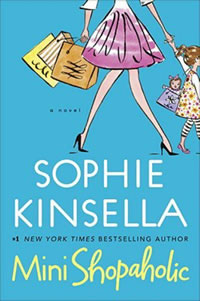
Mini Shopaholic By Sophie Kinsella – Hilarious!

I have a little confession to make.  I have read all of Sophie Kinsella‘s books.  The entire Shopaholic series and the rest of the non-Shopaholic series.  The only books of hers I have not read are her earlier works written under her real name Madeleine Wickham.  I have been doing some soul searching lately.  Does that make me a fan of chick lits?  I think I am more a fan of chick flicks than chick lits, more a fan of  Sophie Kinsella than chick lits.  In fact, I don’t recall reading other click lit writers.  Perhaps I haven’t opened my eyes wide enough.

Onto the 10 years running of the Shopaholic series and onto the 6th book in the series, the heroine of the story Becky Brandon née Bloomwood is back.  And it should come with no surprise that it is a story of Becky’s motherhood.  The development of the entire series has been predictable thus far.  For those who have finished reading the book, we can guess with certainty what the next book is about.

Back to “Mini Shopaholic”.  If you have found the character Becky irritating, you are not going to fall in love with her in this 6th installment.  If you have been accepting her misguided, unpolished, impulsive, and foolish attributes but yet warmed by her tenacity and her refusal to give in no matter how insurmountable the situation seems, you would continue loving her in this book.

I would not divulge too much of the story here.  It is as usual drama filled.  I found myself laughing out loud while reading the book – very often.  That rules out the possibility of reading the book in public or when Cynthia was sleeping.  Sophie Kinsella is gifted as a storyteller.  This book is a page turner.  The characters and down to the clearly chosen company names are memorable.  New to this book are the references to the online technology such as YouTube, Facebook, and Google.  Even down to the modern word usage of unfriend and un-anything (by the way, I find her choice of word “disinvite” strange compares to the more commonly used “uninvite”).  The main character Becky has grown up too.  The center theme is less on the drama caused by the shopping addiction like time and time in the past but on something else.  And I would say the story is more about anti-shopping, more about developing relationship with families and friends.  Sure, Becky still gets herself into unthinkable situations.  Overall, I still enjoy reading Becky’s story no less, looking forward to the next installment.

I suspect for those who take things quite seriously in life may find this book silly and ridiculous.  To me, there are books written for more serious readers.  As for “Mini Shopaholic”, let out a little bit of laughter, loosen up, and the end game is to have fun!  Now, for those who are new to the Shopaholic series, should you start with this one or to start from the beginning?  In theory, you could read “Mini Shopaholic” first because Sophie Kinsella has done a decent job in re-introducing the existing characters as well as recapping on some of the past key events.  However, coming from a fan of the series, one ought to start from the very beginning.

Categories
Book Reviews Fiction

Our Tragic Universe By Scarlett Thomas – 425 Pages Of Storyless Story

If I could have one opportunity to meet with the author Scarlett Thomas, I would like to ask her why with all these wonderful ingredients and potentials in “Our Tragic Universe”, she has chosen to disintegrate them into what appears to me as a storyless story (by her definition and by my observation).  One that makes me feel tragic to even finish reading the book.  If I could meet with Douglas Coupland who wrote that wonderful piece of praise at the back of the book, I would like to ask him specifically how “Our Tragic Universe” manages to surprise him in a terrific way, why he finds it addictive and thinks that the author is a genius.  If I could meet with the one who wrote the synopses of the book, I would like to ask why he or she thinks that “Our Tragic Universe” is a book about how relationships are created and destroyed, and how a story might just save our lives.  I have devoured the book slowly, from page one to page 425, and I have found none of the above.

Let’s start from the beginning again.  These days, I have tried to stick to my initial decision and finish a book that I have started reading.  Especially one whose author is not new to me.  You may wonder: Wilfrid, you are compelled to finish reading a book because you have spent a fortune on it, yes?  The reality is that I seldom buy books these days.  I have borrowed “Our Tragic Universe” from the National Library.  But still, I had this hope that “Our Tragic Universe” would live it up to my expectation.  This book is curiously divided into two parts.  In part one, the main character Meg – a book reviewer, a ghost writer, an aspired writer, a lady in her late thirties, a character that at one point I thought Scarlett is Meg – has a rather mundane life that is getting slightly worse.  In part two, Meg has a relatively more hopeful life that is getting slightly better.  If I may deduce what saves her life (as promised by the synopses), it is money.  Or rather the time freed up by not needing to think about making ends meet can be used to do something more interesting.  If I may second guess on what the synopses writer means by “Our Tragic Universe” is a book about how relationships are created and destroyed, it merely means that if you stuck or think you stuck in a relationship that is going nowhere, break up and start anew.  However, I doubt that is what Scarlett Thomas has intended this book to be (and I surely hope not).

“Our Tragic Universe”, to me, is an experimental work of writing.  A storyless story as defined in page 388 and 389 (and hinted at the very beginning of the story) is as follows.

[The storyless story] is the subtle rejection of story within its own structure …  It has no moral center.  It is not something from which a reader should strive to learn something, but rather a puzzle or a paradox with no ‘answer’ or ‘solution’, except for false ones.  The readers are not encouraged to ‘get into’ the storyless story but to stay outside.

To illustrate what a storyless story is like, here is an example (page 389).  By and large, I see the similarity of that and to the entire book.

A story about a hermit making jam could be as interesting as a story about a hero overcoming a dragon, except that it would be likely that the writer would make the hermit overcome the jam in the same way the hero overcomes the dragon.  The storyless story shows the hermit making the jam while the hero overcomes the dragon, and then the hermit giving remedies and aid – and jam – to both the hero and the dragon before going to bed with a book.

And so I have subconsciously played along with this storyless story concept while throughout the bulk of the book, I was hoping that “Our Tragic Universe” would be as innovative and engaging as “The End Of Mr. Y“.  “Our Tragic Universe” has all the great ingredients.  A book that Meg needed to review called “The Science of Living Forever” has a great potential to be the metafiction (a story within a story), such as the story by Lumas in “The End Of Mr. Y”.  “The Science of Living Forever” even has a sequel called “Second World” that would have fitted beautifully with this book in two parts.  There is a mysterious wild beast living in town.  There is even a ship in a bottle that mysteriously appeared at the shore when Meg was ‘conversing’ with the Universe.  The magical healing power, the placebo versus nocebo (the opposite of placebo), the conversation with the dead on an astral plane – tragically, none of these have been converted into something intriguing, something that lives up to the basic expectation established between a reader and a writer, something that is remotely close to “The End Of Mr. Y”.  This book may wish to break away from the standard structure of (1)  having a central issue or the ‘ordinary world’ of the problem, (2) the problem itself, (3) the way to set out and resolve the issue, (4) a previously unseen element in the central conflict that could make the problem seems insurmountable, (5) a climax or turning point, and (6) the resolution – as implied using Tarot reading on page 322.  In fact, “Our Tragic Universe” has done it so well that it does not have any of the above.  The fallacy of a storyless story, to me, is in the absence of a climax or a convincing turning point, it is not a very inspiring story.  Having said that, with an open mind and if reading an experiment piece is what you are after, “Our Tragic Universe” is certainly unique.  It is still an easy read with lively conversations filled with truncated ideas and well known stories.  Be prepared that this book has nothing to with tragedy, certainly nothing to do with the Universe.  And neglect the bad and misleading marketing tagline “Could a Story Save Your Life?”.

I do not think I would subscribe to the notions of fictionless fiction, historyless history, romanceless romance, unproven proof, and uncertain certainty (page 390).  I think these are some pointless phases the author has dreamed up with (that anyone could create a dozen more).  I do not think that being a realist writer means that he or she has to produce fictionless fiction (page 390).  To me, the goal of a realist artist is to produce artworks with the goals of truth and accuracy in mind.  That, in the context of writing, is a job belongs to the journalists.  A fiction is not a real story, as repeatedly mentioned in a wonderful book called “How To Read Novels Like A Professor”.  A fiction is simply a work of fiction.  If Scarlett Thomas’s aim in this book is to engage an active dialog with her readers, I think she has achieved just that.

Categories
Book Reviews Fiction

The Internet Is A Playground By David Thorne – An Insanely Fun And Bizarre Read

I suppose if one is to publish a book based on what he or she writes in his or her website, the book would look something like “The Internet Is A Playground”.  I have no idea if the materials are factual.  What it does indicate is that the author David Thorne lives in Australia and there are quite a fair bit of reference to that country.  Hence, some of you may be able to relate to the book better than I do.  Nevertheless, majority of the materials are hilarious (those that I got it).  One evening, inside a Japanese restaurant while waiting for our food to arrive, I showed Cynthia some chapters from the book.  She read, I read again with her, and we had a good laugh.  Half of the book contains email correspondence between the author and his neighbor, colleagues, his son’s teacher, and etc.  Looking at face value of these emails, I would say the author is pretty annoying, may even perceive as a bully in the Internet space.  I for sure would not know how to correspond if he writes to me.  Having said that, if you read between the lines, the author writes with good wit and humor.  Usually there is a point he wishes to make, but not directly.  It is fun to read it as a third party.  Hence the book title.

Interestingly, some readers point out that the entire book can be read from his website.  I have not got the time to trace the chapters and verify.  The website appears to have a better layout, contain links to external sites (that Tower Defense online game is insanely fun), and have extra materials (or was I reading too fast?).  So, why would one want to buy the book?  I suppose if you are going on a trip where Internet access is not convenient or if you are having a vocation and the last place on Earth you wish to visit is the Internet, it is good to grab a copy and have a good laugh.  Be prepared for some original hilarious stuffs that blow your mind away.

External Link: The Author’s 27b/6 Website

Categories
Book Reviews Fiction

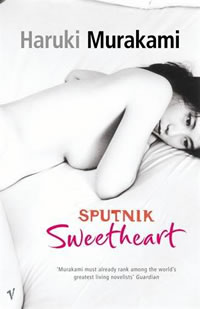
Sputnik Sweetheart by Haruki Murakami – That Sense of Loneliness, That Unattainable Love

I have come to the realisation that perhaps there is no such thing as which is my favorite Haruki Murakami novel (my 6th so far).  Even though my familiarity to his style has led me to half-expecting what “Sputnik Sweetheart” would become, there is still this element of freshness that kept me from putting the book down.  And I finished reading it in one day, wanting more.  The opening paragraph would be the best way to introduce the story.

In the spring of her twenty-second year, Sumire fell in love for the first time in her life.  An intense love, a veritable tornado sweeping across the plains – flattening everything in its path, tossing things up in the air, ripping them to shreds, crushing them to bits … In short, a love of truly monumental proportions.  The person she fell in love with happened to be 17 years older than Sumire.  And was married.  And, I should add, was a woman.  This is where it all began, and where it all ended.  Almost.

The theme of “Sputnik Sweetheart”, from what I observe, is loneliness, riding onto the framework of unattainable love.  That strong sense of loneliness!  The narrator – a man – falls in love with a lesbian who falls in love with a married woman.  True to Murakami’s style, this book is full of metaphors (“did you see anyone shot by a gun without bleeding?“), dualism that leads to surrealism, and characters that come alive in their very own unique style.

What stands out in “Sputnik Sweetheart” is the way the story is narrated and told.  Timeline is shifted to and fro to suit the narration.  Focus is shifted from one character to another and back to the narrator without the readers noticing the change, encouraging us to want to learn more about the characters’ way of thinking and their way of life.  And then, something strange happens to these characters.  The author spends the second part of the book pasting bits and pieces of information together – some from interview, some from his observation, and some from the journals left behind.  Distinguishing what is real from what is not is often not easy, as it is with all of Marakami’s works.  Even as I devoured the very last paragraph of the book, these thoughts lingered: Could this be real?  What happened next?  And in my dreamy state, inside an English cottage at Fraser’s Hill, the follow paragraph from the book has made the most impact to me.

Lying there, I close my eyes for a while, then open them.  I silently breathe in, then out.  A thought begins to form in my mind, but in the end I think of nothing.  Not that there was much difference between the two, thinking and not thinking.  I find I can no longer distinguish between one thing and another, between things that existed and things that did not.  I look out of the window.  Until the sky turns white, clouds float by, birds chirp, and a new day lumbers up, gathering together the sleepy minds of the people who inhabit this planet.

The rate this is going, Haruki Murakami could well be one of my most read author, after Milan Kundera and Italo Calvino.