Categories
Book Reviews Coincidence Fiction

張子璇《早苗》- “Zoumiu”, Again, 9 Short Stories

Zoumiu

This has to be a coincidence.  I randomly picked four Chinese novels to read from the library.  The previous book is a collection of nine short stories.  This books is also a collection of nine short stories.  Relationship, especially in the form of divorce, is one of the themes of the previous book.  Same for this book.  The previous book writes in a certain style of surrealism blurring reality with illusion.  This book, same.  And when one of the stories from 《早苗》”Zoumiu” – note that I translate based on the pronunciation because the title is derived from a female name – has a scene of the main character pondering with a glass of cold beer, I flipped.  It was as though I was reading 《嘉年華會》(Carnival”).  The beer, the divorce, the surrealism, the same number of stories – either it is a common trend in today’s Chinese literature bear in mind that “Zoumiu” is written by a Taiwanese writer while “Carnival” by a Hong Kong writer, the coincidence is simply, surreal.

Before I comment on the “Zoumiu”, I would like to write a bit on what I observe on the languages of these two geographic locations (can’t really say countries, can I?).  Hong Kong and Taiwan are most likely the only two places in this entire world that the people still write in Traditional Chinese.  I sincerely wish with all my heart that Traditional Chinese will not vanish, swallowed by the Simplified Chinese so commonly promoted by China.  For those who wonder what the difference between the two is, it is as though “Simplified English” becomes official and words such as ‘wot’, ‘happend’, ‘wif’, ‘btw’, ‘u’, ‘tt’, ‘impresn’ become the endorsed language.  Imagine English classics printed with those simplified forms.  The analogy may be crude and not entirely correct.  But the essence is there.  And that is how I feel when I read Simplified Chinese.

While I was reading “Zoumiu”, I realize that the choice of words between these two places – Hong Kong and Taiwan – can be different.  An analogy could be the subtle difference when you read British novels and American novels.  Both are written in English.  But there are differences between the two.  I, for one, read Hong Kong novels at a much faster pace.

At times, I am not sure which culture is more dramatic in nature – Taiwan or Hong Kong?  “Zoumiu” is prefaced by two I supposed reputable writer and editor in Taiwan.  Full of over-the-top promises that set my expectation sky high on “Zoumiu”, before I have even started reading the book.  The author 張子璇 has won the 1st prize of the Taiwan’s “Save the Literature” award.  “Zoumiu” is a story of love, and death.  Death is the center theme.  The nine stories are: 《早苗》《那個中午》《夜裡》《活著的記憶》《背影》《陌生人》《等待》《嫉妒的漂浮》《緩慢的自由》.  Again, for ease of reference, I would translate the titles to “Zoumiu”, “That Afternoon”, “In the Night”, “Memory of the Living”, “View of the Back”, “Stranger”, “To Wait”, “Jealousy Afloat”, “The Slowness of Freedom”.

“Memory of the Living” has perhaps the most impact on me.  In the story, the main character’s mother often stares outside the window, every passing moment of the day, holding a little black box.  One day, the main character returns home and discovers his mother has committed suicide.  He then opens the box and understands what his mother meant by: “I will tell it to you one day, until you mother is too tired, cannot hold it any longer, and I will pass it to you”.  My heart sunk when I too discovered what it is.

Another favorite story of mine is “Stranger”.  One day, a girl discovers a corpse like stranger appears in her home.  And through interacting with this stranger, conversing on the topic of her first divorce and second marriage, the stranger does not seem that foreign any more.  An extract of the story below (the author puts an extract upfront at the beginning of each story, interestingly).

要不是偶然遇見了陌生男子,今天也不過是如此平常的一天,
回頭看看剛才走過的路,著實讓她安心不少。
那個蒼白得像個死屍的男人,現在想起來也不覺得害怕了。

The rest of the stories, like these two, explore on the decisions people make, on love, at times observed from a distance, almost like reading from a spirit’s view, or indeed from a spirit’s view.  Some stories are inconclusive leaving me to ponder on what is real and what is not.  One story, “Jealousy Afloat”, the main character is obsessed with the memory and illusion of his lost love decades ago, keeps revisiting old places until he sees her, together with the younger him.  The writing style of that story could seem extreme, but I tend to think that the author is gifted in bringing human interactions alive.

Additional Info: Singapore library tag is ZGZL, Wisdom Books official site, and ISBN 978-957-450-508-1.

Categories
Book Reviews Fiction

王璞《嘉年華會》- “Carnival”, 9 Short Stories

Carnival

Almost in a similar period when I appear to have given up eating meat all of a sudden, I have this sudden urge to rediscover my Chinese root.  Reality is, nothing is ‘all of a sudden’.  I have been wanting to give up eating meat for ages.  And I have been wanting to brush up on my Chinese for ages.  Reading Chinese novels is merely a first step of my long term ambition to regain my innate linguistic ability to its fullest and beyond.  I want to be able to read, understand, and pronounce 100% of the words found in a modern novel, able to write in Chinese, and able to create literature in Chinese.  After all, I believe all my friends who remain in Hong Kong are able to do all these.  I am merely playing catchup.

The joy of reading Chinese books is indescribable.  Language-wise, I am able to understand almost all the words and expressions (versus English novels).  But mere understanding is not my primary aim.  I want to be able to pronounce them as well (unlike the Western language, you can’t really pronounce a Chinese word if you don’t know the word).  And that is when modern technology helps a great deal.  I have found a site that helps me to find out how to pronounce a certain Chinese word in Cantonese.  With my mobile phone that allows me to enter traditional Chinese in handwriting mode, I can look for a word wherever and whenever I need to.

Beyond words, I believe some of you who read both English and Chinese literature would agree with me that the ‘feel’ of the two is very different.  It is the vividness of drama and sound, the emotional complexity, the culture and values, and much more that makes reading Chinese such a joyful experience.  One could take a piece of Chinese literature, translate into English, and to me, the essence is simply lost.  How could one translate the literal meaning of “scrap my eyes and see”, “rub in oil and add vinegar”, or “white as the cleanliness of jade and the clarity of ice”?  Sounds so strange when translated literally but sounds so good when read in the original language.

Back to 《嘉年華會》- one of the four Chinese books I have borrowed from the library recently, the author 王璞 is born in Hong Kong, has lived in China, and since 1989, stationed in Hong Kong.  I have deliberately chosen a Hong Kong writer because I reckon I can relate better – both in terms of the writing style as well as the locations and culture. 《嘉年華會》 is a collection of short stories – 《希臘拖鞋》《嘉年華會》《收藏家》《跳房子》《悼念綠牆袍》《河邊少婦》《我的高麗同學》《啤酒》《流氓是怎樣煉成的》.  For the ease of reference, I would translate these titles to: “Greek Sandals”, “Carnival”, “Collector”, “Hopscotch”, “Mourning of the Green Chinese Dress”, “Young Woman by the River”, “My Korean Schoolmates”, “Beer”, and “Thugs are Made of This”.

Some stories such as “Carnival” and “Thugs are Made of This” are rather short, like a few pages.  “Beer” is perhaps the lengthiest of all for it takes up half a book.  If there is a common theme amongst these stories, that would be an attempt to mix the reality with illusion.  Another theme would be the loss of something.  The author would try to convince the reader something exists only to later on blur it into illusion.  Or a relationship that is well and good and then out of nowhere, a huge quarrel breaks out (that reads like watching a typical local TV drama) and the couple parts way.

In most of the stories, divorce seems to be a main topic.  I wonder why.  Relationships do not seem to work out.  In fact, nothing works out in all the short stories.  The story “Beer” is perhaps one of my favorite.  It has the depth and complexity that I enjoy reading.  The story’s main character is someone who has experienced four divorces and a childhood crush on a train that still lives vividly in her.  To chain the plots is her passion to drinking beer.  To add onto the plot is the main character’s mission to locate her missing father.  All these plots are told not in a sequential manner, but rather randomly picked as the narrator recollects her life story.  The most amazing thing is how the main character – a writer – creates and distorts the story of her childhood crush, in the form of short essays.  That creates a story within a story – an exploration of what happens when love in reality meets with love as an illusion.

I am glad that the book ends with “Thugs are Made of This”.  In just 16 pages, the author tells a story of an apartment owner from being Mr. Nice to someone rude and nasty after a series of unfortunate events.  Such quickness in plot development, what a way to end the book.  I will certainly look for more books written by 王璞.  And one quote from the book to end this entry.

即使是像我一個逆來順受的女人,也有一顆跳動的心。

Additional Info: Singapore library tag is WGPU, Cosmos Books official site, and ISBN 978-988-211-977-2

Categories
Comedy Foreign Movie Reviews

My Girlfriend Is An Agent – So Very Hilarious!

What a funny show!

Once in a while, there are movies that are so beyond expectation that you thought: Wow, I am so glad that I’ve picked it.  Maybe my week has been somewhat humdrum, maybe there are just too many sad news of old wive poisoning old husband, young teen stabbing his young girlfriend to death, or the groom jumping off from the hotel’s rooftop dead while the new bride was showering, I am so in need of something funny, something to make my day.  So I picked “My Girlfriend Is An Agent”, and mobilized the Movie Review Squad.  Not sure why, I was half expecting something like “My Wife Is A Gangster”.  But the resemblance stops at the title.

This movie is closed to two hours.  And the audience was awesome!  Quite a few were clapping hands and all of us were laughing out loud throughout the show.  To the crowd at The Cathay for the 7.30 pm show last Friday, you guys rock!

OK.  To be honest, there isn’t much storyline per se.  Whether some Koreans are selling some very dangerous bio weapon ingredients to some Russians is not quite what I am interested to find out and follow through.  The main storyline, to me, is merely a background and setup for the comic scenes.  I was pleasantly surprised to see how happy Cynthia laughed inside the theater, knowing that Korean films are usually not her cup of tea.  The overall storyline may not be memorable.  But some of the comical materials certainly are.

Categories
Drama Movie Reviews Romance

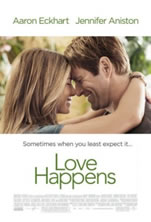
Love Happens, A Misleading Title?

A mismatch of expectation?

Do bloggers know no bounds in what they write?  Do I know no bounds in what I write?  I am not sure if fellow bloggers have faced a similar situation.  At times, in a friendly catching up occasion, my friend would suddenly turn to me and ask, “You wouldn’t put that into your blog, would you?”  The dilemma of wanting some friends of mine to know – or not – that I have a website.

Of course I know the boundary.  And so, Mr. TK, if you are reading this, our little episode is safe with me.  Though we will likely to laugh over this for years to come.  And until I do the same thing you did, then we would laugh at each other for years to come.

Our band’s drummer wanted to watch that Michael Jackson film.  So I mobilized the Movie Review Squad in the morning.  TK suggested “The Hurt Locker”, a war film (which I promise to loop in another friend, Ng,  to watch).  Cynthia suggested “Love Happens”.  If it was up to me, I would love to pick “My Girlfriend Is An Agent”.  I love watching girls kicking asses.  In retrospect, I thought “Love Happens” is “NewYork, I Love You”.  Since all of us seemed happy about “Love Happens”, “Love Happens” it was.  (Still quite amazed that TK could decipher my morning SMS: Love happens today or tomorrow?)

I think the movie title “Love Happens” is misleading.  If it was to be branded not as a romance movie, it would have attracted lesser criticism just on the title itself.  I walked into the theater thinking it was another show, so obviously, I have little expectation on the outcome.  If we take away the notion of romance, and look at Jennifer Aniston’s role as helping Dr. Burke Ryan (played by the talented Aaron Eckart) – together with everyone in the workshop of how-to-get-over-the-loss-of-your-loved-ones hosted by Ryan – to come to terms with the loss of his wife, it is quite a decent movie to watch.  Some scenes are emotional.  Some are somewhat inspiriting (like taking the ‘stairs’ to see things in a different perspective).  The little word games Eckart and Aniston played onscreen makes the film interesting (to be honest, I know none of the three English words they use).  Cynthia and I have been a big fan of Aaron Eckart since the days of “Thank You For Smoking”.  And acting-wise, I think he delivers.

It is unrealistic – in my opinion – to expect a man to fall madly in love with another woman before he has even come to terms with the loss of his beloved partner three years ago on an accident that he blames himself upon.  In as such, the lack of the elements of romance or the presence of a glimpse of what is to come is only appropriate.  Unfortunately, the movie title and the excerpts suggest that “Love Happens” is a romance story.  Personally, I would prefer the filmmakers to use the title of “Brand New Day”, a variation of what the working title was.

Categories
Book Reviews Fiction

The Memoirs Of A Survivor By Doris Lessing – An Amazing Journey Beyond Survival, Beyond Time And Space

A book by Doris Lessing published in the 70s
I deeply respect Doris Lessing’s ability to breath life into characters, and in “The Memoirs of a Survivor (1974)”, she breathes life into rooms and walls and more.  Doris Lessing is one of the most intelligent writers, certainly one of my favorite.  I wish I could have a glimpse of how she creates her works.  Such coherence and linkages as though the beginning is planned as the ending is written, and vice versa.

For example, the ‘it’.  Only when I re-read parts of the book did I noticed that on page 9, she wrote:

I shall begin this account at a time before we were talking about ‘it’.  We were still in the stage of generalised unease.  Things weren’t too good, they were even pretty bad … But ‘it’, in the sense of something felt as an immediate threat which could not be averted too.

I did not take much notice until I read towards the end of the book, on page 130, she wrote:

Very well then, but what was ‘it’?  I am sure that ever since there were men on earth ‘it’ has been talked of precisely in this way in times of crisis, since it is in crisis ‘it’ becomes visible, and our conceit sinks before its forces.  For ‘it’ is a force, a power, talking in the form of earthquake, a visiting comet whose balefulness hangs closer night by night distorting all thought by fear – ‘it’ can be, has been, pestilence, a war, the alteration of climate, a tyranny that twists men’s minds, the savagery of a religion.

‘It’, in short, is the word for helpless ignorance, or of helpless awareness.  It is a word for man’s inadequacy?

I would have missed that linkage.  Also, only when I re-read from the beginning, I can attempt to understand the concept, her concept of ‘they’ and ‘them’.  Attempt, as this book is anything but an easy read.  On the surface, it is a simple story being told from the eyes of a woman – the narrator.  It is a time of near-future when an unspecified disaster causes our society to plunge into the age of barbarism, when people are constantly on a move based on scarce news to a better and more livable place, when no one possesses anything but to constantly make do with what they come across and pass them on, when there is no law and order, and when survival matters.

One day, a small girl Emily is given to this woman’s care.  And comes with this girl is an ugly dog with the look of a cat.  For that part of the story, it reminds me of her book “The Story Of General Dann And Mara’s Daughter, Griot And The Snow Dog”.  A young girl and her animal companion.  The story spans the several years of the little girl’s growing up, the crowds gather at the ‘pavement’ in front of the house they occupied, the emergence of children from the sewage system not brought up by humans, but rather behave like monsters.  Monsters.  Such ugliness that strongly reminisces of the main character of “Ben In The World”.  How Emily has fallen in love with the young leader Gerald, helping him to build communities, authority, and how Gerald – when everyone has given up on those monstrous children who kill and destroy all that they see – never gives up on these children.  A close reference to W. H. Auden’s ‘We must love one another or die’ (a poem called “September 1, 1939”).  Someone has made a note “Lord of the Flies” in the library book that I borrowed.  It is a classic written by William Golding in 1954.  I think there is a certain level of validity on that association.

Layer on top of this straightforward storyline is how the narrator – the woman – sees the surrounding walls transform into images and messages that transcend space and time.  It is when the woman sees the past of Emily – her father, her mother, her little brother, and the babysitter.  Each past from each room, each wall, comes with different metaphor that explains the certain current state of Emily as the narrator observes.  Emily initially is described as ‘invincibly obedience’.  As the narrator observes, there are more and more flaws, then explained by the visions from the walls.  More and more respectable capabilities are observed, as the story unfolds.  That is what I meant by breathing life into a character that Doris Lessing has done it so well.  The narrator never gets too close to Emily, always observes from a distance.

It is hard to describe how Doris Lessing manages to make the ‘walls’ sound so convincing.  She describes the wall as ‘personal’.  In my limited understanding – perhaps I need to read the book again several more times – in that world, nothing is personal as no one truly owns anything.  The only thing ‘personal’ is our memory and our vision, hence represented by the ‘personal’ wall.  And as dramatic as her stories that I have read, just when I was deeply depressed by the gloominess towards the end of the story, a wall – that the narrator promises to show no more – ‘appears’ in a different capacity, in hope and beauty.  That ending, lifts my soul high.

“The Memoirs of a Survivor” lightly explores the concepts of community, feminism, survival, administration, government, and authority – or simply put, humanity.  The most memorable metaphor is how our next generation take what we have used and discarded and create something of their own, something beautiful and useful.  In the story, the narrator’s job is a news gatherer.  Doris Lessing does not tell the readers how important news is in time of uncertainty.  She starves the readers with meagre amount of news that every little plot she discloses I hold dear to, digest and re-digest again.  But still, what causes the disaster?  Are there really big blue fish in the sea?  Or yellow?  No one knows.

Note: Doris Lessing is the Nobel Prize Laureate in Literature 2007 – “that epicist of the female experience, who with scepticism, fire and visionary power has subjected a divided civilisation to scrutiny”.

Categories
Action & Thriller Foreign Movie Reviews

Amalfi (Amarufi) – Japanese Diplomacy Is A Long Process

Yet another Japanese film!

When I was young, I often read Japanese novels of the detective and thriller genre.  In Chinese of course.  There is this Oriental exoticism that is different from the similar stories of the West.  The twists and turns, the ambiance, the backdrops, and the attention to details like an art – all in a pace that is less of a page turner, but rather a consistent grind from start to end.  In a strange way, watching the 125 minutes Japanese film “Amalfi” reminds me of just that.

“Amalfi” is a special production to mark Fuji Television’s 50th anniversary, entirely shot in Italy.  The scenery is beautiful.  As Cynthia and I watched the movie, some scenes reminded us of our honeymoon back in 2000.  The plot is full of twists, though somewhat linear.  You could of course sit back and watch the movie as it is.  Or you could – like me – think together with the actor, as he pauses, eyes dashing around the surrounding, and the music stops giving you the opportunity to think.

As for the storyline, I wouldn’t say too much here.  But here is the excerpt.  A single mother has gone for a holiday with her little daughter in Italy and soon, her daughter is kidnapped.  A Japanese diplomat has joined the Japanese Embassy in Rome and is assigned to handle this kidnap case.  Soon, they discover that this entire setup is more than just a kidnap.

I can understand that some may find this movie a bit too long and boring.  Some parts are a bit far fetched, though by and large, the storyline makes sense.  I in especially am delighted by the acting: a single mother who has to appear strong under even the most trying period of her life, a diplomat who has poor communication skill but his eyes say it all.  “Amalfi” is more than a thriller.  I am not a Japanese.  But it is refreshing to see a Japanese film taking on the International arena.  I for one am awed by the breathtaking scenes shot in Rome.  One scene, they are taking a public bus, standing with the crowd, the camera gradually zooms out, through the bus window.  As the bus drives away, there it is, the famous backdrop of Rome.  Such class!

PS. I think the filmmakers are big, big fan of Sarah Brightman.

Categories
Foreign Horror Movie Reviews

Darah – Made In Indonesia

Blood, a lot of blood!

Last Monday was significant in a few ways.  I have decided to be a vegetarian if the circumstances allow.  Something like a social meat eater.  Let’s see how long it will last.  F1 has one more race to go but the driver and constructor’s champion titles have already been concluded.  Cynthia was out-of-town and with my new found freedom, I picked a horror movie to watch.

Strictly speaking, this Indonesian production “Darah” (means blood in Malay) is not a horror film.  More like a thriller with lots and lots of blood.  I can imagine my buddy Mark would faint halfway through the show.  While some friends of mine have rightfully pointed out that there are better horror films than this (and many others would not want to watch this genre), my motivation of watching “Darah” was as follows:

  1. I love watching a horror film in a theater.  I am often entertained by the atmosphere of pockets of audience screaming-out-loud.
  2. I always enjoy watching an Indonesian production that makes it to the International market.  I have studied the language before and it is fun trying to understand the dialogs natively.

First half an hour of “Darah” is devoted to the character development of six friends – guys and girls and I was thinking: where is the blood?  Second half an hour sees the introduction of the scary family of Dara the mother, Adam and Maya – her scary son and her hot daughter in red, and a rather fat butcher who reminds me of a pedophile or a pervert.  OK, I began to see blood.  The last half an hour is filled with accentuated chopping and dismemberment, blood, more blood, and extremely more blood in a chaotic mindless way.  Oh my.  There was only one color I saw: red.

While one may argue that “Darah” lacks the storyline quality, I do find a story built with a hint of folklore better than just another ghost story in a refreshing way.  At the beginning of the movie, there is an argument of a sister blaming her brother over the death of their parents.  Something to do with an unfortunate decision that the brother has made.  That ties in nicely to the ending of the show, in my opinion, when the sister has realized what a terrible mistake she has made.  Also, there was an opening scene of pieces of steak cooked over charcoal fire somewhere in the city of Bandung.  That metaphor has morphed into something pretty gruesome as the story unfolds.  And what I really appreciate is how artistic this film is created.  I am intrigued by the quality of work too.

My only complain is the censorship.  Even with a M18 rating, there are quite a few scenes being cut and without those, some parts of the movie seem a bit flat.  What a pity.  Having said that, there are still a lot of blood and gore scenes that may make your stomach churns.  Those scenes didn’t seem to affect me though.  I had minestrone soup and vegetarian pasta in tomato sauce for dinner.

Horror movies, I want more!

Categories
Movie Reviews Romance

What Not To Love About (500) Days Of Summer?

I like!

8 hours before the show started, on a slow and lovely Friday, our movie-partner-in-crime sent me a text message saying that he could not make it, for he remembered there was a birthday party to attend.  Panic!  On the 11th floor!  Who was going to take over that one single movie ticket?  Cynthia and I do not have that many mutual single friends and I am not sure if my single friends are comfortable hanging out with the two of us.

To cut a long story short, I really wanted to bring one of my friends out, for she is still trying to heal her broken heart.  Friend support is important in this particular circumstance, I always preach that.  And I prayed and prayed – before and during the show – that she would not break down and cry.  I mean, it is a romance film and I had no idea which direction it would go.  Fortunately, she seemed OK.  I guess hope sells.  Obama won the election with hope; the Nobel price committee may have awarded Obama based on hope; Dan Brown’s new novel ends with hope; I have been telling my friend not to give up on hope.  Thank God “(500) Days of Summer” agrees with me.

“(500) Days of Summer” is a story about a boy meets a girl.  The narration goes back and fro on a particular day through the 500 days Tom Hanson (Joseph Gordon-Levitt) and Summer Finn (Zooey Deschanel) have been together.  A story told from the man’s perspective, but with a twist – at least to me – that there is a role reversal between Tom and Summer.  Hence, I reckon this movie is one that both sexes can relate.  If the narration was to follow the timeline, it would have been quite a depressing show to watch.  Because it is not, there is a good mix and happiness and sadness all told in a lighthearted manner.  It is one very entertaining show that makes the audience giggled all the time.  Cynthia thinks that the main actor has a pair of caring eyes that melts hearts.  I think that dude has a very nice smile (those eyes can surely smile!).  And I find the main actress’s acting a joy to watch, especially those moments that are without words.

This film does not seem to watch like a typical Hollywood production.  I think I may even get a BluRay recording for this show.  Now if there is a sequel …

Categories
Drama Foreign Movie Reviews

Tokyo Sonata – On Starting Over

Every Family Has Its Secrets ...

Whether or not you would like “Tokyo Sonata” depends on (a) how much you like the picture house type of movie, (b) how curious are you on the modern Japanese culture, and (c) how much you can relate to the story.  Ironically, I could not persuade my Japanese friend whom we met for a dinner to watch this Japanese show.  Uh-oh.  On paper, “Tokyo Sonata” has won 8 awards including Cannes Film Festival.  What about on screen?

Behind closed doors, each family member is keeping a secret from one another.  A younger son who doesn’t seem to fit in with his school and wishes to learn playing the piano instead, an older son who is tired of distributing pamphlets in the wee hours for a living and wishes to find meaning in life by doing something totally different, a father who is retrenched from his post as the director of administration and is finding it hard to come to terms with the reality, and a mother who is struggling with this dysfunctional family and is dreaming of a life of the otherwise.

It is a depressing movie to watch.  I have not lived in Japan yet but I can imagine the long recession must have affected Japan, from what I have read.  I feel for these characters.  Each day is a struggle.  Just how hard it is to live a lie every day – in the name of the tradition – and yet, each character exhibits his share of integrity in his own way.

“Tokyo Sonata” is a slow paced movie attending to the very detail of tradition and human interaction.  I could almost imagine watching the entire movie as a sonata, with a very slow and lengthy middle section.  But the last part of the movie is phenomenal.  The story development of each character takes a dramatic turn and converges to a theme of – what I would perceive as – starting over.

Great acting, it is.  And the ending bits well worth the 2 hours of waiting, to me.

Categories
Book Reviews Fiction

Dan Brown’s The Lost Symbol – A Page Turner With Puzzles After Puzzles

Dan Brown's Latest Work

I can’t say that I am a fan of the thriller genre but I do enjoy Dan Brown’s style of puzzles mixing facts and fictions with a healthy or unhealthy – depends on how you see it – dose of spiritual reflection.  Besides, once in a while, it is good to read a page-turner for a change and get entertained.  When I learned from Amazon.com that Dan Brown has kept “The Lost Symbol” under wraps by allowing only a handful of people to have access to the manuscript, I was intrigued.  I hit our national library website 3 times a day to see when this book was open for reservation.  Singapore’s National Library Board has brought in 70 copies of “The Lost Symbol” and I was queue number 3.  Not bad at all compares to how I did for that Kinsella Book (queue number seventy odd of I think forty odd books in total).

I have read almost all his books (except “Deception Point”, I think).  I don’t think I can recall any of the storyline.  What I recall though is that I have always enjoyed how Dan Brown rapidly switches plots, delaying the key story revelation, and keeping us engaged with puzzles after puzzles.  “The Lost Symbol” is no exception.  For maximum enjoyment, I strongly encourage you to refer to the online materials for reference as your read the book.  For example, the painting “Melecolia I” is used as one of the puzzles.  You could read how Dan Brown describes the painting in words.  But nothing beats seeing the painting with your own eyes.

I would not dive too deep into the plot because it is not fun for those who are planning to read this book.  Robert Langdon, a character from “Angels & Demons” and “The Da Vinci Code”, is back for “The Lost Symbol”.  I do not think there is a significant connection with the previous novels  so you do not need to read them in sequence.  And like his previous works, I am often amused by how his characters can sustain such emotional tremor and physical wounds and still able to run around, solve puzzles, and intellectually discuss matters in such a lengthy manner.  Personally, I think his opinion on Christianity is – as always – very thin especially after I have freshly finished reading Karen Armstrong’s latest work.  I would not take his religious view too seriously.  But I suspect his opinion will stir another round of controversy – perhaps lesser in magnitude compares to “The Da Vinci Code” – nonetheless.