Categories
Book Reviews Fiction

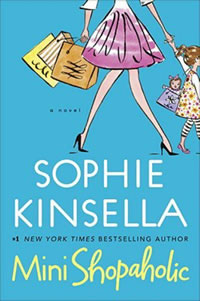
Mini Shopaholic By Sophie Kinsella – Hilarious!

I have a little confession to make.  I have read all of Sophie Kinsella‘s books.  The entire Shopaholic series and the rest of the non-Shopaholic series.  The only books of hers I have not read are her earlier works written under her real name Madeleine Wickham.  I have been doing some soul searching lately.  Does that make me a fan of chick lits?  I think I am more a fan of chick flicks than chick lits, more a fan of  Sophie Kinsella than chick lits.  In fact, I don’t recall reading other click lit writers.  Perhaps I haven’t opened my eyes wide enough.

Onto the 10 years running of the Shopaholic series and onto the 6th book in the series, the heroine of the story Becky Brandon née Bloomwood is back.  And it should come with no surprise that it is a story of Becky’s motherhood.  The development of the entire series has been predictable thus far.  For those who have finished reading the book, we can guess with certainty what the next book is about.

Back to “Mini Shopaholic”.  If you have found the character Becky irritating, you are not going to fall in love with her in this 6th installment.  If you have been accepting her misguided, unpolished, impulsive, and foolish attributes but yet warmed by her tenacity and her refusal to give in no matter how insurmountable the situation seems, you would continue loving her in this book.

I would not divulge too much of the story here.  It is as usual drama filled.  I found myself laughing out loud while reading the book – very often.  That rules out the possibility of reading the book in public or when Cynthia was sleeping.  Sophie Kinsella is gifted as a storyteller.  This book is a page turner.  The characters and down to the clearly chosen company names are memorable.  New to this book are the references to the online technology such as YouTube, Facebook, and Google.  Even down to the modern word usage of unfriend and un-anything (by the way, I find her choice of word “disinvite” strange compares to the more commonly used “uninvite”).  The main character Becky has grown up too.  The center theme is less on the drama caused by the shopping addiction like time and time in the past but on something else.  And I would say the story is more about anti-shopping, more about developing relationship with families and friends.  Sure, Becky still gets herself into unthinkable situations.  Overall, I still enjoy reading Becky’s story no less, looking forward to the next installment.

I suspect for those who take things quite seriously in life may find this book silly and ridiculous.  To me, there are books written for more serious readers.  As for “Mini Shopaholic”, let out a little bit of laughter, loosen up, and the end game is to have fun!  Now, for those who are new to the Shopaholic series, should you start with this one or to start from the beginning?  In theory, you could read “Mini Shopaholic” first because Sophie Kinsella has done a decent job in re-introducing the existing characters as well as recapping on some of the past key events.  However, coming from a fan of the series, one ought to start from the very beginning.

Categories
J Pop Music Reviews

Anna Tsuchiya – Rule – Coming Out From The Nana Personality

I was so excited about Anna Tsuchiya (土屋アンナ) so much so that when Amazon.co.jp alerted me of her 3rd album, I quickly dived in and made a purchase, when I was holidaying in Hong Kong.  Much cheaper than to buy the imported version in a local music store.  Much faster too.  It takes ages for Japanese albums to appear on the shelf here in Singapore.  I inquired.  And learned that HMV Singapore is of a retail outlet status.  Versus HMV Hong Kong, which is a distributer.  Apparently, if the disc comes with a DVD – which is very common for Japanese music – HMV Singapore has to wait until the distributor distributes.  I was used to blame the censorship board for the delay.  Now I know better.

In her first two albums – Strip Me? and Nudy Show! – Anna Tsuchiya was behind the persona of the famous Japanese anime character Nana.  A punk rocker.  Playing catchy upbeat rock songs.  “Rule” is her first album ventured outside ‘the voice of Nana’.  And it probably comes with no surprise that “Rule” is slightly different from her first two.  Her collaboration with the Japanese jazz instrumental band PE’Z has added one jazz track (“暴食系男子!!”) into her new album.  Then there is a theatrical themed song.  And one song (“Shout In The Rain”) with a sound texture that resembles the American rock bank Evanescence.  That song also reminds me of the style of other Japanese singer Oliver Lufkin (from the same anime).

It took me a little while to get used to her new personality and her expanded music direction.  I am delighted that her music has grown.  The album comes with a DVD that contains 5 music clips.  To be frank, I was hoping that my favorite tracks “Human Clay”, “Guilty”, and the slow song “Voice of Butterfly” would be featured as singles.  They are really catchy.

To showcase one of my favorite videos, here is a slow song called “Believe In Love”.

Categories
Comedy Movie Reviews

Dinner for Schmucks – Laughed Till My Face Went Numb

Again, thanks to Omy.sg, we were invited for an exclusive preview of “Dinner for Schmucks” at Iluma.  I think Omy.sg loves me, and I love Omy.sg the same.  I picked “Schmucks” because it is mid week and I reckon I need some comedy.  The movie is not perfect.  But it delivers.  Cynthia and I had a hearty fun time.

We love Steve Carell, the 40 years old virgin and the Tripplehorns.  And in “Schmucks”, he plays the role of an idiot.  Or so it seems by and large as there is a deeper debate on who are the schmucks, which I would not want to spoil your fun watching this movie.  Steve is a talented comedian.  He can play any role and be convincing.  We also love the other lead actor Paul Rudd who has acted in “I Love You, Man”.  If you enjoy watching Western comedy, putting the two together can be quite a treat.  The surprise to us is the talented New Zealander Jemaine Clement from “Flight of the Concords“.  His airtime in this movie is way too little.  I really wish that he had a more significant role to play.  The spooky yet hilarious Kristen Schaal too from “Concords” is also involved in this movie, together with a quality team of comedians too long to be listed here.

From the story writing point of view, “Schmucks” is not going to be memorable.  Rarely comedy films do.  The middle part of this 114 minutes film could be quite awkward to watch, though hilarious.  Because it can be quite … stupid (the young girl next to me were laughing and screaming “It is so stupid” at the same time, all the time – which is quite funny on its own).  The good news is that it has a quality ending and some of the jokes are original.  And if you are not in a hurry to leave the theater at the end of the show (interestingly many people here do), there is a tiny bit of extra clip after the end credits.

If I could single out one thing I wish to complement, that would be those miniaturized mouse models.  So beautifully made, so heartwarming / heart wrenching to look at.  I seriously think that the filmmakers should sell the replicas of these models as merchandise.  I would want to get some.  The choice of soundtrack is good too.  Need a good brainless laugh?  I doubt “Schmucks” would disappoint.  I laughed till my face went numb.

Categories
Book Reviews Non-Fiction

Nothing To Envy By Barbara Demick – A Look Inside North Korea Through 1 City, 6 Main Characters

This is indeed an outstanding work of journalism, the second of the two books I bought at the airport.  The book title “Nothing To Envy” is taken from one of the frequently used propaganda messages in North Korea.  Due to the restricted media access, much of what life is like inside North Korea is sealed off from the rest of the world.  Except perhaps Pyongyang that is staged to impress the international media.  Prior to reading this book, I only had a limited understanding of North Korea: a communist country that is poor, with her leader rather spends the resources on nuclear weapon than food and a country that is labeled as evil by the Bush administration.  But there is much more than that.

To tell the story of North Korea, the author has chosen one city – Chongjin – that is far away from Pyongyang, relatively inaccessible by the media, and was used to be a place for the exiled officials.  Chongjin is the third largest city in North Korea close to the Chinese and Russia borders and has important role to play during the Korea War.  To tell the story of the North Koreans, the author has chosen six North Koreans who came from the same city, Chongjin, and now defected.    To prepare for this book, the author has interviewed over a hundred North Koreans who have defected to either China or South Korea, made nine trips to North Korea between 2001 to 2008, and has reviewed some of the rare to obtain video footages and still photographs.  At the beginning of each chapter, a black and white photography is shown.  The one that has the most impact to me is the satellite image of Korea peninsula at night.  While the majority of South Korea is lit up at night, the entire North Korea is engulfed in darkness with a tiny dot of light at Pyongyang.  The entire country with a population of 23 million is out of electricity (out of food for that matter).  You may wish to stop for a moment and ponder upon what it means.

From the narration point of view, the author has done an excellent job in keeping the story fresh and accessible to the readers.  It is still a dry topic – the history of Korea War, the economic and social outlook from 1960s to today, the regime under Kim Il-sung, the famine of the 1990s, and the life as a North Korean today.  What the author manages to do is that through the main characters whom she interviewed and kept in touch over the years and through the stories told by the family and friends of these characters – a compelling story is weaved in telling what real lives in North Korea are like.  As an icing on the cake, there is even an element of romance in “Nothing To Envy”.  I could not help but to scream (in my head of course): There she has it, a wining story.  What it also means is that Barbara Demick has built a trusting rapport at a personal level to not only pry open what lives are like in North Korea, but also get them talking about the happiest and most painful moments of their lives.  No wonder the characters come alive with so much intimate details.

The characters chosen in the book are of a diversed background.  Some are of a relatively upper class while some are of the lower class.  Some have relatives in Japan, China, or South Korea.  In terms of people’s jobs, there is a miner, a school teacher, a young scientist, a factory worker, a doctor, and etc.  Each story thread has a moving story on why most initially vowed loyal to the Fatherland (as part of the indoctrination process that is probably hard to imagine for the outsiders), how they have to adapt and endure when the situation in North Korea has deteriorated a great deal, and how eventually they made it out of North Korea as defectors.

So what do I get out of “Nothing To Envy”?  At the macro level, I learn that against all odds, North Korea has survived the breaching of the Berlin Wall, the breakup of the Soviet Union, the market reforms in China, the death of Kim Il-sung, the famine of the 1990s, and the two terms of George W. Bush’s presidency.  At the micro level, I have a better understanding on the indoctrination process powered by the North Korean media propaganda reinforced by neighbor watch and police force, the tragic reality of famine when people have to hunt for grass and weed and tree barks to eat as the last resort (many babies died because they were unable to digest these food) and the desperate things they did for food.  There is also good insight during and after the death of god-like dictator Kim Il-sung, on how the social landscape has shifted and how the illegal free market was born out of necessity when totalitarianism collapsed.  It is a painful revelation when some of the North Koreans have come face to face with the reality that the world outside has – in contrary to what they were made to believe – progressed while North Korea simply stuck at the 1960s.  How some of the North Koreans managed to flee the country as traders or even brides only to be caught and sent to the labor camps back in North Korea and then once out of the camps, they tried fleeing again.  One of the most relevant insights – to me – is how the North Koreans who are defected to South Koreans eventually settled down and tried to come to term with a reality, having to face free choices rather than the government to dedicate all that they do and receive.  Because that could well be a reality in the future should North Korea collapse one day.  To end this brief book summary, I would like to quote the author:

While the persistence of North Korea is a curiosity for the rest of the world, it is a tragedy for North Koreans, even those who have managed to escape.

Categories
Book Reviews Fiction

Our Tragic Universe By Scarlett Thomas – 425 Pages Of Storyless Story

If I could have one opportunity to meet with the author Scarlett Thomas, I would like to ask her why with all these wonderful ingredients and potentials in “Our Tragic Universe”, she has chosen to disintegrate them into what appears to me as a storyless story (by her definition and by my observation).  One that makes me feel tragic to even finish reading the book.  If I could meet with Douglas Coupland who wrote that wonderful piece of praise at the back of the book, I would like to ask him specifically how “Our Tragic Universe” manages to surprise him in a terrific way, why he finds it addictive and thinks that the author is a genius.  If I could meet with the one who wrote the synopses of the book, I would like to ask why he or she thinks that “Our Tragic Universe” is a book about how relationships are created and destroyed, and how a story might just save our lives.  I have devoured the book slowly, from page one to page 425, and I have found none of the above.

Let’s start from the beginning again.  These days, I have tried to stick to my initial decision and finish a book that I have started reading.  Especially one whose author is not new to me.  You may wonder: Wilfrid, you are compelled to finish reading a book because you have spent a fortune on it, yes?  The reality is that I seldom buy books these days.  I have borrowed “Our Tragic Universe” from the National Library.  But still, I had this hope that “Our Tragic Universe” would live it up to my expectation.  This book is curiously divided into two parts.  In part one, the main character Meg – a book reviewer, a ghost writer, an aspired writer, a lady in her late thirties, a character that at one point I thought Scarlett is Meg – has a rather mundane life that is getting slightly worse.  In part two, Meg has a relatively more hopeful life that is getting slightly better.  If I may deduce what saves her life (as promised by the synopses), it is money.  Or rather the time freed up by not needing to think about making ends meet can be used to do something more interesting.  If I may second guess on what the synopses writer means by “Our Tragic Universe” is a book about how relationships are created and destroyed, it merely means that if you stuck or think you stuck in a relationship that is going nowhere, break up and start anew.  However, I doubt that is what Scarlett Thomas has intended this book to be (and I surely hope not).

“Our Tragic Universe”, to me, is an experimental work of writing.  A storyless story as defined in page 388 and 389 (and hinted at the very beginning of the story) is as follows.

[The storyless story] is the subtle rejection of story within its own structure …  It has no moral center.  It is not something from which a reader should strive to learn something, but rather a puzzle or a paradox with no ‘answer’ or ‘solution’, except for false ones.  The readers are not encouraged to ‘get into’ the storyless story but to stay outside.

To illustrate what a storyless story is like, here is an example (page 389).  By and large, I see the similarity of that and to the entire book.

A story about a hermit making jam could be as interesting as a story about a hero overcoming a dragon, except that it would be likely that the writer would make the hermit overcome the jam in the same way the hero overcomes the dragon.  The storyless story shows the hermit making the jam while the hero overcomes the dragon, and then the hermit giving remedies and aid – and jam – to both the hero and the dragon before going to bed with a book.

And so I have subconsciously played along with this storyless story concept while throughout the bulk of the book, I was hoping that “Our Tragic Universe” would be as innovative and engaging as “The End Of Mr. Y“.  “Our Tragic Universe” has all the great ingredients.  A book that Meg needed to review called “The Science of Living Forever” has a great potential to be the metafiction (a story within a story), such as the story by Lumas in “The End Of Mr. Y”.  “The Science of Living Forever” even has a sequel called “Second World” that would have fitted beautifully with this book in two parts.  There is a mysterious wild beast living in town.  There is even a ship in a bottle that mysteriously appeared at the shore when Meg was ‘conversing’ with the Universe.  The magical healing power, the placebo versus nocebo (the opposite of placebo), the conversation with the dead on an astral plane – tragically, none of these have been converted into something intriguing, something that lives up to the basic expectation established between a reader and a writer, something that is remotely close to “The End Of Mr. Y”.  This book may wish to break away from the standard structure of (1)  having a central issue or the ‘ordinary world’ of the problem, (2) the problem itself, (3) the way to set out and resolve the issue, (4) a previously unseen element in the central conflict that could make the problem seems insurmountable, (5) a climax or turning point, and (6) the resolution – as implied using Tarot reading on page 322.  In fact, “Our Tragic Universe” has done it so well that it does not have any of the above.  The fallacy of a storyless story, to me, is in the absence of a climax or a convincing turning point, it is not a very inspiring story.  Having said that, with an open mind and if reading an experiment piece is what you are after, “Our Tragic Universe” is certainly unique.  It is still an easy read with lively conversations filled with truncated ideas and well known stories.  Be prepared that this book has nothing to with tragedy, certainly nothing to do with the Universe.  And neglect the bad and misleading marketing tagline “Could a Story Save Your Life?”.

I do not think I would subscribe to the notions of fictionless fiction, historyless history, romanceless romance, unproven proof, and uncertain certainty (page 390).  I think these are some pointless phases the author has dreamed up with (that anyone could create a dozen more).  I do not think that being a realist writer means that he or she has to produce fictionless fiction (page 390).  To me, the goal of a realist artist is to produce artworks with the goals of truth and accuracy in mind.  That, in the context of writing, is a job belongs to the journalists.  A fiction is not a real story, as repeatedly mentioned in a wonderful book called “How To Read Novels Like A Professor”.  A fiction is simply a work of fiction.  If Scarlett Thomas’s aim in this book is to engage an active dialog with her readers, I think she has achieved just that.
Categories
Action & Thriller Movie Reviews

The Secret in Their Eyes – A Man Never Changes His Passion

This morning, it was typhoon signal number one.  Now, it is upped to number three.  I often visit my birth town in winter, seldom experience the rain.  In a way, the rain today brought back the sweet memory of my study life.

Cynthia and I were in IFC Mall when we stumbled upon a cinema.  Ritually, we scanned through the program just in case something interesting came up, with the right timing and not too crowded.  Interestingly, a Spanish movie fitted the bill.  Although we are not quite into the genre of crime, we were happy to take the opportunity to give our Spanish some exercise, especially when we have given our class a one week holiday break.

“The Secret in Their Eyes” or the Spanish title “El Secreto de Sus Ojos” is surprisingly a great movie (consider the fact that for us, it is a “walk-in” movie).  Little did we know that it has won the Oscar for Best Foreign Language Film.  Only when the script mentioned “Buenos Aires” did we realize that it is an Argentine film.  It is an intriguing story that weaved through a rape-murder case in a flashback style.  It has enough twists that keeps the 127 minutes movie engaging.  It has enough drama and character development that makes it more than a story of solving a crime.  In terms of timeline, the story spanned 25 years between 1974 to 1999.  In 1974, the main character Benjamín Espósito was a federal justice agent.  In 1999, he has retired and decided to write a novel on the rape-murder case he worked on.  A case he handled together with his assistance Pablo Sandoval and his department chef Irene Menéndez-Hastings.  Besides crime solving, much of the story is dedicated to Espósito’s friendship with his assistance and the romance with his chef.

“The Secret in Their Eyes” is a moving story, a tragedy.  It is artistically made supported by beautiful classical soundtrack.  From the Spanish learning point of view, we feel that the Argentines speak with a different accent.  It took us some time to adjust.  A good practice nonetheless.  As for the cinema, we love the sofa seat.  The staffs were courteous, well dressed.  They thanked the crowd for coming as we exited.  That is what service industry should be like.

Categories
Book Reviews Non-Fiction

3,096 Days by Natascha Kampusch – A Moving Story Of Human Survival

It is hard not to be moved by this incredible story of survival.  I weeped reading it.  Natascha Kampusch was abducted at the age of 10, in Austria on 2nd March 1998.  In 2006, she managed to escape and shortly after, her kidnapper has committed suicide.  It is a tragic story with a relatively happy ending.

On my way to Hong Kong, at the airport, I picked up two books.  “3,096 Days” is one of the two.  Plane ride, to me, is the best time to read.  Besides the occasional meal breaks, there are absolutely no other distractions.  And it never fails to amaze me how fast I read on the plane.  I almost finished reading this 240 pages long book while we flew from Singapore to Hong Kong (about 4 hours).  Note: I am generally a slow reader.

Natascha Kampusch together with two collaborators Heike Gronemeier and Corinna Milborn have done a great job to articulate the story in a highly readable manner.  The opening chapter is dedicated to the childhood story of Natascha.  The broken family, the time separately spent with her father and mother, her relationship with her grandmother – these texts aim to provide the readers a glimpse of who Natascha was prior to the kidnap.  As the story develops, much is emphasized on the psychological impact, which makes the book a whole lot more encouraging to read.  As one would expect, throughout the 8 years of abduction, Natascha would have gone through the toll of physical and psychological abuse, depression, and possibly sexual abuse.  However, from the storytelling perspective, she has set the boundary of keeping the sexual abuse private and she has kept the writeup on depression and suicidal attempts to the minimum.  Instead, she focuses on how she made the best out of the situation, how she adapted in order to survive, the ongoing forgiveness she has for her kidnapper, and the complex relationship between him and her.  Natascha might have been imprisoned by her kidnapper.  But her kidnapper too was being ‘imprisoned’ by the situation for he could not let her go and return to a normal life after the kidnap has happened.  A deadlock situation that did not seem to lead to a happy ending for the both of them.

After reading “3,096 Days”, I feel that the author Natascha Kampusch – besides sharing with us her incredible survival journey – has a personal agenda against the media that backslashed and the cover-ups within the police force.  In any case, I belong to the camp that probably not empathize but sympathize with her.  As an even sweeter ending beyond the book, in spring 2010 at the age of 22, Natascha has graduated from university.  Bear in mind that she has received no formal education between the age of 10 to 18, that is one remarkable achievement.  How she did it?  The answer may lie in her book.

Categories
Drama Movie Reviews

Wall Street: Money Never Sleeps – A Worthy Sequel

Thanks to Omy.sg, we have received a pair of tickets to watch the world premiere of “Wall Street: Money Never Sleeps” at our favorite cinema in town – The Cathay.  I can’t remember when I watched the original film “Wall Street (1987)” on rental (I am really not that old) as my memory on the plot was fuzzy.  It would be a good idea to grab a copy and refresh your mind before September 23, when the sequel is opened in theaters.  You may get more kicks from this sequel.

Michael Douglas has won an Oscar for his role in “Wall Street (1987)”.  His return on this sequel as Gordon Gekko comes with great expectation.  I was fully engrossed by his performance throughout the movie.  That fire in his eyes, that emotion.  Some scenes moved me.  British actress Carey Mulligan plays the role of Gordon’s daughter, Winnie.  I love her performance in the award winning movie “An Education“.  And she is a worthy supporting actress for Michael Douglas in this movie – father and daughter in an estranged relationship.  In “Wall Street: Money Never Sleeps”, Josh Brolin picks up the role as the villain – a hedge fund managing partner.  For some strange reason, I think he has played the role well because his character reminds me of some real life people whom I know and are of that caliber or social status.  In comparison, Shia LaBeouf’s performance as the trader, Jake, may not be as memorable.  But as a whole, the movie has a strong casting.

The beauty of this movie, to me, is the background of the story.  Set during the financial crisis in 2008, the story begins with the collapse of a financial institute that reminds me as part Bear Stearns and part Lehman Brothers, the government’s bail out process, and then the sub-prime crisis that leads to a wider collapse of the banking system.  As someone who is working in this industry and have friends and colleagues who were affected by the financial crisis, this movie captures the sentiment and the background well – the free fall of stock prices, the painful nationalization process.  It relived my memory.  When we now talk about sub-prime, it seems so far away.  But that was only two years ago.

I don’t think that “Wall Street: Money Never Sleeps” is positioned as a movie primarily to entertain – solid acting aside (although I must say that I was excited by the crisis in the movie while Cynthia didn’t quite feel the same).  And the financial aspect of the story may be challenging for some to follow.  The movie to me is reflective in nature.  For example, through the three main characters – Gordon, Winnie, and Jake – the movie has explored the different aspects of “money does not matter (then what does?)”.  We seem to have a different definition of what money is for.  And there is this concept of moral hazard when no one is responsible in managing money.  The movie also prompts us to reflect upon the economic bubbles that we have created time and time again dated all the way back to the days of tulips (?!).  The movie even attempts to predict what the next bubble would be (wouldn’t it be funny if that turns out to be true?).  The most memorable part of this 133 minutes long movie?  The very dialog that gives forth its title.  For those of you who are going to watch to show, please pay attention to the beginning and ending narration and drop me a comment here on what you think of it for I don’t fully get what the narrator is trying to say.  Thanks in advance!

Categories
J Pop Music Reviews

Anna Tsuchiya – Nudy Show! – Catchy, Very Catchy

As the vocalist behind one of the two bands in the popular Japanese anime series “Nana”, at times I wonder if Anna Tsuchiya has made the anime famous or it is the other way round.  I think it is a bit of both.  Her second album “Nudy Show!” (2008) follows closely with the style of her first album “Strip Me?” (2006).  Catchy rock music, with majority of the songs and lyrics in English.  The direct imported version from Amazon.co.jp comes with translated lyrics in Japanese (?!) and a DVD that contains 7 music videos and other bonus clips.  I did not think that I am capable to order from a Japanese website but I did it.

Two beautiful songs from the Nana anime has made it to this album – “Lucy” and “黒い涙”.  The latter one written in entirely Japanese, which is unusual for Anna Tsuchiya.  What stands out in this entire album besides the catchy tunes is the quality of the band.  The tracks are creatively played.  It is enjoyable to listen to each instrument taking turn to do its solo.  The amount of production is just nice.  Not too highly produced until you cannot tell who is playing what.  Nor too under produced until you feel empty with the gaps and repetitions.  The track “Ginger” stands out to be the most contagious track, a collaboration with the Japanese band Monkey Majik.

And if you prefer an upbeat song, check out “Ginger”.  I think “Nudy Show!” has enough materials for Nana had the manga author decided to continue with the series after her hospitalisation.  As for me, I have Anna Tsuchiya’s upcoming album to look forward to (end of September release).

Categories
Comedy Foreign Movie Reviews Romance

Heartbreaker – A Quality French Romantic Comedy

If you love romantic comedy, you ought not to miss this one.  As far as the story goes, there are three categories of women in a relationship: (1) happy, (2) knowingly unhappy, and (3) unknowingly unhappy.  The main character played by Romain Duris together with his sister and his brother-in-law have made a profession out of breaking up relationships in the last category.  The method is seduction.  The only rule is that they do not break up couples in love.  Then comes a day when Team Heartbreaker is desperate for money and they are hired by the bride-to-be’s dad to break up a seemingly perfect couple.  That is when Romain Duris meets Vanessa Paradis.

I have been following some of Romain Duris’s work since the day I watched his sci-fi movie “Peut-être (1999)” in Paris, which includes the more well-known films (in this part of the world) “The Spanish Apartment (2002)” and “The Russian Doll (2005)”.  He is one versatile actor and there is a good range of emotion in “Heartbreaker” for him to shine.  As for Vanessa Paradis, most of the time she plays it cool so I cannot say much about her acting.  At the age of 37 and a mother of two, she is still stunning.  And she does not wear excessive make-up either.  Pure natural beauty.  I have been a fan of her music career.  It is my first time seeing her on big screen, which I am glad that I did.

As far as the movie goes, there are plenty of quality comedy from the beginning till the end.  And there is also a fair amount of drama.  What does quality comedy mean?  Well, you know how forgettable most comedies are?  When you walk out of the theater long after you have watched “Heartbreaker”, chances are, you would still remember some of the scenes and still have a good laugh thinking about them.  Speaking as such, I still remember some of the scenes in “Peut-être (1999)”.  Filmed largely at Monaco, which we have recently visited, that is probably another reason why we love “Heartbreaker”.