Categories
Book Reviews Non-Fiction

What Matters Now By Gary Hamel

“What Matters Now” calls for a deep reflection on where your organization is, and to be.  And as a leader, what you should do now.  This book is divided into five sections: value matters now, innovation matters now, adaptability matters now, passion matters now, and ideology matters now.  Each section contains five articles that offer different perspectives under the same topic.  Each article is packed with relevant case studies to illustrate where the pain points and pitfalls are, the success stories, and how organizations can do better.  Some ideas are so bold that it may require a drastic change in the entire organization in order to make it happens.  It is as though the author is challenging us to aim higher.  Perhaps Hamel is right.  In today’s world, there is no place for an average performing organization.  Our organization has to beat the market or our competitors so as to survive and thrive.

Using the bankers, legislators, and regulators as a case study and recounting the major events happened during recent financial crisis, the author highlights that when a leader sacrifices long term goals with quick payout, people would not see them as trustworthy.  The author appears to feel strongly against corporation’s erosion of moral.  Hamel uses farmers as an example to contrast these highly paid leaders.  Here is the “Farmer’s Creed” for sharing.

I believe a man’s greatest possession is his dignity and that no calling bestows this more abundantly than farming.  I believe hard work and honest sweat are the building blocks of a person’s character.  I believe that farming, despite its hardships and disappointments, is the most honest and honorable way a man can spend his days on this earth …

Would you trust your life with a company’s CEO or would you trust the nurses or the farmers instead?  The author suggests that it is a high time for leaders to regain moral high ground and to embrace what Socrates called the good, the just, and the beautiful.  In short, value matters now.

When it comes to innovation, it should come as no surprise that Apple is used as a case study.  The author examines how Apple becomes one of the most profitable companies in the world today.  Hamel makes a detail listing of Apple’s success, from design innovation to passion within the organization.  Does your company often analysis the trade-offs and compromise?  Or is your organization as unreasonable as Apple so as to transcend trade-offs?

On adaptability, are we changing as fast as the world does?  Under the section of “Adaptability Matters Now”, there is a chapter on how decline can be diagnosed and another chapter on how your company can be future-proofed.  To make a company adaptable, the author has outlined six critical factors: anticipation, intellectual flexibility, strategic variety, strategic flexibility, structural flexibility, and resilience-friendly values.  In my opinion, to achieve this is no easy feat.  It depends on how entrenched your organization are with the existing processes and policies.  The paragraph below sums up the concept.  Ask yourself one question: how close is your organization to the following dream state?

We can dream of organizations that are forever looking forward and jump at every opportunity to better the human condition.  We can dream of organizations where the enthusiasm for change is palpable and pervasive, where individuals, ennobled by a sense of mission and unencumbered by bureaucracy, rush out eagerly to meet the future.  We can dream of organizations where the fearless renegades always trump the fearful reactionaries, where the constituency for the future always outguns the constituency for the past.  We can dream of organizations where the drama of renewal occurs without the trauma of a turnaround.  And, if we’re daring and inventive and determined, we can build these organizations.  That’s what matters now.

On passion, Hamel looks inside the Facebook generation for inspiration.  On how we as a community interact in an online environment where the hierarchy does not exist.  Everyone can contribute, anyone can lead.  No one can dictate or kill a good idea.  Ideas built upon ideas and excellence usually wins.  The author also brings up Christian community as an example, that the Church’s followers are on a decline nowadays.  Lesser and lesser people visit a Church these days.  But does that mean people do not believe in God?  The question is, how to bring these people back to the rhythm of visiting a Church?  The solution lies in the ignition of passion within the community.  When left without formal control and discipline and given a freedom to pursue their goals, people do rise up to the occasion and leaders do emerge.  Smaller groups can be formed and everyone contributes in accordance to their strength.

The last section “Ideology Matters Now” is, for lack of a better word, radical.  If not for the case studies of W. L. Gore, Morning Star, and HCLT, I would not be convinced that self-management works.  Imagine a company that has a flat organization chart.  Imagine the only way to lead is to gather enough supporters around you.  Imagine there is no top down authority, and there are no defined roles.  Imagine everyone is accountable for the decisions they are empowered to make, that anyone can be a decision maker.  Can your organization escape the management tax?  This book spells out the things we should do in order to reach the goal of self-management.  While this model may have its challenges, it has made organizations successful.  I guess, that is all that matters.

What matters now, more than ever, is that you question your assumptions, surrender your conceits, rethink your principles, and raise your sights – and that your challenge others to do the same.  We know broadly what must be done to create organizations that are fit for the future.  The only question is, “Who’s going to lead and who’s going to follow?”  How you answer that question matters most of all.

ISBN-10: 1118120825
ISBN-13: 978-1118120828

Categories
Foreign Movie Reviews Romance

Love, A Chinese Movie

Here in Singapore – or it could well be anywhere in the world – we are suffering from a severe movie dry season.  There are just not enough movies these days that entice the Movie Review Squad to get out of our homes and do something.  For close to two months, three of us would have our weekly meeting over Whatsapp going through the agenda items of (1) are there any good movies to watch this weekend, (2) are there any good movies to look forward to the week after?  No and no.  We, at the virtual headquarter of MRS begins to wonder: has piracy finally killed off the entire movie industry?  Or is it the decline of our Singapore film distributors not willing to bring in quality films from other countries?  What happen to the Japanese or Korean movies?  European movies?  Or these markets too suffer from the same dry spell?  No idea.  We are sad pandas indeed.

Now comes the Chinese movie LOVE, staring a bunch of well known actors including Shu Qi and Vicki Zhao.  There are a multitude of characters all consciously or subconsciously looking for love, embracing love.  Each character comes with an individual story – a story that is weaved into an overarching  story of … you guessed right, love.  There is a little boy who has not met his father since birth.  A real estate agent who appears to prioritize supporting her family over anything else.  A woman who has never had a job in her life, always receives financial support from men.  A business executive who does not know what is love. Two girls, best friends of each other, and one of them is pregnant.  A young man whose dream is about to be shattered by one mistake he has made.  An old man who is rich beyond imagination but he is not always happy.  And finally, a young man whose stuttering affects his physical outlook, but well compensated by his kindheartedness and childlike attitude to life.  The story is tight, a quality piece of script writing.  The acting is good too.  There are scenes that tickle.  And there are scenes that move.

I do not know how to classify LOVE.  It is a tragedy, yet a comedy.  It is romance, yet drama.  I think it is best described as a movie about finding love through the extraordinarily unexpected.

Categories
Book Reviews Fiction

Lord Of The Flies By William Golding – A Hard Look At Who We Are

Let’s not dissect Lord of the Flies in an academic style.  I am sure that has been done professionally over and over for decades.  Some studied this book in school.  As for me, when I first saw the title many years ago, I mistook it to be related to Lord of the Ring.  Soon I found out that it is not.  I may have bought this 50th anniversary edition eight years ago.  But I did not have the courage to read it, until recently, when I have this crazy for old classic books.

This story prompts me to ponder upon our very own humanity, when society may one day break down, a return to the prehistorical era.  Can democracy, human rights, respect to all things and more survive when we plunge into a setting similar to the reality TV series Survivor?  Like the famous Chinese proverbs, are we born as good or are we born as evil?  How do we as a human race build our society to what we have today and what is keeping it from falling apart?  We have seen, as history has told us, the rise and fall of civilization.  What if …

Tons of questions in my head after reading Lord of the Flies.

It is a simple story.  A group of British boys not older than 13 years of age have crash landed onto an island.  It is the era of nuclear warfare.  What happens outside the island, no one can speculate.  One of the main characters Ralph – a natural born leader with charisma, good intention, and a logical mind – finds a conch by chance.  Upon blowing it, he unintentionally gathers the boys who are scattered around the incident scene.  Ralph then calls upon a meeting.  His first agenda is to determine if they are indeed on an island.  An impromptu agenda, it seems.  Like any politician who is gifted to think on his feet, he delivers a rather fluent speech.  Piggy – an overweight boy with bad eyesight and asthma – encapsulates the concept of the intellect group that is important to a society, but can be physically vulnerable.  He is a trusted adviser to Ralph, although Ralph often bullies him like everyone else.  He holds one of the most important tools in the island – a pair of glasses that can be used to make fire.

The way I see it, in this remote island, Ralph and Piggy represents the last defender of civilization trying their best to uphold democracy and to assign work to others in order to ensure their basic survivability.  The boys are tasked to create a fire big enough to signal any ship that may pass by as well.  While all are motivated by a rescue plan, most do not like to work.  Without reward and enforcement, the boys soon are doing their own things ignoring the assigned duties.  In this island where there is no such thing as law – what does law mean to the young boys anyway – how can a community get organized?

Here come the hunters.  Led by Jack, another leader in his own right, a bunch of choir boys go about hunting pigs for food.  Jack has lost the leadership position because he does not gather enough votes in the first assembly.  Back then, a sound rescue plan seemed more superior to chasing pigs in a foreign island.  But as time goes by, eating meat appears to be more satisfying than eating fruits.  Killing seems to be more superior to waiting for a rescue.  The very first kill Jack and his hunters made marks a major turning point of the story – boys losing their innocent.  The consequence is immense.  With new found confidence and the will to kill, Jack stands up against Ralph.  It is like the military against the council.  If pigs can be killed as food, why can’t humans be killed?  Especially the ones that stand against those who wield the wooden spike?

I am ahead of myself here.  There is no taking of human lives until the arrival of Lord of the Flies.  Simon is a peaceful boy.  Someone who is positive and loves the nature.  While Ralph motivates the boys with a rescue plan, Ralph terrifies with the boys with the presence of a beast – a terror born out of the nightmares of the younger ones.  Where does the beast come from?  Nobody knows.  Some say it comes from within the island.  Some say it comes from the sea.  In fact, the so-called beast is none other than the corpse of a pilot who parachuted into the island and died.  Only Simon has seen the corpse.  He is assigned by Jack to carry the pig’s head as an offering to the beast.  A head that is dripped in blood and swarmed with flies.  All of a sudden, Simon has a vision.  A terrible one.  He sees Lord of the Flies, consumed by it, and become it.  To me, Lord of the Flies personifies the Devil.  It has a message for Simon and the boys.  It is they who create the beast.  And it is they who have the beast within.

This is where the beauty of symbolism comes alive in this book.  The pig is initially described as a swine peacefully feeding her children.  Nothing ugly or foul in that sense.  Once brutally killed, its decapitated head looks gross, covered with flies.  The pig’s head is offered to the beast created by the boys that in reality is a corpse that does nothing.  The pig is transformed into Lord of the Flies that engulfed Simon.  Later that day, Simon was murdered by the boys in an animalistic ritual.  Such act then corrupts the boys into further murdering and torturing of their kind.  It is as though an element of devil that originates from the boys has spread and now lives in each of the boy.  Upon reading this, I cannot help but to ponder on the old debate on God and Devil.  If God creates all things in life, what about evilness?  What makes this story realistic is the demonstration of free will.  Unfortunately, this also makes it depressing to read.  Is there hope in humanity?  Is it an inevitable fate that we shall degenerate into such terrible stage in end time?

From the social standpoint, it is interesting to observe how Ralph and Jack split into two camps due to their differences in beliefs.  They think that it is happier that way.  Initially yes.  But sadly, separation has its issues.  It fosters hostility and insecurity, much like today’s world.  That eventually leads to violence and bloodshed.

In the end, when all hope is lost, a naval vessel has found the island.  The boys are saved, all crying for the loss of innocence.  But is this true salvation?  When the naval vessel is heading to another war – the war of the adults?  The ending is truly depressing, yet truly awakening.  Can we ever break away from this cycle of endless killing and evil deeds?  Or is this the only mean of survival?

As an afterthought, I think there is much imbalance in this novel. I cannot help but to imagine what if these are girls instead of boys.  Would it be any difference?  What if we have a mixed group of boys and girls?  Would that make the story too distractive due to an extra layer of social complexity?  This book briefly touches onto the topic of the need for a religion but stops there.  Why is there no balancing act against the presence of the Devil?  It is as though the author is screaming: Give up, there is no good, no evil, there is no God, only Devil.  My heart weeps thinking about it.

To me, this story is devoid of love.  And we know that in the absence of love and light lies hatred and evilness.  Perhaps, that is the main message.

Categories
Blu-ray / DVD Review For the Geeks

Chinese New Year TV Marathon – Seeker, Confessor, Shu Qi, Ayumi, Alice, And More

Contrary to everyone’s belief, Cynthia and I did not spend 4 days in front of our computers playing our favorite online game.  We have hardly touched that game during this holiday.  Ha!  It is for the love of Chinese tradition (hard to explain so we shall leave it there).  It is a rare opportunity to take a break from the game.  And the main reason is because Cynthia has envisaged this holiday to be a TV marathon.  She has magically transformed me into a coach potato for four full days.  Water and snacks were within an arm’s length.  We ate at our sofa every day.  And the only time we moved out of the coach was to answer the call of nature.  She hypnotized me using modern technology.  Some of what we consumed was junks, as in most things that come out from that box.  Others though are worth mentioning.

Legend of the Seeker (Season One)

To be totally honest, what initially attracted me to this TV series was the rather, erm shall I say, revealing medieval clothing that accentuates the beauty of a female body.  Some of the slow motion scenes can really pop my eyes, my heart, and what not.  How fortunate are the men in the old days.  I also find the costume and backdrop pretty authentic, especially since I am a huge fan of fantasy computer games.  When I paid better attention to the story and tried not to be distracted by the eye candies and on-screen chemistry, it is pretty faithful to the genre of fantasy.  Love, friendship, betrayal, sacrifice, good and evil, heroes and cowards, battles, sorcery, quests and more quests, difficult decisions and more love – all checked.  There are some unique hooks that I don’t often find in other fantasy titles.  Sharing more here you may find me insane, as though I am talking to myself.  So I shall leave it here.  We have consumed 5 discs worth of entertainment – the entire season one – in 4 days.  Monsters, we are!

Now, why on earth would they drop the franchise after a merely two seasons of broadcast?  Save the Seeker.  Please.

A Beautiful Life (不再讓你孤單)

At home, we have a rather good collection of DVD or Blu-ray, most are not opened.  I always have this urge to buy and collect.  But I seldom have the time to watch them.  During this holiday, I tried to look for a happy movie suitable for the occasion.  My eyes stopped at Shu Qi.  It is a Chinese movie.  Both titles – English and Chinese – sound positive.  So I jammed the disc into our player, sat back, and clicked play.  Cynthia has started crying way before the movie ended.  I would say “A Beautiful Life” is an art house type of movie, an emotional one.  During the interview, Shu Qi mentioned that making this movie was harder than a martial art one.  Some clips can last as long as 10 minutes, continuously.  Imagine having to do several retakes.  I pity the cameraman who carried that ninety pounds monster.

It is a rather beautiful movie.  A movie about love in difficult circumstances.  What some may see as handicap, in the eyes of the loved ones, they are unique.  It is a movie about finding happiness.  Quite an inspiring one I must say.  Good acting.  Two thumbs up.

Ayumi Hamasaki Countdown Live 2010-2011 A: Do It Again

After a while, I begin to lose track of how many Ayumi concerts I have watched on TV.  Each year, she releases one tour recording and one countdown recording.  I can tell each tour recording by theme.  But I am often confused by the countdown releases.  At the end of each year, Ayumi hosts a concert for the fans.  Usually the song set is pretty mellow in the start.  Then there is a buildup to the countdown and thereafter, you can almost guess what songs she is going to play.  Upbeat, rather happy.  Unlike the tour performance, the song choice for the countdown concert often gears towards her older classic – which is good because it is different from the tour recording.  But that also means that all the countdown recordings are somewhat the same – hence the confusion.  If not for the beautiful duet “Dream On”, I would not have known if I have already watched it some time in the past.  How come “Dream On” has not been released in any album?  How come there is no duet in any of Ayumi’s album?  I have no idea.  One thing for sure though.  Ayumi is single, and available again.

The stage is pretty unique for this countdown concert.  There are a few concentric pieces that rotate and elevate.  And Ayumi has put the stage right in the middle of the stadium.  I thought it is a pretty good design.

Alice: Madness Returns

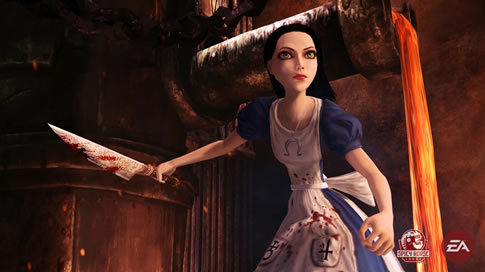
“Alice” is neither a movie nor a TV series.  It glued me in front of the TV nonetheless.  I am a big fan of Alice in Wonderland.  This is a game adaptation.  A second one indeed.  I bought the PS3 version, at a discount.

Recently, I read an article on how game developers dread the review scene.  If a game is poorly reviewed, or even at lukewarm, that turns gamers away from buying it.  Thousands and millions of dollar of investment go into the drain.  Years of development go along with that.  It is a brutal scene.  This game “Alice: Madness Returns” has not been kindly reviewed.  I hesitated during its release, have forgotten about it for a long time, then I saw the rather attractive price tag a few days ago.  I have always enjoyed playing a game as a heroine.  This version of Alice wields a Vorpal sword (you have to ask Lewis Carroll what that is) and lives in a real dark and twisted world.  Despite the lukewarm review, I have decided to give it a try.  This game is not perfect.  I will probably write a more detail account of my adventure with Alice in the future.  However, from what I have experienced so far, I like it.

Categories
Book Reviews Fiction

Memories of My Melancholy Whores By Gabriel García Márquez

This book, I have read twice.  After “My Cousin Rachel“, I wanted to keep up with the soul nourishing reading spree.  I ransacked my book collection, even scanned through the book list according to Harold Bloom’s Western Canon for inspiration.  I have read “Memories of My Melancholy Whores” once, possibly in the year of 2004.  I wish I had started writing book summary or introduction since the day I have started reading.  It is without a doubt one of the top-10-things-to-do-if-I-could-turn-back-time.

Gabriel García Márquez is a Colombian writer who has awarded with Nobel Price in Literature in 1982.  I have always wanted to read his books.  Both “One Hundred Years of Solitude” and “Love in the Time of Cholera” look mightily heavy.  Perhaps one day I will consume them.  For now, I am happy to have read his modern novella, especially since I enjoy reading short story format.

The topic of humanity has a wide reaching coverage.  To that extend, I shall not read this book purely from the angle of morality.  Any mature individual should be able to tackle the material with an open mind.  Those things that you may not approve of in life do not mean that they do not exist.  Nor should they be conveniently ignored.  I do not believe that the writer uses the book to endorse certain objectionable behaviors.  Rather, he uses it to bring out a facet of life that some of us rather not look at.

Because of its mature content, I would not recommend this book to the young adults (nor should you continue reading this post if you are one).  Also, this post may contains spoilers.  In case if you plan to read the book, you may wish to come back later instead.

The narrator of the story is turning ninety.  And he has an idea on what to get for his birthday.

The year I turned ninety, I wanted to give myself the gift of a night of wild love with an adolescent virgin.

This one simple, yet genuine statement kick starts the story, sets the tone of what is to come, and basically tells the book in one line.  Slowly, the author introduces the main character: his near-century long career of being a mediocre columnist, his wedding that he failed to turn up, his stumbling into the scene of prostitution when he was merely twelve, and decades of paid sex without love, without friends.  Why does not he get married?  Why frequent the prostitutes?  To that, his reply is:

Sex is the consolation you have when you can’t have love.

No, that does not justify his action of sleeping with more than five hundreds women by the age of fifty.  Nor it was his intend to boost his conquest.  It is a consolation.  For someone who has lived for decades without someone to love, it sounds melancholy to me.  As a reader, I do not despise the main character.  I sympathy him.

I do not know the era the story sets in.  There is a hint that it may be in the ’60s.  I suppose the era does not matter.  Even in today’s world, underage girls are sold into prostitution (more can be read in CNN’s The Freedom Project).  When this ‘adolescent virgin’ turns out to be a 14 years old girl, part of me frown upon the main character’s moral standard, even though he did not specify his requirement for the virgin’s age.  Part of me, however, is aware that this is a slice of reality.

I woke in the small hours, not remembering where I was.  The girl still slept in a fetal position, her back to me.  I had a vague feeling that I had sensed her getting up in the dark and had heard water running in the bathroom, but it might have been a dream.  This was something new for me.  I was ignorant of the arts of seduction and had always chosen my brides for a night a random, more for their price than their charms, and we had made love without love, half-dressed most of the time and always in the dark so we could imagine ourselves as better than we were.  That night I discovered the improbable pleasure of contemplating the body of a sleeping woman without the urgencies of desire or the obstacles of modesty.

The beauty of Márquez’s work is that he can tell something plain in such a ordinary and neutral way that when read, it is uplifting.  That honesty and so directly to the point, I can’t help but to feel for the main character.  Making love without love and hiding the true forms in the dark.  No, there is no sex between the ninety years old man and the fourteen years old girl.  In fact, for a year, they spend time with him watching her sleeps.  He names the girl Delgadina, in accordance to a Mexican folk song.  I did some research in the Internet.  The folk song tells a story of a young girl whose father proposed a marriage with her.  She refused, was locked up as punishment, and died of thirst.  The song ends with the girl going to Heaven while her father to Hell.  It is in some way fitting to this novella.  The girl is young and her client could be as old as her great grandfather.  It kept me thinking how the story would resolve itself to be.

I cannot find words to describe the relationship between this girl and the old man.  After the first night (of he watching her sleeps), the old man has fallen in love.  Most interactions between these two throughout the book are one directional.  Some are highly imaginary.  Others, I am not too sure.  It is as though this platonic love from him to her is mostly his virtual creation.  Is it how love is born?  Because of this, the old man has changed, starting with the way he writes his columns.  All of a sudden, he is happy.  His new work has gained popularity.  From then on, a twin plot surfaces.  It is a story of celebrating being ninety.  That ‘age isn’t how old you are but how old you feel’.  The main character’s transformation can be best illustrated below.

Thanks to her I confronted my inner self for the first time as my ninetieth year went by.  I discovered that my obsession for having each thing in the right place, each subject at the right time, each word in the right style, was not the well-deserved reward of an ordered mind but just the opposite: a complete system of pretense invented by me to hide the disorder of my nature.  I discovered that I am not disciplined out of virtue but as a reaction to my negligence, that I appear generous in order to conceal my meanness, that I pass myself off as prudent because I am evil-minded, that I am conciliatory in order not to succumb to my repressed rage, that I am punctual only to hide how little I care about other people’s time.  I learned, in short, that love is not a condition of the spirit but a sign of the zodiac.

Another plot is the main character’s recollection of some of the women he encountered in his life.  Each encounter is memorable.  One of them retired from prostitution and was married.  She said to him: Today I look back, I see the line of thousands of men who passed through my beds, and I’d give my soul to have stayed with even the worst of them.

Melancholy.  Isn’t it so?

I found there are quite a few take home messages upon reading “Memories of My Melancholy Whores”.  It is never to late too transform ourselves in a positive manner, as what we always envisage ourselves to be.  Celebrate the present, regardless the physical state we are in.  Love, or rather loving others is the path to happiness.

Categories
Blu-ray / DVD Review

Taylor Swift · World Tour Live · Speak Now – A Must Have!

Everybody loves Taylor Swift.  Even those who have not heard of her before instantly fall in love when I play her concert recording at my home.  Including my 2 years old niece who clapped and danced and looked merry and gay.  The most amazing thing is that Taylor Swift was only 21 when she performed the Speak Now World Tour.  She looks very young on camera.  But she has the maturity and musical ability to pull through 18 songs.  A rather lengthy performance if you take into account of the choreography on various stage settings as well.

The bottom line is, by now, with three solid albums, she has more than enough songs to entertain.  Taylor has won awards, broken records and her success factors beside being very pleasant to look at: she writes good songs and sings them well.  She writes songs that are personal and yet, to her surprise, fans can relate.  She writes songs that are meaningful to the youth without an element of angst that may displease the parents.  She has a clean outlook, unlike some of her peer pop musicians.  Her root, I would say, is country.  That is what I gathered when I heard her first album.  I guess in time, all [popular] things transform into pop.  How powerful it is to sing country songs (that in general are more meaningful) in a pop fashion.

There are so-so artists who stand on the same spot throughout the show performing as though they are recording an album.  And there are artists like Taylor Swift who covers the entire stage and beyond, played different instruments in different arrangements.  She incorporated some cover songs into hers as well.  The performance is stellar.  As for the bonus materials, there is a rehearsal recording and there is also a heartwarming home movie.  My only tiny complain is that unlike the US version, this local version is purely a Blu-ray disc without the CD.  The DVD version though comes with a CD.  But who buys DVD these days when there is a better format out there?

There are not many live recordings I would want to have a repeated watch.  This one, I have already watched twice.

Categories
Book Reviews Fiction

My Cousin Rachel By Daphne Du Maurier – Words Of The ’50s Still Haunt

I normally do not read books that are written before I was born.  I mean, way before I was born.  This book “My Cousin Rachel” was published in 1951.  I cannot even relate to what the world was like back then.  Inside a library, deflated by my return of a book that I was not able to even get through the second chapter, I was looking for one that is nourishing, yet easy to read.  I was attracted by this book’s hardcover design.  Very unique, and elegant.  I flipped to chapter one and immediately, I was hooked.

They used to hang men at Four Turnings in the old days.  Not any more, though.  Now, when a murderer pays the penalty for his crime, he does so up at Bodmin, after fair trial at the Assizes.  That is, if the law convicts him, before his own conscience kills him.  It is better so.  Like a surgical operation.  And the body has decent burial, though a nameless grave.

I was intrigued.  What is going to happen next?  I read on.  Before I realized, I was reading in the library, continued reading at Subway over my lunch, and I read it while waiting for Cynthia to leave the office.  I read it in the evening and in the morning over breakfast.  I could not stop.  It became, briefly, my obsession.

The narrator Philip from Cornwall is 24 years old (or shall I say four-and-twenty like in the novel?) when he inherits his elder cousin Ambrose’s estate and wealth.  Ambrose has died in Italy and at that time, was married to his cousin Rachel (who is half English half Italian).  Did Ambrose really die of brain tumor?  Or was he murdered by his new young wife?  Now that Rachel is heading to England, what is her motive and what will happen when the two meet?

“My Cousin Rachel” is a mystery novel, a masterpiece of its genre.  There are layers upon layers that are built onto the story.  There are hooks within the story that lead you onto seeing the characters from different perspectives.  What if this is true?  What if that is true?  Which one is the truth?  Characters come alive by the hands of Du Maurier.  Philip is young and inexperience, arrogance yet innocent.  Rachel is charming and mysterious, unpredictable and full of mood swing.  Both characters are acting on impulse.  Philip’s actions are rather predictable but Rachel’s not.  Other characters too.  Such as Philip’s wise godfather who is always cautious and selfless, knows where to draw a line and when to step aside.  His godfather’s daughter who has always been a good friend of Philip no matter what.  As well as Philip’s servants.  The characters are alive, even those who are dead.  Such mastery in literature, it is a rare gem I have found in recent days.

The center theme, to me, is about the collision of the two worlds – Philip’s and Rachel’s.  It is jealousy and obsession mixed with delusion and deception.  Because Philip is blinded by his background (he has not been raised or around women in his childhood), his infatuation, and his lack of experience, it is hard for the readers to truly decipher who Rachel is, through a man’s and through such a man’s eyes.  This rift could also be caused by the cultural difference between England and the Continent back in the old days whereby there was a certain expectation on a woman’s role in the society in England.  Should a woman yield to money, gift, and power when it came to her marriage?  Could a woman decide for herself?  After reading the novel once, I must admit that there are still much I am unable to grasp.  I feel as though I am hopelessly charmed by Du Maurier’s writing yet at the same time rendered helpless, wondering what the truth is.  I may never find the answer.  It could as well be a mysterious that Du Maurier has taken to the other world.

Part of this book has invoked a powerful and vivid recollection of my younger days.  I am sure most of you can relate too.  The days when we were young and innocent, thinking that anything is possible.  Days when we could give it all without reservation, just gambling everything away.  Days when we first fell in love, the silly things we thought, said, and did.  The clumpy things we did to the opposite sex.  The misunderstanding.  The make ups and the break ups.  The frustration, the infatuation.  Hope and despair.

On a side note, this version I am reading contains an introduction by Sally Beauman.  It is beautifully written.  If I am to take her words for it, “My Cousin Rachel” could well be Daphne Du Maurier’s best work in her entire career.

The next bit of this entry are some of my favorite quotes that I wish to share.  First, on women whom some men cannot live with, cannot live without.

‘I don’t know what’s come over you,’ she said; ‘you are losing your sense of humour.’  And she patted me on the shoulder and went upstairs.  That was the infuriating thing about a woman.  Always the last word.  Leaving one to grapple with ill-temper, and she herself serene.  A woman, it seemed, was never in the wrong.  Or if she was, she twisted the fault to her advantage, making it seem otherwise.  She would fling these pin-pricks in the air, these hints of moonlight strolls with y godfather, or some other expedition, a visit to Lostwithiel market, and ask me in all seriousness whether she should wear the new bonnet that had come by parcel post from London – the veil had a wider mesh and did not shroud her, and my godfather had told her it became her well.  And when I fell to sulking, saying I did not care whether she concealed her features with a mask, her mood soared to serenity yet higher – the conversation was at dinner on the Monday – and while I sat frowning she carried on her talk with Seecombe, making me seem more sulky than I was.

Perhaps it is a high time to note that literature written in the old days has a foreign touch to it.  Fortunately, this book is highly readable.  I found myself chuckle at times by the unfamiliar usage of words.  I find it charming.

Du Maurier describes the scenery well.  The era of the story is unknown.  There is something magical when reading how she paints the picture with words.  Such enchantment.

In December the first frosts came with the full moon, and then my nights of vigil held a quality harder to bear.  There was a sort of beauty to them, cold and clear, that caught at the heart and made me stare in wonder.  From my windows the long lawns dipped to the meadows, and the meadows to the sea, and all of them were white with frost, and white too under the moon.  The trees that ringed the lawns were black and still.  Rabbits came out and pricked about the grass, then scattered to their burrows; and suddenly, from the hush and stillness, I heard that high sharp bark of a vixen, with the little sob that follows it, eerie, unmistakable, unlike any other call that comes by night, and out of the woods I saw the lean low body creep and run out upon the lawn, and hide again where the trees would cover it.  Later I hard the call again, away from the distance, in the open park, and now the full moon topped the trees and held the sky, and nothing stirred on the lawns beneath my window.

Yet another view of a woman through the eye of the narrative (written by a woman!)  I approve the entire paragraph.

Why, in a sudden, had she changed?  If Ambrose had known little about women, I knew less.  That warmth so unexpected, catching a man unaware and lifting him to rapture, and then swiftly, for no reason, the changing mood, casting him back where he had stood before.  What trail of though, confused and indirect, drove through those minds of theirs, to cloud their judgement?  What waves of impulse swept about their being, moving them to anger and withdrawal, or else to sudden generosity?  We were surely different, with our blunter comprehension, moving more slowly to the compass points, while they, erratic and unstable, were blown about their course by winds of fancy.

This quote is my favorite.  Because it seems so true.

My tutor at Harrow, when teaching in Fifth Form, told us once that truth was something intangible, unseen, which sometimes we stumbled upon and did not recognise, but was found, and held, and understood only by old people near their death, or sometimes by the very pure, the very young.

Categories
J Pop Music Reviews

YUI – How Crazy Your Love

“How Crazy Your Love” is YUI’s fifth studio album.  I am a fan.  Hence you can imagine how painful it was for me to wait till the record hits the store here in Singapore when not too far away, in a place called Hong Kong, the album not only comes with a CD, but also a DVD recording of YUI’s live concert in Hong Kong.  Normally, it takes up to a month for a regional cut Japanese CD to arrive at our stores.  It takes even longer if the album contains video contents.  Having learned my lesson, I ordered online via HMV Hong Kong and have this special edition album (that comes with a YUI printed guitar pick!) delivered.

If you are a fan, the special edition is a must buy.  Her 2011 concert in Hong Kong has a listing of 17 songs plus 5 encores.  That is over 2 hours of entertainment.  Compare to her 2006 “Song of the Sun” concert, she now has more songs and has grown up to be a sweet 24.  Like the previous recording, she plays her guitars on stage.  Shy, she may seem, her live performance has exceeded my expectation.  I cannot wait to see the same concert recorded in Japan.  The DVD is lying somewhere inside my shelf.

It took me a bit of time to like “How Crazy Your Love”.  Perhaps my sensory system has been abused by over-produced music of recent time.  Or perhaps I wanted more rock music from the album or that missing killer slow song.  To be frank, YUI is not a great singer.  But she writes good songs.  So far, her albums are pretty consistent, in terms of style and delivery.  And I am still eagerly awaiting for her next production, which I hope to see later this year.

Back to the album, the more rock flavored “Rain” is my favorite.  The opening track “HELLO” is playful, and it seems to work really well in a live setting.  I also like “Separation”, which is more melody driven especially on the bridge.  I can’t say I love all 13 tracks.  But I can’t find one that I don’t like.  Fans out there.  What are you waiting for?

Categories
Drama Movie Reviews

Margin Call – “It Is Just Money”

Having worked in the financial market industries for quite some years, both Cynthia and I found the movie “Margin Call” pretty realistic.  There are moments in the movies when we chuckled at the rather private jokes (OK, maybe not that private, but we have not worked in other industries for long to be frank).  And there are many moments we can relate, and are emotionally moved.

Subprime crisis is brutal.  It brought many giants down to their knees.  It is also an humbling experience.   However good the time now is and however successful we think we are, there is always an unknown force out there to hit us.  We could blame the investment bankers for the things that they did leading to the subprime crisis.  But ultimately, it is the greed of the nations that escalate the issue.  We want maximum return with the least investment we put in.  And there are people out there who earn big bucks to deliver just that.  I am often puzzled by how we manage to package financial securities into exotic products that even the distributors may not have a thorough idea on what they are, and sell them.  It seems to me that no matter how much we learn from past lessons, no matter how sophisticated our risk management system has become, greed will eventually find a loophole somewhere.  And the cycle will repeat itself.

While “Margin Call” triggers my thought in the above written paragraph, the movie delivers more than that.  For a start, it takes us all the way to the evening before subprime crisis hit the world.  The filmmakers have brought in a panel of talented actors (minus Penn Badgley from my favorite series Gossip Girl) to fill up the key roles.  It is mesmerizing to watch Paul Bettany, Stanley Tucci, Kevin Spacey, Simon Baker, Demi Moore, and Jeremy Irons playing different roles within the firm.  Each has his or her unique perspective to share.  Some lines can be thought provoking.  In fact, the entire movie is thought provoking.  What am I doing with my life?!

Joke aside, today has been a physically demanding day for us.  We woke up early, on our holiday, and took my mother to Ubin Island.  My sister and her husband wanted to join, so we have a 2-year old baby with us too.  In retrospect, I am not sure if Ubin Island is baby-friendly.  We had a good time nonetheless.  I will share the photos with a write-up once I get down to doing it.

Ever since my mother is in town, Cynthia and I have not caught up with our movie partner TK for a movie outing.  So I picked “Margin Call” to celebrate our year end.  It is the 33rd movie Cynthia and I have watched this year.  And yes, I still want to watch “Mission Impossible”, although Cynthia is not that into Tom Cruise no more.

Categories
Book Reviews Fiction

1Q84 By By Haruki Murakami – A Magical Read

1Q84 is the 10th Murakami book that I have read.  There are similarities when compared to The Wind-up Bird Chronicle.  It is divided into three books that span across three consecutive time periods.  Each chapter is named using a phrase found inside that chapter. 1Q84 further explores the concept of free will versus destiny and fate.  Having a page count of 925 covering the topics of cult religion, love and friendship, murder and violence, history and philosophy, 1Q84 is an ambition work of literature.  In addition, 1Q84 opens us to the world of alternative realities and it embeds stories within a story.  George Orwell’s Nineteen Eighty-Four has a theme on Big Brother.  1Q84 – a world that bears a question – switches the theme to Little People.  I took my time in devouring the entire book slowly and I enjoyed every bit of it.  For those who are new to Murakami, he is a Japanese writer and has won literature awards such as Jerusalem Prize.  Milan Kundera and Don DeLillo are among the prize winners whose work I also enjoy reading.  In view of this, perhaps I shall explore that list further in order to expand my reading horizon.

Some readers of my site have asked why I am so into Murakami’s books.  It is hard to describe.  But in the best I can, his unique style works for me.  Murakami tends to spend much effort in building the characters as well as the environment that wraps around the plot.  When writing in the mode of realism, Murakami put much details onto every single elements making them alive and real.  When writing in the mode of surrealism, Murakami describes the unimaginable so well that you feel as though you are sucked into this surreal vision.  The author is meticulous in crafting the plot, down to the very detail that links multiple plots into one.  His works are often filled with mystery that readers have little idea on where the story is heading.  In my limited reading experience, I have not read any book quite like his, in the same quality level.

Book 1 begins with the story of Aomame.  She is inside a taxi stuck in a traffic jam listening to classical music played on the radio.  On one highway, she has decided to get off the taxi, walk down the emergency exit and take a subway.  Before leaving the taxi, the driver says the following.

“It’s just that you’re about to something out of the ordinary … And after you do something like that, everyday look of things might seem to change a little.  Things may look different to you than they did before … But don’t let appearances fool you.  There’s always only one reality.”

That pretty much kicks start the concept of an alternative reality.  And before the author reveals the nature of Aomame’s appointment that cannot be missed, chapter two brings in a new character called Tengo.  He is a mathematics teacher by day and writes literature as his hobby.  He is about to encounter a writing competition submission by a seventeen years old girl.  Her story Air Chrysalis may read like a fantasy but it is slowly shifting into the very reality Tengo lives in.  How are the two main characters going to interact in 1Q84 when they have no such possibility in 1984?  This book by and large follows a structure that toggles the stories between Aomame and Tengo.  Throughout the book, there is this concept of light and shadow, or maza and dohta.  There are enough logos and hooks that make the twin stories connect, and not feeling disjointed.  Murakami varies the timeline too by allows part of the plots to overlap in time.  The result is that although the plots run in different threads, the overall story is not confusing.  Characters may overlaps.  But Murakami is meticulous to distinguish what each character knows in their story line versus what he or she speculates or does not know.  Taking all in, 1Q84 is a magical read.

Readers who are used to the author’s first person writing style may feel a need for a certain adjustment when reading 1Q84.  The twin stories are written from the third person perspective, with main characters’ thoughts written in italic and in a first person style.  It does feel odd in the beginning.  But this works better than some authors who switch the alternate stories in first person style whereby confusion may become a major hindrance to reading.  Among the three books of 1Q84, I would rank book two high in action and entertainment value.  Because of that, book three seems a bit slow.  It feels as though Murakami is trying very hard to control the pace, to impart upon us this sense of anxiety and lost, danger and death – slowly and steadily.  As always, patience readers are rewarded accordingly.  I don’t see a need to rush through the plots.  There is a reason and time for everything in life.

I would say 1Q84 is perhaps Murakami’s most polished work to date.  The hard copy design is beautiful.  On the front cover, there is a picture of a woman and at the back, a man.  On alternate pages, the page number and the book title is reversely printed.  Even the inlaid pictures of the moons are reversed comparing the ones in front and the ones at the back.  After finished reading the book, I cannot think of a better art design than this.  I have read 1Q84 in English and I am looking forward to reading the same story in Chinese.  I could be wrong to think that the Chinese version may be closer to the original Japanese version.  But I am keen to see the difference between the two – English translation versus Chinese translation.

Similar to my previous book summary entries, I am going to share some of the favorite quotes I found in the book.  I am often careful in not giving out too much spoilers.  If you intend to read the book, you may stop here and return to see if these are your favorite quotes too.

A while back, my friend and I had a lengthy discussion on practice versus talent.  On page 65, Murakami talks about talents versus instinct.

You can have tons of talent, but it won’t necessarily keep you fed.  If you have sharp instincts, though, you’ll never go hungry.

As for the next paragraph, I like the way the author describes the situation when communication breaks down.

[She] fell silent again, but this time it did not seem deliberate.  She simply could not fathom the purpose of his question or what prompted him to ask it.  His question hadn’t landed in any region of her consciousness.  It seemed to have gone beyond the bounds of meaning, sucked into permanent nothingness like a lone planetary exploration rocket that has sailed beyond Pluto.

“Never mind,” he said, giving up. “It’s not important.”  It had been a mistake even to ask [her] such a question.

I do enjoy reading some of the dialogues between two people.  Here is one on a dog.

“How’s Bun?” she asked.

“She’s fine,” [he] answered.  Bun was the female German shepherd that lived in his house, a good-nature dog, and smart, despite a few odd habits.

“Is she still eating her spinach?” [she] asked.

“As much as ever.  And with the price of spinach as high as it’s been, that’s no small expense!”

“I’ve never seen a German shepherd that liked spinach before.”

“She doesn’t know she’s a dog.”

“What does she think she is?”

“Well, she seems to think she’s a special being that transcends classification.”

“Superdog?”

“Maybe so.”

“Which is why she likes spinach?”

“No, that’s another matter.  She just likes spinach.  Has since she was a pup.”

“But maybe that’s where she gets these dangerous thoughts of hers.”

“Maybe so.”

The next paragraph – I believe – is not written by Murakami and is taken from a book called Sakhalin Island by a Russian writer, Anton Chekhov.  I find it a beautiful read.  And its style blends well into the story.

… The roaring sea is cold and colourless in appearance, and the tall grey waves pound upon the sand, as if wishing to say in despair: “Oh God, why did you create us?”  This is the Naibuchi river the convicts can be heard rapping away with axes on the building work, while on the other, far distant, imagined shore, lies America … to the left the capes of Sakhalin are visible in the mist, and to the right are more capes … while all around there is not a single living soul, not a bird, not a fly, and it is beyond comprehension who the waves are roaring for, who listens to them at nights here, what they want, and, finally, who they would roar for when I was gone.  There on the shore one is overcome not by connected, logical thoughts, but by reflections and reveries.  It is a sinister sensation, and yet at the very same time you feel the desire to stand for ever looking at the monotonous movement of the waves and listening to their threatening roar.

How would you write about ‘time’?  Here is the author’s attempt in describing time.  That is a pretty interesting way to observe time and us.

[He] knew that time could become deformed as it moved forward.  Time itself was uniform in composition, but once consumed, it took on a deformed shape.  one period of time might be terribly heavy and long, while another could be light and short.  Occasionally the order of things could be reversed, and in the worst cases order itself could vanish entirely.  Sometimes things that should not be there at all might be added onto time.  By adjusting time this way to suit their own purposes, people probably adjusted the meaning of their existences.  In other words, by add such operations to time, they were able – but just barely – to preserve their own sanity.  Surely, if a person had to accept the time through which he had just passed uniformly in the given order, his nerves could not bear the strain.  Such a life, [he] felt, would be sheer torture.

Through the expansion of the brain, people had acquired the concept of temporality, but they simultaneously learned ways in which  to change and adjust time.  In parallel with their ceaseless consumption of time, people would ceaselessly reproduce time that they had mentally adjusted.

I like the way Murakami describes reality.

… where I’m living is not a storybook world.  It’s the real world, full of gaps and inconsistencies and anticlimaxes.

And here is the most cryptic message of all.  I think that has something to do with beliefs.

If you can’t understand it without an explanation, you can’t understand it with an explanation.

1Q84 has also quoted Karl Jung.  I now recall that quite a few of my favorite books quote Karl Jung.

It is as evil as we are positive … the more desperately we try to be good and wonderful and perfect, the more the Shadow develops a definite will to be black and evil and destructive … The fact is that if one tries beyond one’s capacity to be perfect, the Shadow descends to hell and becomes the devil.  For it is just as sinful from the standpoint of nature and of truth to be above oneself as to be below oneself.

Within the story of 1Q84, Tengo is given a task of ghostwriting a fantasy book written by a seventeen years old girl.  In that story, there are two moons.  Tengo’s editor keeps on telling him that when writing something out of ordinary, more details need to be added so that readers are able to visualize.  But how?  Later on when that story diffuses into the main story, here is Murakami’s take in describing a scene with two moons.  He further infuses this symbolic vision into some of the characters, making this paragraph read more like a prophecy.

No doubt about it: there were two moons.

One was the moon that had always been there, and the other was a far smaller, greenish moon, somewhat lopsided in shape, and much less bright.  It looked like a poor, ugly, distantly related child that had been foisted on the family by unfortunate events and was welcomed by no one.  But it was undeniably there, neither a phantom nor an optical illusion, hanging in space like other heavenly bodies, a solid mass with a clear-cut outline.  Not a plane, not a blimp, not an artificial satellite, not a papier-mâché moon that someone made for fun.  It was without a doubt a chunk of rock, having quietly, stubbornly settled on a position in the night sky, like a punctuation mark placed only after long deliberation or a mole bestowed by destiny.

Here is one on hope and trials.

Wherever there’s hope there’s a trial … Hope, however, is limited, and generally abstract, while there are countless trials, and they tend to be concrete.

I also happen to like how Murakami describes clouds.

The clouds continued to scud off toward the south.  No matter how many were blown away, others appeared to take their place.  There was an inexhaustible source of clouds in some land far to the north.  Decisive people, minds fixed on the task, clothes in thick, gray uniforms, working silently from morning to night to make clouds, like bees make honey, spiders make webs, and war makes widows.

Finally, a quote by Tolstoy, another Russian writer.

All happiness is alike, but each pain is painful in its own way.