Categories
Book Reviews Non-Fiction

The Last Lecture by Randy Pausch – A Lecture from the Heart to Whom He Loves

Given Randy Pausch’s medical condition, it is astonishing that he is able to publish a book (with the help of Jeffrey Zaslow).  Randy delivered the now famous “Last Lecture” last September when he was told to have only a few months to live.  A while back, I wrote a brief summary on his “Last Lecture” and if you like what you read, this little book (206 pages, 61 chapters, paperback) will certainly inspire.

In my previous blog entry, I have covered Randy Pausch’s background, his positive outlook, and how inspiring he is.  Hence, I won’t repeat myself here.  The objective of the book is exactly the same as the objective of his lecture as seen in the video linked in my last entry.

“The Last Lecture” is organized in six sections and it is far from being a depressing book to read.  In the first section, Randy Pausch touches onto his medical condition, how he and his family is coping with his aggressive cancer treatment, and why he is doing this – the lecture and now this book.

In the second section “Really Achieving Your Childhood Dreams”, Randy shares with us what some of his wild childhood dreams are and how he really went all out to achieve them.  Some he has attained, some he hasn’t.  It is inspiring to read how a goal focused person he is and how he walks the talk of brick walls are there to proof how badly we want things.

The section “Adventures and Lessons Learnt” probably contains the highest dosage of heart warming moments – a section dedicated to his mentor, his love story with his wife Jai, his and his sister’s children.

In one of John C. Maxwell’s seminar I have attended, his vision of the highest order of success is to make others to be more successful.  Here in Randy Pausch’s book, he has devoted a section on how to enable the dreams of others.  This section may cause you to reflect upon the things that you do and the person you think you are.

30 topics are packed in the second last section “It’ About How You Live Your Life” and they are a lot to be absorbed in the first read.  You may become a better person who constantly show gratitude and always tell the truth; you may take on a new attitude towards your job; you may even want to be the ‘first penguin’ who dares to head for the potential ‘glorious failure’.

This entire book is by and large kept to a tone of positivity and optimism.  To keep it real, you will also get to read about the emotional vulnerable side of Randy and his wife Jai.  The short final section “Final Remarks” is probably one that fills with heartfelt moments and to remind us that there is a bigger picture in life out there, at times beyond us.

I can imagine some readers may find his ideas too hard to achieve.  But here is my observation: You will get to read how he lives what he writes and from within his book, how the people around him succeed in doing so.  My question is: If other can, why can’t you?  The journey to achieving your dream is not going to be easy.  That’s why we have to work hard for it.

Related blog entry: Last Lecture of Randy Pausch – How to Live Your Life

Categories
Book Reviews Non-Fiction

Marketing Metaphoria by Gerald Zaltman and Linsay Zaltman – A Book for the Marketers and More

I beat the book by arriving at the conclusion that “Marketing Metaphoria” has a much wider application way before I’ve reached the final chapter.  Marketers who wish to reveal the minds of the consumers will certainly find this book useful (Which marketer doesn’t wish that?).  Even if you don’t work directly in the line of marketing, you may benefit from being aware of the key deep metaphors that exist in almost every aspect of our lives.  The book quotes a few case studies in the final chapter to illustrate just that.  I will add one potential application out of my own experience later in this review.

In your line of work, you may at some point in time need to solicit opinions like some of my previous projects – be it as a survey that your team has developed for a market research project or a set of probing questions prepared for a focus group discussion.  The question remains: How do you know if the responses to these questions reveal what the sample audience really think and not what you deem important?  To add an extra level of challenge, your sample audience may not really mean what they say.  How can then you go beyond the metaphors appear at the surface (from what they say) and reveal something deep from within (of what they think)?

This book “Marketing Metaphoria” is a crystallization of hundreds of market research projects across more than thirty countries and it has a simple structure.  The first two chapters build a business case on why recognizing deep metaphors is important.  The subsequent seven chapters are dedicated to the seven key deep metaphors that are common to us.  And the final chapter puts all these metaphors at work through real life examples that go beyond marketing.  Due to the difference in the authors’ background, each chapter has a good mix of academic theories as well as real life case studies.  In a sense, the theories do not appear dry and they do reinforce and substantiate the examples quoted.

Before I get into the how, let’s take a quick look at what deep metaphors are.

Deep metaphors, simply put, are unconscious viewing lenses that structure what we think, hear, say, and do.  And the authors Gerald and Linsay Zaltman created the term Metaphoria that refers to ‘a place where our basic views of the world are formed’.  It is because metaphors transcend our nationality, ethnicity, language, and other differences we may have, understanding how to reveal individual deep metaphors can be a powerful tool.  Applying this skill to marketing, for instance, can help the managers in the areas of market segmentation, advertising, product design, new product ideas, and product positioning.

In the book, the authors present seven deep metaphors that account for about 70% of the cases they have encountered.  These metaphors are: balance, transformation, journey, container, connection, resource, and control.  I won’t describe these metaphors in details.  Instead, I have placed a link at the end of this review for further reading.  What I’ll do here is to give you an illustration on, say, the container deep metaphor.

When we think of containers, we may think of two functions: keeping things in and keeping things out, and they are pervasive.  Believe it or not, this metaphor is deeply rooted in us.  Think ‘from womb to tomb’, we travel from one container to another.  I wonder if anyone can remember one of the old advertisements from Coke (here is the YouTube video).  The theme was “have a Coke and a smile”.  Back then, Coke was described as ‘a container of positive emotions that flow into yet another container’.

How about freedom from a repressive container?  If you take a look at the image on the right taken from the Harley-Davidson website, a lone motorcyclist on an open road invokes the unique American symbol for freedom.  The motorcycle dissolves restrictive containers in life granting its rider the ability to express freely.

“Marketing Metaphoria” addresses each key deep metaphor in a similar fashion: highlighting the various facets on both the application of the positive and the negative sides of the deep metaphor supported by theories, illustrated by examples.

I must admit that this book does not elaborate too much on how to reveal the deep metaphors from the sample audience.  It does mention one technique of asking the participants of the market research to bring along eight images that they think are relevant to the topic.  The interviewer will on the spot scan in the images and create a single picture using an image editing software as the participants talk through it.  Deep metaphors are identified this way.  Perhaps it is the same technique that they have been doing for these hundreds of market research projects.  “Marketing Metaphoria” does not necessarily replace the existing methodology you have already been practicing, in my opinion; it does equipe you with the essential tools to formulate the questions and interpret the responses from the sample audience.

This book, though is an easy read on its own, may require much effort to internalize and apply to your line of work.  Those who are already in the fields of marketing or cognitive science may find it a breeze to read.  In a mere 256 pages (hardcover), it is packed with lots of valuable ideas covering a wide spectrum of industries.  These ideas, I can imagine, are good for those who have a passion to understand what the consumers or sample audience want in a deeper level rather than asking the questions that they deem important.

The last bit of this review is really what I can personally apply based on the new ideas I have acquired from this book.  From my more than a decade of experience in both external and internal consulting work, I often am involved in projects that bring forth change to the organization.  The context is not important here – be it as technology, process, strategy, or others – what is important is: I am here to change the way you work whether you like it or not.

The reality is, seldom people like change.  So project usually puts in a change management piece of work that includes a communication plan amongst others to help transitioning the affected parties into the new way of working.  The number one question from the potentially unhappy crowd would be: How does this going to benefit me?

That’s where internal (or external if you are the hired consultant) project branding and marketing comes into the picture.  Some organizations create project logos, posters, and so on to communicate the change.  The challenge is usually what kind of common message would resonance with the people on the ground who will be affected.

The best time to answer this question is in fact going back to the beginning of the project when the people on the ground are interviewed during the requirement or information gathering activity.  Reveal their pain points using deep metaphors and when the time comes (usually at the middle or towards the end of the project depending on the scale of the project), create a common message that the people on the ground can relate.  In fact, by understanding what their pain points are in the forms of deep metaphors at the early stage of the project may even steer the project in a positive way.

In the closing chapter of “Market Metaphoria”, the authors highlight other applications such as resolving political and personal conflicts amongst others using deep metaphors.  Marketers would treasure this book.  I believe the rest would too and be able to relate.  After all, who is not a consumer in our modern world?

Gerald Zaltman is an emeritus professor at the Harvard Business School, and has served on the Advisory Board of Harvard’s “Mind, Brain and Behavior Initiative.” Lindsay Zaltman is managing director at Olson Zaltman Associates. They are the authors of Marketing Metaphoria: What Deep Metaphors Reveal About the Minds of Consumers (Harvard Business Press; May 2008).

ISBN: 978-1-4221-2115-3

Related Link: Seven Giants – Deep Metaphors

Categories
Book Reviews Fiction

Blind Willow, Sleeping Woman by Haruki Murakami – Surreal and Beautifully Written Short Stories

I would be lying to say that I wasn’t stopped by this rather sexy book cover (which later found out that it is rather relevant to the leading story).  But there are plenty of sexy book covers out there to grab attention.  I liked the book title but was not familiar with the author’s name.  I am naturally attracted to foreign writers but shall I invest my time to read an unfamiliar author’s work and to broaden my exposure when my personal reading preference flavors depth than breadth?  I flipped the book open and started reading it, inside a library.

“To put it in the simplest possible terms, I find writing novels a challenge, writing short stories a joy.  If writing novels is like planting a forest, then writing short stories is more like planting a garden.  The two processes complement each other, creating a complete landscape that I treasure.  The green foliage of the trees casts a pleasant shade over the earth, and the wind rustles the leaves, which are sometimes dyed a brilliant gold.  Meanwhile, in the garden, buds appear on flowers, and colourful petals attract bees and butterflies, reminding us of the subtle transition from one season to the next.” – Haruki Murakami, Blind Willow, Sleeping Woman, vii.

I love to write and I couldn’t agree with him more.  I have attempted to write both novels and short stories and I often find myself torn between the two.  Why?  Haruki Murakami couldn’t have said it better.

I personally enjoy reading short stories; not used to in the beginning but I have grown accustomed to, and now fall in love with.  On that count, I simply cannot, for instance, get enough of Italo Calvino’s work – an Italian author who wrote lots of great short stories.

“Blind Willow, Sleeping Woman” is a collection of short stories written in the period of 1981 to 2005.  And they are translated from Japanese by Philip Gabriel and Jay Rubin.  I can’t really pinpoint a common theme across all these 25 stories (334 pages, hardcover).  All I can say is that Haruki Murakami has a keen sense of observation at the most minute detail.  You can actually see the story as you read it.  And Haruki Murakami’s stories are mostly surreal, at times metaphoric.  I sense that some stories are inspired by certain bizarre news that most people disregard.  Some stories are written using himself as the main character so I gather that these stories relate to people in his real life and are told with a certain dose of imagination.  Some supposedly fictional characters read almost like the author himself with a changed name.  Some fictional characters are, I believe, purely fictional.

In short, there are no ordinary stories when told by Haruki Murakami, even those with plots that do not resolve into any dramatic ending.

Out of these 25 stories, some leave a deeper impression than others.  The four and a half pages long short story “A Perfect Day for Kangaroos”, for instance, is one of my favorites.  The author wrote about a man bringing his girlfriend who wanted to see a baby kangaroo to visit a zoo.  “Man-Eating Cats” started with a piece of news reporting on an old woman who died in her apartment and the hungry cats locked inside had nothing to eat but to feed on the dead body .  The story itself is nothing gross to that extend but a good metaphor that links the main character with an, perhaps, imaginary lover?  The story “Firefly” is a beautiful love story of perpetual waiting while “Chance Traveller” is an emotional story between the two estranged siblings.  “The Kidney-Shaped Stone That Moves Every Day” is a carefully crafted story that is told within a story and the last chapter “A Shinagawa Monkey” exposes our very own psychological subconciousness and identity with the help of a … talking monkey that steals name tags.

The opening chapter “Blind Willows, Sleeping Woman” may as well be a representative piece of work from the book with the same title – a statement of what Haruki Murakami’s unique style is all about, at least for this book.

Certainly, I intend to follow the rabbit hole and dig deep into what Haruki Murakami has to offer.  To end this review, I found this rather interesting dialogue between the main character – an author – and a subject of his affection.

“Writers don’t have any talents to offer.  A pianist could play you a tune.  A painter could draw you a sketch.  A magician could perform a trick or two.  There’s not much a writer can do.” – Haruki Murakami, Blind Willow, Sleeping Woman, 293.

Categories
Book Reviews Fiction

Paulo Coelho – Brida – Witchcraft, Bridging the Visible and the Invisible

OK.  Seldom do I need to finish reading a book, write a review, and return it to the library before midnight.  This is going to be an interesting experience.  Usually after I arrive at the last page of a book, I would revisit all the pages I noted that are pivoting to the development of the story for completeness’s sake.  Speed blogging at its best without compromise!

It is interesting that only in year 2008 the English translation of “Brida” is published.  The original version (written in Portuguese I presume) was published in 1990 sandwiched between Paulo Coelho’s two classics “The Alchemist” (1988) and “The Valkyries” (1991).  “Brida” lacks the inspirational impact these two classics have and it also lacks an engaging storyline as compares to some of his recent works, in my opinion.

His recent work “The Witch Of Portobello” (2006) paints the journey of the witch Athena loosely based upon Jung’s four stages of individual progression: Persona, Shadow, Soul, and Wise Old Man or Great Mother.  As for “Brida”, the author takes a deeper look into witchcraft – the four ways a woman can communicate with the Universe through reincarnation: the virgin, the saint, the martyr, and the witch.

To bridge the visible and the invisible is magic.  And how do some manage to get there?  According to the book, there are two traditions: the Sun (for wizards) and the Moon (for witches).  Strange concept, isn’t it?  There are more to it.  Paulo Coelho links the nine gifts that these two traditions took care with St. Paul’s first epistle to the Corinthians.  For those who are familiar with the Bible, these nine gifts should not be foreign to you: the word of wisdom, the word of knowledge, faith, healing, the working of miracles, prophecy, the discerning of the spirits, speaking in tongues, and the interpretation of tongues.

The book has some strange linkages to the Virgin Mary, Jesus, and the Catholics.  You may know that at one point in time, witches were burned by the Christians.  In fact, the rituals – described by the author in a separate warning note as the practices of the Tradition of the Moon for centuries – are somewhat related to the hardship that the witchcraft has lived through.  From within the story, Catharism (a Christian religious sect with dualistic and gnostic elements) is mentioned and because there is a linkage to historical events, it makes me wonder how much is factual.  Perhaps, some people do able to alter their state of consciousness and observe auras.  Looking at today’s world, there are people who claim to be able to do that.  There are even machines that can take pictures of our auras.

Bizarre surreal tradition of witchcraft and to some extend wizardry aside, “Brida” is loaded with fragmented inspirational messages.  Check this out.  How many of are you (like me) constantly trying to find a right path in life – be it as love, career, or anything in general?  Sometimes we set off down a path because we don’t believe in it.  And it is so easy to prove that it isn’t the right one.  But when things start to happen and the path does reveal itself to us, what do we do?  We become afraid of carrying on.  So true.  And why do we experience disappointment, defeat, and despair at times?  Well, according to the author, they are the tools God uses to show us the way and to encourage us to have the courage to make mistakes, to risk failure and disillusion, and basically prompting us to keep searching, keep looking.

Some of the concepts – though are not new to me – do make me stop and think.  If I want to find out about something, what shall I do?  Plunge straight in!  I know it is so obvious but more often than not, I avoid taking the plunge and instead, procrastinate just for another day, and another.  How about doubts that I have, doubts that get constantly generated off my head?  Maybe I doubt if I am good enough to do this or that.  Maybe I doubt if this or that will happen.  According to the author, the moment we stop doubting is the moment we stop moving forward.  And I often think that – in contrary to the book – changing on the outside is easier than changing on the inside.  Come to think of it, I don’t think the way I am perceived externally have changed much over the years (still the shirt and tie at work and blue jeans after all).  But I have changed the way I perceive the world and the people around me from within much over the same period.  My favorite message?  Finding one important thing in life doesn’t mean that I have to give up all the other important things.

So true.

Go back to “Brida”, the book has devoted much of its content in the sexual union between a man and a woman.  In its own words, “when male knowledge joins with female transformation, then the real magical union is created, and its name is Wisdom”.  For the conservative minds, the idea of experiencing communion with God by opening all the five senses during sexual union could be hard to accept.  To that end, instead of hearing my interpretation, here is an excerpt.

“Because anyone who comes into contact with sex knows that they’re dealing with something which only happens in all its intensity when they lose control.  When we’re in bed with someone, we’re giving permission to that person not only to commune with our body, but with our whole being.  The pure forces of life are in communication with each other, independently of us, and then we cannot hide who we are.” – Paulo Coelho, Brida, 128.

So, is “Brida” a must-read?  I think if you are new to Paulo Coelho, you may wish to start with some of his other classics.  For the fans, I guess we just have to read it right?  I am not sure why Cynthia loves “Brida” better than “The Witch Of Portobello” …

Wait, “Brida” is also a book about a love so strong but yet cannot be possessed.  Could it be …

To end this entry, let me share with you two memorable quotes from the book.

Nothing in the world is ever completely wrong … even a stopped clock is right twice a day.

And by an English poet William Blake.

What is now proved was once only imagin’d.

PS. I made it before midnight!  Time now is 11.20pm and I am heading to the library to return the book.

Categories
Book Reviews Fiction

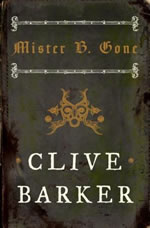
Clive Barker – Mister B. Gone – How Open Is Your Open Mind? Can You Read A Book Backward?

Whether or not you will find “Mister B. Gone” rewarding hinges on whether or not you “get it“.  Since I am a responsible netizen, I am going to self-censor this entry with a NC-16 rating due to my personal views on homosexuality and religion.  Besides, why would we wish to expose readers younger than 16 years old to a book full of grotesque and evilness?

But I got it so I find “Mister B. Gone” not entertaining, not pleasant, but a rewarding read.  I am going to tell you what it is in just a bit without giving out spoilers that may affect your reading pleasure – that is if you still decide to read this book after you are through with this review.

Many people think that Stephen King is a master of horror stories.  Stephen King’s stories are not scary, the earlier work of Clive Barker are.  I have read all his 9 fictions up to “Everville”, which is where all the good stuffs stop.  I have read some of his recent works and they are not as inspiring.

I often find Clive Barker’s ideas original.  “The Thief of Always”, for instance, is a rather short story on someone stealing the “always” from the kids.  Imagine, things that “always” happen do not happen anymore.  How cool the idea is that?  I also like “The Great and Secret Show” and its sequel “Everville”.  I have even endured the close to 900 pages “Imajica” and loved it.

So, how do I find “Mister B. Gone” (year 2007, 256 pages, hardcover), a story of a demon who finds himself fished out of Hell and now walks the Earth?

It is known to the world that the author lives with his partner David Armstrong.  And to that end, I didn’t know what to feel when I discovered that the main character is perhaps a gay demon.  OK, it was not explicitly mentioned that the demon is gay but he is emotionally in love with another guy.  Bottom line is, for sure I can’t relate.  But I suspect another group of readers may be able to.

“Mister B. Gone” also makes reference to the Christian Gospel, the Vatican, the Pope, and the Archbishops and cast them into less than positive light.  Again, it is a formula that has been tried and used millions of times and the idea of a battle between the Angels and Devils is also not new.  At times I wonder what would an alternative reality be if someone replaces these ingredients with the Quran, the Ulama, and the Imam and writes the same storybook?  I think of Salman Rushdie (the book “The Satanic Verses”) and Geert Wilders (the short film “Fitna”).  And why does the Christian world so tolerance towards such a blaspheme?

Freedom of speech, I got it (though not totally agree with it).

Nothing is pretty inside “Mister B. Gone”.  Nothing pretty survives inside “Mister B. Gone”.  It is not a horror fiction.  It is more like a fiction of grotesque.  And it is written in such a strange way that this (gay) demon supposes to keep talking to you (as a reader) and begs you to burn the book.  He even threatens you, insults you, and makes you feel very uncomfortable to continue reading the book.  And why would anyone wish to continue reading a book that even the main character is far from lovable – an ugly, mutilated, evil albeit intelligence demon committing grievous crimes that make the World War II atrocities look mild?  Granted that the human counterparts within the plot are not doing things that we are proud of either.  But I wouldn’t philosophically read too much into that.

Enough of suspense.  So, what is it?  If you are observant enough, it may occur to you that the book is created backward based on one random sentence one character says.  I suspected that after I have spotted that tiny sentence and all of a sudden, the title of the book makes so much sense when you tie it back to the ending (at first I thought it was due to “Mister B. Be Gone”, which also makes sense as that line is taken from somewhere in the book).  Usually the author’s note of acknowledgement is at the beginning of the book right?  Guess where this note is?  And I often wonder why the author keeps repeating the key events of the story that happen in the past.  Now, I think if I read the book backward, section by section, I may still be able to follow the flow of events.

Isn’t that brilliant?  A book version of the Eagle’s song “Hotel California” (rumor has it that when played backward, there is a hidden message). 

To be frank, the last 6 pages of the book is very rewarding.  It does change your perception of the story in a big way provided that you can withstand 250 pages worth of torture – a torture not because the book is badly written, but because it is full of agonies and grotesque in graphical details, insults and verbal abuse to say the least.

Categories
Book Reviews Fiction

Doris Lessing – The Story Of General Dann And Mara’s Daughter, Griot And The Snow Dog

Doris Lessing - The Story of General Dann and Mara\'s Daughter, Griot and the Snow Dog

By no means I wish to diminish the genius of Doris Lessing, the sequel to the epic novel “Mara and Dann” reads more like an extension than a novel that exists in its own right.  But, any kind of follow on story on where “Mara and Dann” has left off is going to be a piece of good news to the fans – at least to me.

Unlike “Mara and Dann”, “The Story of General Dann and Mara’s Daughter, Griot and the Snow Dog” (year 2005, 282 pages, hardcover) has a totally different emphasis; and that emphasis is certainly not of the civilization progression and the struggle of survival that has been so well covered in “Mara and Dann”.  Like some of Doris Lessing’s previous works, there is a switch of perspective here and the world is now seen through the lens of Dann instead of Mara. 

I won’t cover how the story begins in this review as by doing so will inevitably give away the ending of the prequel.  All I can say is that the story dwells more on human emotion from within rather than a plot driven by quests and events as it was for the prequel.  Some readers may wonder why so much literature is spend on the internal struggle of Dann himself against his the other side and the undying loyalty to General Dann through the eyes and heart of Captain Griot.  To me, feeling seldom changes overnight; perspective seldom changes overnight; we seldom change overnight.  For the patience ones, the reward is the seamless transition of perspectives through different characters and to be able to observe how the characters grow, gradually and realistically.

Added to the main storyline are Mara’s daughter Tamar and a snow dog Ruff.  The snow dog has certainly added a new dimension of the story telling never seen before in “Mara and Dann”.  For the observant ones, I think the brilliance of having a snow dog as the plot unveiled is an attempt to explain and perhaps acts as a redemption to what happens at the beginning of the story.

This story reads like an extension partly because the physical location covered is a lot lesser than its prequel.  Dann’s perpetually yearning for exploration does guide him towards the Ice Cliffs of Yerrup – a part of the world that is new to “Mara and Dann”.  Other than that, the majority of the plot happens in North Ifrik.  And similar to “Mara and Dann”, this sequel does not have a main quest.  For those are hoping and expecting to read a story of how one man can save the world, this is not a story of such kind.  And no, I would not recommend you to read this before its prequel either.

With its open ending, I will not be surprised that there will be another sequel in the making.  Even if there is none, I am happy that the story ends where it is now, more so than how it was ended in “Mara and Dann”.

Related Entries:-

Categories
Book Reviews Non-Fiction

Richard Laermer – 2011 Trendspotting For The Next Decade – A Futuristic Concoction That Aims To Inspire

Richard Laermen's 2011 Trendspotting for the Next Decade

Be it as you want to make sense of what is happening in your life or be inspired as you look ahead into the next decade, futurist Richard Laermer’s new concoction made of personal observations and opinions that are witty, humorous, and enlightening sprinkled with a healthy dose of sarcasm and brutal honesty will certainly make you stop and ponder: now, why didn’t I see it coming?

“2011 Trendspotting for the Next Decade” is not a list of inevitable events that are going to happen.  That – as quoted from the author- is the job of a fortune teller.  Instead, Richard Laermer has created a map that explains and forecasts a range of possible futures in the areas of media, technology, sociology, entertainment, and more.

I want to believe in the author that on January 1, 2011, we will finally wake up rising above the era of mediocrity – an era of us weighed down by the international inertia as we are perpetually waiting for something to happen in this decade.  But such a claim is likely to invoke a certain level of skepticism even for the most susceptible readers.  It is not until I have finished reading all the seventy over topics, attempted to connect all the dots together, then I said to myself: these may well be true.  All these trends may possibly point towards an era that something good is going to happen and I may possibly wake up to a bright new day!

How about a future whereby we say goodbye to short attention span and get more sleep by sleeping less?  A future whereby e-mail is death, office workplace is going to be way better than working from home, and more people will give genuine complements?  Think of what you can do with a paper thin battery.

But not everything is going to change in the year 2011.  TV is here to stay.  Mobile phone will always be our first love regardless of what other new toys we may have.  Our ‘generation broke’ will still be narcissistic (surprise?) and the ‘old people’ will continue to have a role to play in the workplace.

On a lighter side, “2011 Trendspotting for the Next Decade” is packed with entertaining topics ranging from Richard Laermer’s lively remarks on celebrities such as Donald Trump, Ashlee Simpson, Jennifer Lopez, and Britney Spears to his less than pleasant personal encounters with or opinions on the big corporates such as Starbucks, Apple, Frito-Lay, Victoria’s Secret, and Google.  You may even pick up tips on how to be famous and be cool.  At the other end of the spectrum, the book does layout concrete advice on topics such as how to spot trends, what is branding and marketing, and more.

Depending on your social and geographic background, you may connect to the book differently from other fellow readers.  First, the people, organizations, and events mentioned are largely from America.  If you are from the US or very much in tune with the US culture, you should quite readily be able to relate to the contents.  Second, to fully appreciate the book does require the readers to have a keen sense of current affairs including what goes on with the celebrities (you can easily fill up the gaps with the help of the Internet these days).  And third, some of the topics may urge you to self-reflect on something that you may not want to face.

Also, as a business book, the humorously casual writing style that tends to be random at times may not be something you are used to.  However, for the net savvy ones who frequent the blogsphere, you may feel at home.  Don’t expect a structured information download from this book and be prepared to be an active reader – constantly reading, constantly thinking.

Beyond the text, the author often leaves specific website addresses of his own for further reading.  Unfortunately, at the time of this review, none of these links were ready and there was this one-liner standard response at the site that did not say much.  I wrote to Richard Laermer via e-mail.  Within half an hour, he responded with a friendly reply, took my humble suggestion, and edited his web page to be more informative on the situation.  That’s right.  Richard Laermer is reachable, just like what he wrote in his book.

You may become more net savvy after reading this book (like I do); you may be loaded with interesting topics for your next (offline) social gathering; and you may even start to spot the trends based on your daily observation.  As an afterthought, even if only half of what Richard Laermer has mentioned turns into reality in the next decade, the world will still be a better place than today.  And if you become inspired and want to do something with the trends, I think that is what the author is trying to achieve.

“2011: Trendspotting for the Next Decade” by Richard Laermer is published by McGraw-Hill and can be found in all good bookstores.

Categories
Book Reviews Fiction

Mara And Dann By Doris Lessing – An Adventure Of A Sister And A Brother During The Next Ice Age

Mara and Dann by Doris Lessing

Having read a few of the books by the Nobel Price winner in literature, Doris Lessing, I am curious about her another genre that is not popularly accepted by the critics – science fiction.  So I picked up “Mara and Dann” (year 1999, 407 pages) from our National Library.  I have not read all of her thirty over books yet but if the book publisher describes the heroine of this book as “one of Doris Lessing’s most appealing heroines”, I would gladly take their words for it is a nice departure from the rather dark and depressing titles of “The Fifth Child” and its sequel “Ben in the World” whereby the main character is more or less a monster living in our own world.

Perhaps human condition regardless of time is depressing.  Life is hard.  And the saving grace throughout the time continuum is love.  In “Mara and Dann”, the story is set somewhere in the distant future when our Earth is covered in ice – except Ifrik (equivalent to our modern day Africa).  Dotted in this continent Ifrik are civilizations of different progression (stone age, medieval, military, religion, and science), people of different shapes and colors, richness and the poor, and in the diverse race of the Mahondi,  the Rock People, the Hadrons, the Hennes, the Agre, and the Albs, nothing escape the sharp eyes of Mara who is always hunger for knowledge.

Abducted since young, Mara – a Mahondi by birth – began an epic journey traversing Ifrik together with her little brother Dann.  The main plot evolves around Mara with Dann coming in and out of Mara’s journey.  In “Mara and Dann”, you will get to experience Ifrik first hand with Mara.  You may even feel the thirst and hunger of Mara like I do, and the joy and desperation.  You will certainly see how the characters grow as they aged, how their bonding gets stronger as days go by.

What some may see lacking maybe a main quest within the story.  What propel me to continue reading the book, however, was simply: what will Mara see next?  In such, “Mara and Dann” is a different type of page turner perhaps more appealing to those who are drawn to the world of scare resources, slavery, conflicts, racism, and sexism.  My main take home messages are two: (1) we always expect things to remain the way they always do (which they don’t) and (2) we can’t truly understand something unless we experience them.

A timely read as we ourselves are faced with the challenge of climate change, today.

Related Entries:-

Categories
Book Reviews Fiction

Remember Me By Sophie Kinsella – A Calculated Risk That May Or May Not Work For Some

Remember Me by Sophie Kinsella

Fanboi talk aside – as I do have read all eight of her novels – “Remember Me” is an interestingly subtle departure from her time proven success with the Shopaholic formula.  First, let’s recap.  Be it as Becky Bloodwood of the Shopaholic series (5 books), Samantha of “The Undomestic Goddess”, Emma of “Can You Keep A Secret”, or Lexi of “Remember Me”, the author’s heroines have always been an embodiment of someone who is flawed, optimistic, and passionate towards family and friends.  The formula extends beyond the main character herself.  There will be lovers involved, parents, best friends, best friends who are no longer best friends, bosses, and a sister in some cases, and to top it up, Sophie Kinsella’s books are always a fun read that make you laugh-out-loud drawing suspicious glances from people around you.

The bottom line is: does the world need another book from Sophie Kinsella?  For those who worship the Shopaholic series, “Remember Me” may come across as less entertaining.  It has lesser laugh-out-loud moments per page flipped.  For those who find the Shopaholic series too shallow but enjoy reading her standalone novels instead, “Remember Me” may come quite close to “The Undomestic Goddess”, which I still think it is the author’s best work today.

There is a novelty in the idea itself: imagine what would happen if one day you wake up and three years worth of memory has just vanished?  And you wake up with a new job title, a new look, new set of friends, and you realize that you are married to someone who is a stranger to you.  Through the character Lexi, Sophie Kinsella explores the condition of amnesia, and more so than any of her previous works, I think there are a fair bit of planning in order to make the storyline works – set aside the need to have every small details made sense to the readers.  To that, I think Sophie Kinsella has done a great job in delivering a relatively more complex storyline with relatively more character development for those who surround the main character.

“Remember Me” is still a page turner and prompted me in thinking: perhaps all these efforts of upkeeping my own blog site are not too bad an idea just in case one day, touch wood, I bump my head onto something and lose a chunk of memory.

PS. I tried to place a reservation at our National library but I gave up after seeing the queue.  I was close to number 250 with just over twenty books available for lending.  And knowing how long it may take for the paperback to hit the bookstore, I go for the hardcover instead.

Related Entries: Can You Keep A Secret?, On Sophie Kinsella’s Shopaholic & Baby, and Undomestic Goddess – A Good Read

Categories
Book Reviews Fiction

Ben In The World By Doris Lessing – Sympathetic Love And Desperation Mashed Into One

Ben In The World - Doris Lessing

I have written and rewritten this entry so many times that it is no longer funny.  So I shall get straight into the point.  The beauty – which ironically the word beauty is the least appropriate word to describe the story – of “Ben in the World” is that Doris Lessing has created a main character so far fetched from the current reality (a yeti? a primate?), put this hideous being into an imperfect world of greed, abuse, violence, indifference, and desperation (a.k.a. our reality) and you wonder, who or what is more hideous?  The main character, Ben, or the rest of the scumbags?  And because Ben is so out-of-this-world, it gets you curious in finding out who he is and what he is.  But that is not all that “Ben in the World” has to offer.  Just when you thought you have seen it all and let your common sense anticipates how the storyline unfolds, you are vastly disappointed.  The storyline simply defies all expectations, fails to resolve the way you want it to be, and this frustration motivates you to make connection with the main character of the book and you wonder, who is more frustrated?  You or Ben?  And when you finish reading the very last sentence, it suddenly hits you.  It is you whom Doris Lessing is talking to.  It is you who should feel ashamed of being indifference to the less fortunate, physically and mentally challenged ones.

OK, I am ashamed of who I am.

I think what Doris Lessing does is witty.  Through the little actions and conversations of her characters, she invokes metaphors that aid self-reflection.  In “The Fifth Child”, the focal point is onto Ben’s family, especially his mother Harriet.  I must say while I view “The Fifth Child” as a story with a powerful plot that comes down to maternal love, unconditional love, I was greatly curious about what this abnormal child of Harriet really like.  What pleases him?  What does he want in life?  How does he perceive external environment?  Is he evil?  And “Ben in the World” picks up where “The Fifth Child” leaves off.  If the original story is about maternal love, unconditional love, I would say this sequel is about sympathetic love and desperation.

The last sentence of the book still lives vividly in my mind.  Oh God, I want to unread that.  PS. That sentence only makes sense if you read the book.

Related Entries:-