I’ve been thinking about food lately. Not the kind you photograph, recommend, or complain about on Instagram.
Just… ordinary meals—the kind you buy, sit down and quietly finish even when something isn’t quite right.
Over the years, I’ve had a handful of these moments. None of them were dramatic, but for some reason they stayed with me. I think I’m only starting to understand why.
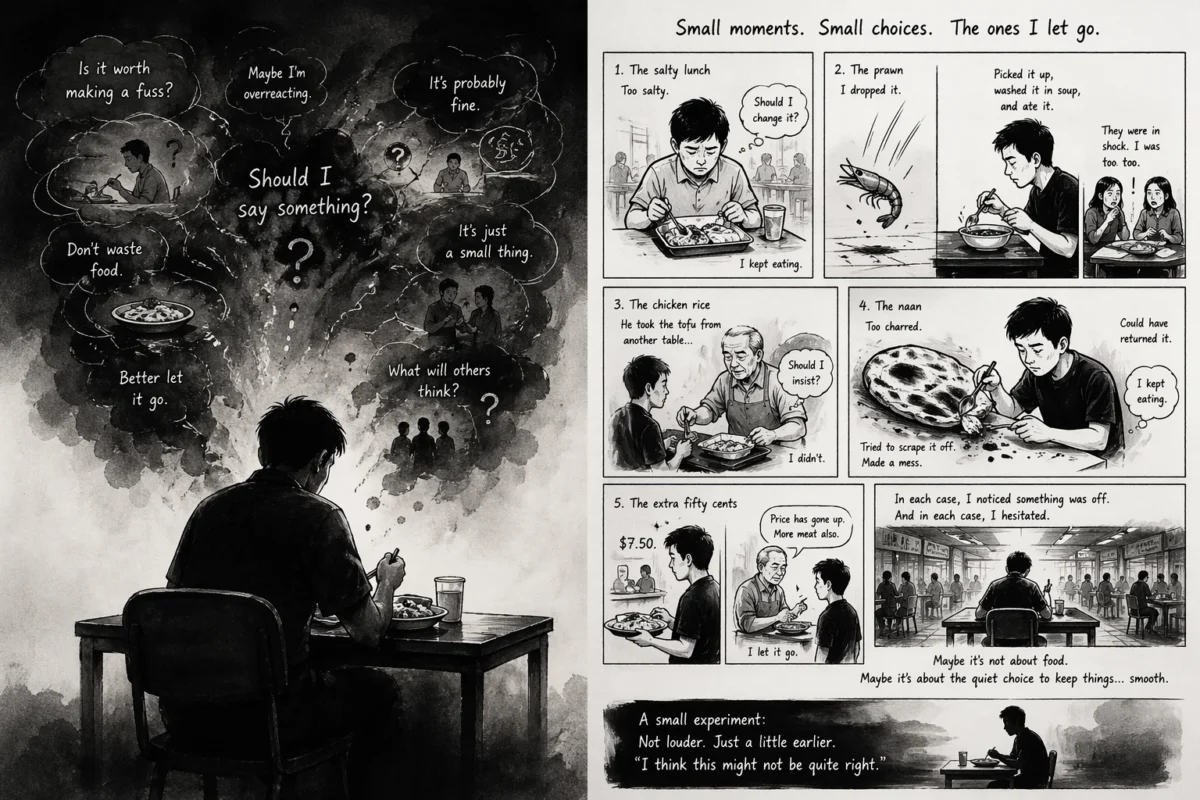
The salty lunch I kept eating
When I was a student in Hong Kong, I used to buy lunch outside school. It came in those foam takeaway boxes—usually a main dish swimming in sauce paired with some form of carbs. One day, I had pork chop with spaghetti in cream sauce.
I remember the first bite: it was unbearably salty—the kind of salty that makes you pause, then try again, then start negotiating with yourself. Was it just this bite? Or the entire box? I must have visibly cringed. An adult nearby noticed and told me I should stop eating and ask for an exchange. It sounded reasonable.
But I didn’t stop. At least, not immediately. I remember continuing for a while, forcing it down as if that was the more natural thing to do.
To this day, I don’t quite know why. If it were a faulty electronic device, I would have no hesitation returning it. But food felt… different: more subjective, harder to prove, easier to endure. Or maybe I simply didn’t trust myself enough to say, “This isn’t right.”
The prawn I shouldn’t have eaten
More than twenty years ago, I was having dinner with two female colleagues at a seafood restaurant. We ordered jumbo prawns. At some point, I dropped one.
What happened next was almost instinctive. I picked it up, rinsed it in my bowl of soup, and continued eating. Only after I looked up did I realise what I had just done. They were in shock, and in that instant I felt something shift—not just embarrassment, but a sudden awareness that I had crossed an invisible line.
To me, at that moment, it was simple: the prawn was expensive; it had a shell; it didn’t feel right to waste it. But clearly I had misread the situation.
I’ve never spoken about this to anyone. Yet somehow, the memory stayed.
The Hainanese chicken rice I quietly accepted
Recently, I ordered chicken rice at a hawker stall. The uncle prepared a plate—chicken breast, braised tofu, egg—and passed it to the gentleman in front of me. Then came my turn. My plate came without the tofu. The uncle walked over to that same table, took the plate back, and with his hands moved the tofu onto my plate.
I hesitated. I did protest gently, that someone might have already started eating. He waved it off, assuring me it was untouched. I could have insisted, but I didn’t. Instead, I told myself it was probably fine—that it would be a waste otherwise.
And I ate it. Quietly.
The naan that became a scene
At Lau Pa Sat, at one of the many independent stalls, I ordered an Indian set meal. It came with two large naan, fresh from a traditional oven. The underside was heavily charred—not the usual blistering, but something thicker, darker.
I took the tray back to my seat anyway. My plan was simple: scrape it off. Except it wasn’t. As I tried to remove the char with a spoon, bits of blackened crust started falling everywhere—onto the table, onto the floor, onto my white shirt. What I thought would be a quiet fix slowly turned into something that drew attention. Unnecessary attention.
At that point, I could still have returned it. Instead, I kept going. And eventually, I ate most of it.
The extra fifty cents
One evening, I bought roasted meat from a hawker stall. $8. Back at my table, as I ate my dinner, I looked up at the signboard. It said $7.50.
As I finished my dinner and was about to leave, I went back. The uncle explained that prices had gone up and that he had given me more meat anyway. It didn’t fully make sense, but I nodded, accepted it, and left.
I could have insisted on a refund. But I didn’t.
I haven’t been back since.
So what’s going on here?
Individually, these moments feel trivial—a salty meal, a dropped prawn, some burnt bread, fifty cents. But together, they form a pattern I can’t ignore.
In each case, I noticed something was off. And in each case, I hesitated—not because I didn’t know, but because I wasn’t sure if it was worth saying.
Maybe it’s not about food
Looking back, I don’t think this is about taste, hygiene, or even money. It feels more like a quiet instinct to keep things… smooth, not to inconvenience others, not to create awkwardness, not to turn a small issue into a bigger one.
So instead, I adjust. I rationalise. I accept. I move on. Most of the time, it works—until it doesn’t, and the moment stays with me longer than it should.
A small experiment
Lately, I’ve been trying something different. Nothing dramatic—just acting a little earlier, before the internal negotiation begins. A simple sentence, said calmly: “I think this might not be quite right.”
No accusation. No escalation. Just… finishing the interaction properly.
Final thought
I don’t think I’ll ever completely lose that instinct to avoid friction. And maybe I shouldn’t. It has served me well in many ways.
Perhaps it’s not about becoming more confrontational—
just a little more willing to trust that noticing something is already enough.