Categories
My Hobbies Oil Painting

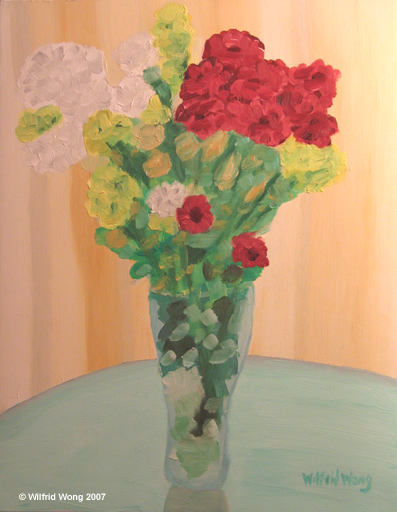
My 6th Oil Painting – 2 Dollar Flowers

Click to view a larger image

Last week, I have painted probably one of the most expensive oil painting to date. You will see why. Click on the thumbnail to view a larger image and click here to view the real life composition.

So far, I have painted vegetables and fruits, sky and reservoir, teddy bear and human face, I have yet to try painting flowers. How difficult it was for me to paint flowers! There are just so much detail with the petals and stems, leaves and water.

This time, I calibrated both my viewfinder and the board that holds the oil painting tablet into a 8×8 grid so that I can replicate the composition as faithful to the reality as possible based on the coordinates of the objects. In layman’s term, it is much easier for me to paint the objects in the same way I see them through the viewfinder – for novice like myself in especially. It took me 45 minutes just to sketch the composition (which I am happy about). I made lots of mistake this time ended up have to scrap the oils time after time. I wanted to give up halfway because I did not have a clue on how to model the yellow and white flowers and how to fill in the gaps in between the stems.

Anyway, I managed to finish the painting. It is expensive because first, I paid two dollar for the flowers that cannot be consumed like vegetables and fruits. Cynthia looked at the bunch of flower over our meal and commented that they don’t look good nor smell nice. Well, it is no roses I suppose. Second, I have wasted a lot of paint on this and probably have to stock up more paints soon. Took me 4 hours to finish the painting. I wonder how much time I would spend on a canvas that is 4 times bigger.

Click here for my oil painting “gallery”.

Categories
Drama Movie Reviews

Letters From Iwo Jima – Almost Perfect

By now, you must have thought that I am someone who gets overly excited easily because of all the generous reviews be it as books, movies, music albums, or even DVDs. Truth is, if the product is not potentially good, I wouldn’t pay for it. Since I only write reviews on products that I buy, naturally they are already in my good book. As for Golden Globe Award Winner for Best Foreign Film – “Letters From Iwo Jima”, I do have my 2-cent worth of criticism though.

I picked “Letters From Iwo Jima”, together with the rest of my Movie Review Squad, because we have been anticipating this movie since we watched “Flags Of Our Fathers” (see previous blog) back in mid December last year. So, let me be upfront here. My only two complains of this movie are (1) it is a long slow moving show and (2) for a war that 20,000 Japanese troops have perished, it certainly does not look like there are that many Japanese in the show (compares to the fleet size of the American troops in “Flags Of Our Fathers”).

“Letters From Iwo Jima” has quite a number of interesting points that should not be missed. First, I have not seen anyone who directs two separate movies based on the same scenario and have the story told in two different perspectives. Clint Eastwood is the director of both “Flags Of Our Fathers” and “Letters From Iwo Jima”. Second, I seldom get to watch a war movie being told from the Japanese perspective. I have watched many war movies told from the Western perspective, even from the German’s perspective. But from the Japanese perspective acted by the Japanese? It is kind of rare. I have learnt quite a few things new about the Japanese from the movies itself which is refreshing. Third, there is so much humanity being put into the show that I felt bad just to watch what the Japanese has to go through.

Now, back to my two complains. It is a long slow moving show because the movies portrays a losing war. I mean, whatever they do, however smart and humane the Commander-in-chief is, they are going to lose the war. The first explosion happens 45 minutes into this 2 hours long show so you can imagine it is a different kind of war movie. Watching a losing war is like watching “Apollo 13” – a doomed to fail mission (“Apollo 13” is equally boring to me). And we don’t get to see that many Japanese probably because the story is reconstructed from the letters found inside the Japanese caves and I think the focus of the story is on some of the key characters.

I am a fan of Ken Watanabe (“The Last Samurai” and “Memoirs of a Geisha”) who plays the role of General Tadamichi Kuribayashi in “Letters From Iwo Jima” well. That is probably another good point coming from this long slow moving show.

Categories
I See I Write

Driving In Melbourne, Singapore Driving Behavior, And Others

I remember in one of the case studies as illustrated by Melcolm Gladwell’s The Tipping Point: How Little Things Can Make a Big Difference, we human beings are sensitive to the environment around us without us consciously thinking about it. Take a mad driver like me in Singapore and put me in Melbourne, I am a changed man. Drivers in around Melbourne do stick to the speed limit and I must admit it is a pleasant experience because most people are sticking by the rule. No aggressive drivers like we do in Singapore.

When I rented my small car from Metrocar second day into my Melbourne trip, I had a nice chat with the salesman. And in especially I wanted to know how traffic laws are enforced in Australia. I do that all the time wherever I go. For instance, in Malaysia, 110 km/hr is the highway speed limit. 120 km/hr is how much you can safely reach with a low possibility of getting fined. Anything above 120 you will have to exercise common sense like watch out for policemen hiding underneath the opposite pillar of an overhead bridge (i.e. slow down when approaching one), watch out for policemen lying flat on the ground on either side of the highway (this one is hard, be prepared to jam brake), watch out for policemen hiding around the road construction area (because drivers are usually distracted by the mess around the roadwork area and for me, I usually slow down), watch out for flashing headlights from the cars of the opposite direction (road block ahead). Knowing the time of the month when the policemen need to meet a certain speeding ticket quota helps too. Of course there are other things to watch out for such as holiday period, timing of the day, concentration of Singaporean drivers (yes, they love to fine us), and so on.

Driving in Mauritius is totally insane. You can basically get away with any kind of speed during morning rush hours. A local once told me that the authority usually keeps a closed eye because having the traffic to move faster in the morning rush hours is not necessarily a bad thing. The only thing to watch out for is late at night when you can see the policemen mounted on their shiny motorcycle ready to catch you speed away.

Singapore is an interesting place. The mechanism is based upon deterrence and the aim is to keep the accident rate in tap. Speed cameras are deployed on major highways and there are tons of road signs to remind us of the speed cameras miles ahead. The traffic police has this mobile speed camera that somewhat looks like a video camcorder. These traffic policemen with their white and shiny uniforms under the sun are either standing on an overhead bridge that is hard to miss or they are along the side of the highway with a shiny motorcycle or a shiny Subaru WRX parked next to them. At night, they will turn on all the lights of their Subaru WRX – of white, yellow, and blue – and you must be pretty drunk to even miss this blinking Christmas tree on your left. And if you talk to any taxi driver, they know all the exact locations where the traffic police try to hide and give us the drivers a surprise. So with all said, some Singaporean drivers (knowing that our government does scan our blogs) pay more attention to the “road conditions” other than speed limit road signs.

Within the state of Victoria, however, is a different story. They have hidden radars all over the place (even the speed limit around the road work areas are enforced). According to this dude from Metrocar, the state of Victoria receives AUD 300 million odd a week from fines. Those radars are capable of knowing if you have been speeding in a stretch of 5 or so km. I guess how it works is that once you enter a slower limit zone, you have the next couple of kilometers (or less) to slow down. The pattern is similar. When you are in no man land, you can go by 100 km per hour. Once you approach town, you are asked to slow down to 80 then 60, and if the city is pretty big, to 50 and 40. Once you leave town, you can increase your speed from 40 to 50 to 60 to 80 to 100. It can be pretty stressed up at times as I did from time to time forget if the speed limit has changed – especially when I turned into a scenic lookout location and when I was back in the main street, I usually turned to my navigator for advice on speed. More likely or not, none of us could remember what the speed limit was.

Highways in and around Melbourne are mostly toll free. Locals have a device in their cars that enable them to pass through the toll and have their accounts deducted (or it is like a monthly fee, I am not sure). For travellers like me, if you pass the toll, you have to visit a post office (or a 7-eleven) within 24 hours to declare that you have utilised which stretch of highway and pay for the toll. If you are unsure, it is not possible for you to enquire if there is a need for you to pay because your record will only be in the computer system 3 working days after you pass the toll without a valid device. By then, it will be too late. Failed to declare will result in AUD 100 fine as well as an administration charge of AUD 55 by your car rental company. If you think Singapore is a “fine” country, think twice.
Categories
Book Reviews Non-Fiction

The Medici Effect – An Answer to Innovation

Named after the banking family in Florence, Medicis, who funded creators from a wide range of disciplines and together, they forged a new world based on new ideas – the Renaissance, “The Medici Effect” explores what the best chance to innovate is, how to create the Medici Effect, and how to make these new ideas happen. It is by far one of the most engaging non-fictions I have read. I seldom use “page turner” to describe a non-fiction and “The Medici Effect” is one. I finished reading the book on my way travelling from Singapore to Melbourne.

I can certainly relate to the book’s content. I have worked as a consultant in two of the biggest global firms and on one end of the spectrum, we put consultants of different disciplines – not only that but to exploit the strength of it, different cultural and social backgrounds, different experiences, and I have witnessed the explosion of creative ideas being realised. On the other end of the spectrum, I have seen a homogeneous group of consultants – even the subtle differences were not exploited – being put under a straight hierarchical order and focus is less on innovation. The key difference is one of these two global firms actively assembles a team of people with a wide range of disciplines and backgrounds and to provide them with an environment to innovate. How about at an individual level? Many creative ideas are realised by mainly one person. As an individual, it is how we broaden our horizon, having a core skill and proactively expand into different domains – doesn’t matter if they are related at all, and to be able to view the world in various perspectives that put us right at the “Intersection” where our best chance to create the Medici Effect is.

“The Medici Effect” has numerous citations (52 in total) from other famous non-fictions and sources and it is packed with entertaining and inspiring case studies. In “The Medici Effect”, the author pointed out that the quality of work has a direct correlation to the quantity of work. That is to say, the more we create, the better chance we are to create something good. However, having created a masterpiece does not mean that the next masterpiece is guaranteed. There is always an element of randomness. That is why some famous businessmen at times made the worst business decision, some great musicians release albums that may disappoint fans, and even great painters do have their bad days. The author continues to write about how to overcome some of these challenges.

By the way, I have come across a wonderful definition on creativity and innovation. Being creative is to be able to generate original ideas. New ideas that no one has thought about. To innovate is to be able to realise those creative ideas. That, is the difference.

Categories
My Hobbies Oil Painting

My 5th Oil Painting – Intensity, A Self-Portrait (2007)

Click at your own risk!

I have a mixed feeling on this self-portrait oil painting and it is edging towards the borderline of disaster (click on thumbnail to view a larger image at your own risk). Perhaps I am not used to looking at my own image, having this somewhat intense guy who somewhat looks like me with a face larger than me staring back at me … it is sort of scary. When Cynthia returned from work and discovered my new oil painting, she couldn’t stop laughing. I reckon she knows my face better than I do (duh!) and she kept on asking how come this and how come that. I have to drag her into the bathroom and post “that look” to her. To demonstrate how I got “that look”, I positioned my shoulders 45 degrees relative to the mirror, I turned my head at a 30 degrees relative to my shoulders while my eyes looked straight ahead. Still, the questions of “how come” did not subside.

While the result could be disastrous, it was my intend to create a pair of eyes that captivate attention, lips that are redder than normal for contrast, and an overall texture of ruggedness. For that, I think I have achieved what I wanted. Hopefully my next self-portrait will be better.

To paint this self-portrait image, I have to turn my tiny bathroom into a painting studio because that is the only place in my home that has a huge mirror with 3 spot lights over my head. The easel was mounted right on top of the closed toilet bowl with a jar of turpentine to wash my brushes resting on top of the bowl’s lid. The paint tubes were lined up carefully along the side of the bathtub. The smell of the oils can be overwhelming at times because there was hardly any air circulation inside.

An excerpt of our conversation after Cynthia saw the painting.

Me: So, what do you think of this self-portrait?
Cyn: Erm …
Me: (looking at Cyn with anticipation)
Cyn: Well, the painting looks intense.
Me: Shall we frame this one then?
Cyn: Hmmm … how come you are not smiling?
Me: I can’t.
Cyn: You can’t?
Me: No, I can’t keep smiling for 3 hours. Besides it looks insane to smile at the mirror while painting.
Cyn: Hmmm … perhaps we can hang it somewhere that we don’t get to see first thing in the morning?
Me: …

Looking back, I don’t think I want to hang this painting in the bedroom either. Last night before I retired to bedroom, I dimmed the light, looking at that pair of eyes staring at me sort of freaked me out.

Click here for my oil painting “gallery”.

Categories
Diary

My Scorecard Results for Feb 2007

Time passes me by and without realizing it, it is the month of March. A good portion of this rather short month I was holidaying with Cynthia in Melbourne. Barely made it for the home cooked meals measurement, I yet again have failed the exercise index with a downward trend. If only I can find a way to quantify all the walking and hiking in Melbourne, I could have made it. I guess the take home message for me is to emphasis on training this March. Besides, my friends and I am heading to Mount Kinabalu at the end of the month.

Looking ahead, I am most likely to fail two of the three quarterly measurements. Oh well, I have a month to think about it.

(click here to see the color coding system).

Category Measurement Frequency Target Stretched Target Result Score
Life Traveling Budget Utilised Half-yearly S$2,000 S$3,000 n/a n/a
Life No. of Extraordinary Projects Quarterly 1 2 n/a n/a
Health Exercise Hours Monthly 8 10 4.5 0
Health No. of Home Cooked Meals Monthly 15 20 15 5
Money Return of Total Savings Quarterly 3% p.a. 5% p.a. n/a n/a
Hobby No. of Public Performance Quarterly 1 2 n/a n/a
Hobby No. of Books Published Yearly 1 2 n/a n/a
Habit No. of Hangover Monthly 2 0 0 10
Habit No. of Gaming Hours Monthly 40 30 7.5 10
Categories
Drama Movie Reviews

Paris Je T’aime – A Movie Unlike Anything You Have Seen

Paris does has her magic. When I was studying in UK, I spent most of my school holiday in Paris with my Aunt and Uncle who worked there. I used to know the city inside out, where the historical sites were, and where the best ice-cream store was. Indeed while I was in Paris years later under a work attachment, the city has inspired me to write. Most of my older articles were written in Paris. Of which, my favourite articles are One Late Afternoon (At McDonald’s), Love Fiction, and One Simple Day. And I have written a number of poems as well. One of which (Death Marriage) has over one thousand hits making it the most popular article in this website.

Back to the movie “Paris, Je T’aime”, it is a collection of 18 short stories packed with International movie stars. I picked “Paris, Je T’aime” because I thought Natalie Portman is the main actress. However, she is one of the 46 actors in the movie excluding the extras. Directed by 22 directors and written by 25 script writers with one common theme – love, “Paris, Je T’aime” presents love in different aspects filled with twists that keep audience entertained throughout. My favourite story is definitely Natalie Portman’s “Faubourg Saint-Denis” (the rest of my Movie Review Squad has their own favourites).

Perhaps Paris holds a special place in my heart and perhaps I do enjoy reading short stories grouped under a common theme, “Paris Je T’aime” is by far the most original work I have seen so far. I have included a trailer below. Hope you’ll enjoy watching it.

Edit: I watched the trailer again and realised that I have missed out 2 of them. Hence, the total number of short stories is 18 instead.