Categories
Action & Thriller Foreign Movie Reviews

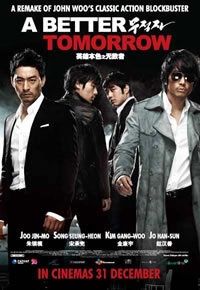
A Better Tomorrow – Emotional, And Gripping!

TK, our partner-in-crime in Movie Review Squad texted Cynthia when we were waiting to board our plane, on New Year’s day, back to Singapore.  I was still on a Zen mode, cut off from any Internet access for more than a week.  And so, after numerous text exchanges between TK and Cynthia discussing the logistics of our first movie outing of 2011, I could not contain my bursting desire and said to Cynthia, “Just ask TK to book anything, and we will be there”.  When I learned that TK has booked us a Korean movie, I was very excited.  I pictured a typical Korean drama, with lots and lots of pretty Korean actresses.  Ah, I was so hyped up for some solid visual simulation that when TK met us in Orchard, when he texted us that he was really excited about our first outing of the year, I wanted to reply, “You have no idea”.  I didn’t, because I was driving.

“A Better Tomorrow” is – later as I found out – a remake of a Hong Kong classic movie of the same name.   I have not watched that classic, so I may not be as traumatized as those who are in love with the old film.  Personally, I am finding it quite unfair to compare Korean actors with Chow Yun Fat and Leslie Cheung whom some of us are so familiar with.  Looking at the quality of acting in this Korean remake, I was touched.  The emotion is convincing and one of the gangsters (the Chow Yun Fat clone) does look cool enough to get Cynthia all excited.  No wonder she loves this Korean remake more than the two of us for there are no actresses in this movie, at all.  Zero.

I see where the “problem” is.  Korean men (at least those on screen) are usually, how shall I say, so “pretty”.  Or handsome in a feminine way.  It does look strange to see two men crying to each other trying very hard to defy the urge to say, “I forgive you”, or “Let’s forget the past”.  And they have to act persistently stubborn over the duration of the film with one says, “You are not my brother, I do not want to see you anymore”, and another says, “You are the only brother I have, and let’s not get separated again.”  Mind you, this is a Korean film, with subtitles.  Hence I am not sure how much is lost in translation.  Maybe the original lines are not so cheesy.  By and large, I am drawn into the emotion of the acting.  I like most of the actors, except perhaps the little brother who appears to overact.  But hey, looking at the plot, I suppose  he has the reason to hold his grudges, for all these years.  So, what is the plot like?

Here is a highlight, no spoiler of course.  It is shown right in the beginning of the show.  A pair of brothers together with their mother tried to make an escape from North Korea into South Korea.  Somehow (I think), during the chase by the guards, the little brother fell down and the elder brother scared of being discovered, deserted his little brother and his mother.  The two got caught and the mother was executed.  Since then, the two brothers have been separated, until later in the story, when one becomes a criminal and another, a cop.

There is a good sense of heroism in the movie.  The drama bit made some of the audiences cried.  The gunfight bit was exciting to watch (except perhaps for those who know the ending, since this is a remake).  If I was the scriptwriter, I would replace the little brother with a childhood sweetheart of the elder brother.  And I would make the first desertion perceived as one, but it is not.  Now, that would make a more heart wrenching movie, true to Korean standard.

Categories
Book Reviews Fiction

Luka And The Fire Of Life By Salman Rushdie – Now, This Is Fantasy!

OK.  Let’s kick start the new year with a writeup on Salman Rushdie’s latest novel.  One of the seven books I have read when I was on holiday.

Born in the video gaming era, Salman Rushdie’s new novel “Luka and the Fire of Life” talks to me.  As the main character Luka transverses through the World of Magic, on a quest to save his storytelling father (the Shah of Blah) who has fallen into a deep sleep, Luka needs to face magical creatures not too far off from those found in the World of Warcraft, and gods and titans that remind me of the game God of War.  Even down to the details of leveling and ”˜ding’ (commonly known among the gamers as getting to the next level), save points, number of lives, and the concept of game-over (or in the book, it is termed as ”˜permination’ – Permanent Termination).

On the surface, “Luka and the Fire of Life” draws from the same source of inspiration similar to many of the video game titles today – fantasy.  Where does fantasy come from?  Legend, tradition, mythology, religion, and science – Rushdie’s new novel has done a marvelous job in meshing up a vast repertoire of fantasy from all over the world and presents them in a concise manner.  A 216-page novel, as compares to the last Rushdie novel I have read, is indeed concise.  This book is an easy and entertaining read.  How the story develops reminds me of the sci-fi writer Piers Anthony’s Mode series.  In that series, a little girl is able to step into an alternative reality and has to take on endless quests in order to complete a certain goal.  In “Luka and the Fire of Life”, a ten year old boy together with a dog named bear and a bear named dog step into the World of Magic.  From there, Luke gathers new fiends, faces new enemies, and together, they have to overcome seemingly insurmountable obstacles in order to attain an impossible goal – to steal the Fire of Life.

In a deeper examination, the author subtly slips in an at times humorous and at times inspirational message where possible.  Why “Big Bang” when there is no medium bang or an even bigger bang?  Do we live in a fated world whereby our future has already been written?  Or we are truly free to write our history?  What if there is no heaven?  And death merely means meeting one’s counterparty – like particles and anti-particles – and when the two meet, in contrast to be as in coming into being, the person simply un-be and vanish?

For those who enjoy reading fantasy stories, folklores, and mythologies, “Luka and the Fire of Life” guarantees to leave you breathless.  There are dragons and flying carpet, beauty contest amongst the goddesses such as Venus and Aphrodite, the Egyptian sun god – Ra – who speaks in Hieroglyph (it is hilarious!), there are heroes and villains too long to be listed, and there are memorable locations such as the Lake of Wisdom, the River of Time, the Mountain of Knowledge, and the Inescapable Whirlpool and above it, El Tiempo (like El Niño).

From the writing style point of view, this book is lively and modern.  The author has even created terms such as P2C2E (Processes Too Complicated To Explain) and made subtle reference to modern technology (“We [the magical creatures] aren’t needed anymore … with your High Definitions and low expectations”).  There are songs and poems.  And there is a character that partly speaks in Spanish.  I have observed a degree of dualism in the book to link real life characters (within the book of course) and the corresponding characters in the magical world.  I have also observed that when possible, the author augments a commonly associated concept to its opposite pole in order to keep ideas fresh (such as fire of life instead of fountain of life).  From the narration point of view, Salman Rushdie is without a doubt a master storyteller.  He draws you close into Luka and his companions.  Each character is distinct and they are intelligent.  The environment is magical.  Above all, Salman Rushdie has done something probably few have done – a good fantasy story does not have to be lengthy.  And it can be modern too.

Categories
Book Reviews Fiction

Great House By Nicole Krauss – Beautiful Prose Albeit Being Dry And Confusing

It was a promising beginning, for the opening chapter “All Rise”.  The narrator addresses to Your Honor confessing a break-up with her boyfriend, R, in the winter of 1972.  Initially, I thought Nicole Krauss’s new novel was a collection of short stories, which in my opinion would have worked out much better.  Comes the second chapter “True Kindness” when the narration switches from first person to second.  That is unusual.  Because there are only a few novels that tell a story involving you – the reader – throughout the plot.  It is refreshing, even though this second chapter seems depressing.  It is a story told from a father’s perspective.  You are his first son and you have a brother.  There is a funeral for his wife.  And your father recounts the memory of your upbringing, how different you are from your brother, and how you and your father never get along (it does read a bit odd being referred as you, doesn’t it?)  At that point, I still thought that “Great House” was a collection of short stories, a genre I adore reading lately.

Then we have “Swimming Holes”.  A story told by an old husband in the first person perspective, on his soon to be dead wife, and a secret kept by his wife soon to be revealed – she has a son whom she was given away at birth.  And there and then, a connection back to the first chapter “All Rise” with a Chilean poet.  Or is it?  Fourth chapter “Lies Told by Children” is a story – again in first person – about a girl having a brief relationship with a boy who has a sister.  The focus of the story appears to be the siblings’ father, who is an antique collector.  Linking these four stories is an old desk (it could be one, it could be different ones – I cannot tell).  There is where it gets confusing.

These four stories confuse me because they do appear to be independent.  The linkage could well be symbolic.  It is also hard to remember the narrator’s names (or even some characters who are not frequently mentioned but plays a role to the story).  If “Great House” was a collection of short stories, one could get immersed into one story, expect it to have an abstract ending, without the need to memorize the characters, and move onto the next one.  It is like admiring a beautiful garden instead of navigating through a jungle.  To read “Great House” as a novel requires a fair bit of thinking.  If I was to read it again (less likely to be so), I would start to write notes as I progress.  On the characters, the relationships, the objects, the events, the locations, and the timelines.

First four chapters of the book contribute to part one.  In part two, the chapter titles almost resemble the previous part: True Kindness, All Rise, Swimming Holes, and Weisz.  To add onto the reading complexity, one has to link the two parts as well.  Nicole Krauss is a witty writer.  No doubt about it.  Her prose is beautiful, although some of the airy scripts that devote to emotions and feelings may at times lose me.  Because I prefer to see a good balance of actions and internal thoughts.  Also, the entire book has no conversational dialogs.  There are dialogs in the form of thoughts.  And the difference between the two is interactiveness.  Reading how one thinks is different from seeing how two converse.  Hence in summary, I feel the novel is a bit dry for me to read.

To demonstrate the author’s style of writing, here is an excerpt taken from the “True Kindness” that I like best.  Your name is Dov.  A girl you are in love with has spent a night in your room (details not known).  And the narrator is your father who mets this girl in the morning over breakfast while you – I presume – are still asleep.  And you are writing, or attempt to write, a novel about a shark inside a tank.

I sat across from her and watched her eat.  Such a small girl and such a large appetite.  She was sure of her beauty; it was evident in her smallest gestures.  She flung her arms and legs around with unstudied carelessness, but they always landed with grace.  There was an inner logic that organized her thoroughly.  Tell me something, I said.  She looked at me, still chewing.  A musky odor clung to her.  What? she asked.  I sat there, hair growing out of my ears.  Never mind, I said, and let the giant shark swim off away from me.  She finished eating in silence and got up to clean her plate.  At the door she paused.  The answer to your question is no, she said.  What question? I said.  The one you didn’t ask, she said.  Oh?  Which one is that?  About Dov, she said.  I waited for her to go on, but she didn’t.  There was much in that instant I failed to grasp.  I heard the front door close behind her.

Death is everywhere in the book.  I suppose if you are in the right state of mind, this level of melancholy is beautiful.  Some parts of the story can be heart wrenching, emotions described in such realism.  There is also a linkage to the Jews and their heritage.  To link up the stories, Nicole Krauss uses objects such as a desk, a symbolic stone, Israel, and writers, mingled with some of her characters.  Above all, she uses the concept of a house, a Great House (hence the title).  What is a Jew without Jerusalem? she asks.  Bend a people round the shape of what they lost, and let everything mirror its absent form, she adds.  Quote from Books of Kings by the author: He burned the house of God, the king’s house, and all the houses of Jerusalem; even every great house he burned with fire.

“Great House” is one of the books in which I struggle midway wanting to give up but am happy with the poetic ending.  I have read “The History Of Love” too.  But this one is a bit too sad, and dry.

Categories
Book Reviews Fiction

Book 3 Of Midnight’s Children – Wrapping Up Week 4 Read-Along

One month has passed since I have joined my blogger friend and her friends and her extended friends to read Salman Rushdie’s “Midnight’s Children”.  I can be a slow reader when the topic gets heavy and indeed, I am happy to have completed my reading in time for the closing of this read-along activity.  When did I finish reading it?  The time is important too.  I could have crossed the finishing line on Saturday evening.  But I was too tired.  A fine book like this does not deserved to be rushed through.  So one fine Sunday morning, to the best of my recollection, the moment has arrived.  Hooray!

Instead of reading Author’s note upfront, I saved it to the end, after I have devoured 647 pages worth of literature.  I wanted to read the book with a rather clean slate of mind, and then I look upon his note for validation.  I don’t find “Midnight’s Children” an easy read at all.  I suspect quite a few friends of mine would have said the same.  When I read the author’s note, this bit struck me.

In the West people tended to read Midnight’s Children as a fantasy, while in India people thought of it as pretty realistic, almost a history book.

I am not from the West.  Neither am I from India.  I don’t see it as a fantasy book because I live in Southeast Asia.  Nor do I possess sufficient tradition and background to understand the Indian history.  Had I read it purely from the fantasy perspective, it would have been quite a fascinating read.  Unfortunately, I was unable to suppress my inquisitive mind.  There is so much I wish to learn and understand – the history of India and the rhythms and thought patterns of Indian language.  I could tell you in plain English that in “Midnight’s Children”, the author attempts to tell the history of a nation and the population of hundreds and millions through one character and leaving the readers to imagine the rest.  That was my expectation before I started reading the book.  But nothing beats actually experiencing it and to really understand what it means by that.  In that sense, this book is a masterpiece.  While “Midnight’s Children” appears to lack in entertainment value (the character or characters are hardly lovable, no offence to India as a nation) – most likely due to the fact that I am neither from the West nor from India and I am neither reading it as a fantasy nor a history book – the construct of the plots and the characters and the carefully researched materials that span a few nations, a few decades; putting this concept in writing that is of a high literature value is respectable.

In book three, Saleem Sinai has moved to Bangladesh.  The story is dark, bloody, and gloomy.  Have a brief and closer look into Bangladesh’s modern history, you can see why this part of the book is written as such.  Book three is also the section whereby the historical figure Indira Gandhi is introduced.  Indira Gandhi was the Prime Minister of the Republic of India for three consecutive terms from 1966 to 1977 and for a fourth term from 1980 until her assassination in 1984, a total of fifteen years (taken from Wikipedia).  Now that I have read the brief note on Indira Gandhi and the related historical events, this entire book makes so much sense.  If the main character Saleem Sinai born on August 15, 1947 denotes the metaphor of the birth of a nation, his son born on June 25, 1975 signifies the Emergency – one of the most controversial times in the history of independent India when a state of emergency was declared.  Now you can see why Indians would read this like a history book while the Westerners may read it as a fantasy.  In my personal life, I have enough Indian friends and colleagues that make me wanting to know more about the Indian culture.  Hence the steep learning curve I am willing to endure.

Back to the author’s note, it is evident that some of the characters in “Midnight’s Children” are inspired by Salman Rushdie’s family and friends.  Is this an autobiography?  Although the author was born pretty close to the birth of India (57 days earlier), I still think that Saleem Sinai is India, more than Salman Rushdie.  What do you think?

External Link: Biblojunkie’s Week 3 Wrap-Up

Categories
Blu-ray / DVD Review

Vanessa Paradis Divinidylle Tour – Intimate And Fun, Musically Satisfying

“Vanessa Paradis Divinidylle Tour” is more than a live concert recording.  It is a documentary of her 2007/8  music tour in France.  There are behind-the-scene footages narrated through the interviews of Vanessa and her band.  These footages offer rare insights – especially for those who live outside of France – on the music creation journey of the music album “Divinidylle”, which in my opinion, is her best work to date.  I am in love with “Divinidylle” (read more on the previous review here); and  I cannot remember where I bought the Blu-ray version of this documentary (either in Paris or Hong Kong).  It is a must-have if you are her music fan.  Her previous concert recording was released back in 2001, “Vanessa Paradis Au Zenith”, which I too have both the DVD and the CD for that recording.  This recent recording is taken mostly from the concert at Bercy in Paris.  The stadium looked huge when I attended Mylene Farmer’s concert back in the early 2000.  It still looks huge when I watch it on TV.

While Vanessa may have released a few music albums (her debut was released when she was 14), she may be more well known as an actress or a model.  I can relate to her guitarist Matthieu Chedid when he mentioned that working with Vanessa is like working with an icon, instead of a musician even though she is a good musician.  Matthieu, someone looks to me as the driving force behind the tour.  Not in a overshadowing sense, but to support Vanessa with full devotion.  He got her into doing something simple and fun on stage, like playing the guitar or the drums.  On stage, Matthieu – who releases his solo album and has co-worked on Paradis’s “Divinidylle” album – is on fire with his guitar.  Together with the rest of the talented band members, they have added vigor to the songs, transforming the easy listening numbers into songs that move your feet, make you wave your hands in the air (like to me, for instance).  Each musician has his intimate moment with Vanessa – musically speaking.  This live documentary contains 24 songs, presented in a lengthy 2 hours 30 minutes recording.

Matthieu describes Vanessa as iconic, fun, and accurate [in tone] and has good timing.  I think the acoustic video recording below sums that up well.

Categories
Book Reviews Fiction

Book 2 Of Midnight’s Children – Wrapping Up Week 2 & 3 Read-Along

I read somewhere that vocabulary defines one’s wisdom.  In the sense that it is a tool – perhaps one major tool – to express oneself.  The more diverse and vast one’s pool of vocabulary is, the more precise one’s idea can be articulated.  It is observed that most adults after leaving school seldom learn new words.  Perhaps ten or twenty new words a year?  That is the reason why I always get excited when I come across a writer who is gifted with the ability to articulate ideas with exactitude.  Even if I have to research on why certain words are chosen for a given context, I am happy to do so.  It affects the fluidity of reading.  But I hope that in my subsequent reading – same author or same book – I would have a much enjoyable ride.  That also explains why I prefer to stick to a certain set of authors.  Salman Rushie is one.

OK.  I survived book two of Salman Rushdie’s “Midnight’s Children”; 313 pages in total.  In book one, I have spent much time catching up on the culture and history of India, Pakistan, and Kashmir.  In book one, I have read the story of Saleem Sinai’s grandparents all the way till the time when Saleem is born – midnight of August 15, 1947 when India has gained independence.  Book two is about Saleem’s childhood, all the way till he is 18.  It is a story mashed up with the history of India and Pakistan.  It is chaotic.  It can be confusing.  The chapter “The Kolynos Kid” sheds some light on how “Midnight’s Children” can be read.  A ‘dualistically-combined configurations’ in connecting the characters literally and metaphorically to the fate of nations.  Specifically speaking, actively-literally, passively-metaphorically, actively-metaphorically, and passively-literally.  What a minute, you may say: What are you talking about?

Combining active and literal mean the actions of the characters alter the course of historical events.  That is to say, these are works of fiction.  Nice and simple.  Passive and metaphorical refer to the socio-political trends and events by their mere existence affects the characters metaphorically.  That means to say one has to interpret a certain plot, usually abstract in nature, in an attempt to decipher which historical incident it derives from.  Passive and literal means that the story of the characters happens against a historical background, which is also the most intuitive to the readers (or so it seems because unfortunately, mixing the four modes makes it confusing to read at times).  The last one is active and metaphorical.  It is the most bizarre of all.  Things that are done by or to the characters are mirrored in the microcosm of public affairs – to be symbolically at one with history.  That is when interpretation can often run wild.  To me, understanding these four modes of dualism helps me understand the book better.

One thing I admire about “Midnight’s Children” is the effort Rushdie has put into the planning of the story.  Often, the ending of the sub-plot or the character is foretold and it is a matter of telling the story in reverse.  Rushdie has even planned out where the middle of the story is to be (titled as “Alpha and Omega”).  I have yet to read the author’s note.  If I could ask Rushdie a question on “Midnight’s Children”, that would be: Did you create the storyline backward?  How did you know that “Alpha and Omega” would be the middle of the book?  Do you have a laundry list of metaphors and what they mean to share with me?! OK.  Three instead of one question.

Out of the 15 chapters of book two, which are written in a diverse style, I enjoy reading the beginning of “At the Pioneer Café” a lot.  Below is an excerpt taken from the last sentence of the first paragraph.  In case if you wonder why it is written that way, the narrating character is having a bad fever.

Now only she and I and no more screams the Widow’s hand comes hunting hunting the skin is green the nails are black towards the corner hunting hunting while we shrink closer into the corner our skin is green our fear is black and now the Hand comes reaching reaching and she my sister pushes me out out of the corner while she stays cowering staring the hand the nails are curling scream and mmff and splash of black and up in to the high as sky and laughing Widow tearing I am rolling into little balls the balls are green and out into the night the night is black …

Back to the read-along that Jo is hosting, do head over to her latest post and read the wrap-up and further discussion questions.  After my week one wrap-up, looking back, I think I may wish to answer some of the questions after I have completed my reading.

Categories
Book Reviews Fiction

Lovers In The Age Of Indifference By Xiaolu Guo – Neat, Witty, And Melancholy

How effortless Xiaolu Guo has turned indifference into art!  In this collection of 17 short stories of vastly different styles, a few themes persist.  Indifference is one.  And then there are lovers in love, not in love; a prominent linkage to China with geographic locations within China, outside China.  While it is difficult to feel for the characters – short stories after all – especially when the characters do not usually love themselves or others (that is indifference for you!), I am loving Guo’s writing style.  So neat and concise, with a filmography touch.  There is subtle humor in “Lovers In The Age Of Indifference” too.  Often linked to observations through the Chinese eyes.  For example, one story is titled “Winter Worm Summer Weed”.  I starred at the title for like five seconds before I got what she was trying to say.  It is a literal translation of a Chinese herb called “冬蟲夏草”, which is Cordyceps Sinensis in English.  I think Guo’s translation tickles me more.  Her humor extends beyond literal translation.  Take a look at the excerpt below.  It takes place in the morning over breakfast, the narrator is a Chinese girl and she lives with her French boyfriend Pierre in UK.  I chuckled at the punch line, still do.

Pierre has made coffee, and bread is in the toaster.  He has also bought some goat’s cheese from a nearby French deli.  Pierre always complains he can’t find good cheese in London, and when he occasionally does it costs the price of a cinema ticket.  I don’t care about cheese – I think it’s a bit crazy to talk about cheese all the time, it’s like talking about cow’s tits.  I don’t really care about bread either.  Brown or white, what’s the difference?  It’s all made from the same crops.  I’m Chinese.  We eat better stuff than that.

In “Lovers”, some stories are written in email, text message, or letter style.  Some are narrated through different characters, different locations, or different timestamps.  There is even an epic loveless love story cut out from a well-known Chinese legend.  It is hard for me to pick my favorite short story.  It has to be either “Beijing’s Slowest Elevator” – a story of a karaoke mistress, a young man from the thirtieth floor, and an elevator going up, and down – or “Anywhere I Lay My Head” – a story of a school teacher, her boyfriend, her ex-boyfriend, and her ex- ex-boyfriend’s apartment.  Both stories are told as a single day event.  Come to think of it, I like “Anywhere I Lay My Head” better, a more romantic story in a melancholy sense.  If you have read the book, what about you?  Which one is your favorite story?

Categories
Book Reviews Fiction

Book 1 Of Midnight’s Children – Wrapping Up Week 1 Read-Along

Before I write a wrap-up of my week one’s read-along progress, I have two confessions to make.  This activity was first conceptualized with Jo – the UK blogger – and I commenting on a list of books that we wish to have started reading but now collecting dust at our bookshelves.  You see, I have Rushdie’s “Satanic Verses” for years and have even downloaded a reference guide (as that book is known to be cryptic in nature) ready to have a go with it.  That never happens.  For reasons beyond my comprehension, I was (still am in a certain extend) convinced that I own a copy of  his other book – “Midnight’s Children”.  Maybe I do have a copy lying somewhere in my house.  Or maybe I have been thinking about reading “Midnight’s Children” for so long that its virtual existence has become closer to my home than, say, a bookstore.  On Nov 12, the Friday that this mini-global read-along began, I was frantically searching high and low for my copy of “Midnight’s Children” but it was nowhere to be found.  Have I accidentally purged the copy during one of my periodic overly enthusiastic spring cleanings?  I hope not.  Cursed at my procrastination (to be fair to Jo, this read-along has been announced months in advance) and my wild imagination of this virtually non-existence book, I reserved a copy from our national library.  I collected the book last Tuesday but the condition of the book is so poor that had “Midnight’s Children” been as light as, say, a chick-lit, I would still be able to mentally bypass its yuckiness and focus on its content.  This book is anything but.  So last Thursday evening, I have decided to invest my 6 days worth of lunch money and purchase a copy.  I am late for the game and that is embarrassing.  But it is better late than never.  My errors in my previous narration of my story thus far are purely unintentional – unlike Rushdie’s treatment to the narration of the book, which I am still undecided if his errors are indeed purposeful or accidental or a bit of both.

My second confession is that vocabulary is never my strength.  And I have this dislike to guess the meaning of words.  In the past, what I would do is to research on every word I did not fully understand and document them into an Excel spreadsheet together with an excerpt of the literature of which that word was used.  Alas!  I lost the password to that spreadsheet and so in finality, I put that obscure hobby of mine to rest, in peace.

Obsession dies hard, and hence, I crawled through the pages of “Midnight’s Children” looking up all the words that are unfamiliar to me.  To be fair, a lot of them are references to the Indian culture – such as pice, hartal, godown, kurta, and the ingredients of food commonly found in India – or to other religions I am not familiar with – such as Hinduism and Islam.  And I stopped my progress numerous times to research further on the buildings – such as Chandni Chowk, Red Fort, and Meenakshi Temple (I even took time to admire the images of these buildings) – and geographic locations mentioned in the book as well as the historic background that is foreign to me.  Like the Burma Campaign, the Rowlatt Act, and the birth of Pakistan and India.  From the historical perspective, the Rowlatt Act enacted by the British has led to the Jallianwala Bagh massacre.  Rushdie tells a story of the same massacre through one character – the grandfather of Saleem Sinai – in a rather comical manner.  The body count is close to what has been documented in Wikipedia.  Why am I so obsessed with numbers?  Because I am mentally prepared on Rushdie’s method in encrypting certain messages in form of numbers.  If possible, I would cross reference the numbers to the historical events and attempt verify where those segments of the story are based upon.  Still, there are numbers that I am unable to decipher, as of now.  Like that 8,420 pie-dogs or 630,000,000 particles of anonymous (for the latter, is he referring to the population of India back then?).  And still, there are words that do not exist in the dictionaries, that would take me probably another read to research upon them.  I am also intrigued by some of the references to well known Indian stories (not to me of course).  Such as Ramayana and Ravana.  And when Rushdie briefly mentions the curse Babar has on his son Humayun that all [Indian] schoolboys know, I put down the book and switched to Internet.  What is that curse about?  I found two possible explanations.  Either it is a curse of being appointed as a Maghul Emperor and have to face the betrayal by close relatives (Babar or Babur being the first Maghul Emperor and Humayun as the second).  Or more likely, it is related to the Kohinoor diamond that its successive royal owners either suffered untimely death or lost their kingdoms.  Now you know how I read this book.

“Midnight’s Children” is divided into 3 books.  647 pages in total (for my edition).  Book 1 occupies 161 pages of the entire book.  It is a good logical break as far as this 4 weeks read-along activity is concerned.  I am still undecided if the next logical break due next week should be the end of book two – 289 pages in total.  If you have not started reading with us, I urge you to join us today.  This book is a must read, from the literature point of view.  I would not have touched it had I not committed to this read-along.  I am a turtle reader and aim to complete the race one page at a time.  You too can do it!

In book one, Rushdie tells a story through Saleem Sinai who was born on the day when India gained independence, at the stroke of midnight.  And through Sinai’s narration, we travel back in time to how his grandfather met his grandmother, how his father met his mother.  It is more than a journey through time.  It is a journey through Kashmir, Amritsar, Agra, and Bombay; through the old and the new India.  Book one is a complete unit that has a climatic ending – a single celebrated event of the birth of a nation and the birth of the main character.  The author manages to tell a story of a population of millions through one character.  That is remarkable.

Now, back to the read-along activity, my responses to the questions posted by Jo are as follows.  As my reading progresses, I may change my mind for the first 5 questions.

1. Saleem describes himself as ”˜handcuffed to history’.  What do you think that this means, and do you think that this is true of him?

Take it at face value (after reading book one), it means that his destinies are chained to those of his country.  He has a strong belief that the events dated all the way from his grandfather’s time have led to his very existence, and would continue to affect his life.  In parallel to this, I think Rushdie wishes to say that the historic events dated all the way from Kashmir 1915 have led to India and Pakistan’s independence, and the destinies of these two countries would continue to be chained by Earl Mountbatten’s act of splitting British India in 1947.

2. The prose of Midnight’s Children has a distinctly filmic quality.  Why do you think this is, and what would be the implications of making a film of the novel?

It does read like a Bollywood production.  Would it work if making “Midnight’s Children” as a film?  Personally I think it would be a difficult task.  As some of the characters I suspect are used to refer to other neighboring countries or concepts.  And the flow of time is extremely fluid in the book.  It would be interesting to see how a filmmaker can transform this book into a film.

3. Unlike many novels, Midnight’s Children is not written using a linear narrative.  Why do you think that Rushdie uses this technique, and do you think that it is successful?

Thank God the story is not told linearly.  Otherwise, it would be rather boring, like reading a history textbook.  This style of narration builds a strong linkage between the present and the past.  I think that is why.

4. Saleem makes many errors in his narrative – both accidental and purposeful.  Why do you think that he does this, and why does he not bother to correct his mistakes?

To be honest, I suspect something is wrong with the narration but I cannot pinpoint in exactitude.  That may explain why there are parts that I find harder to follow.  But say, if his narrative is erroneous, it is not a surprise.  Because any story told in first person form is not to be trusted in totality, compares to a story told in third person form.

5. What is Padma’s role in the novel?

A meta-story, it seems to me.  A way to get readers’ involvement with the narrator, Saleem.  At times, I found myself saying the exact same thing as Padma.  And I giggled.

6. “What is so precious to need all this writing-shiting?” asks Padma (p. 24). What is the value of it for Saleem, do you think?

[Spoiler Warning:] Good question.  Consider the fact that the entire book one Saleem spent on narrating does not even come from his true family!  It is probably a birth story that he would not have hoped for (like the could-have-been unified India).  But since he has fully embrace himself as not only the children of midnight, but also children of time, it would appear to me that the history he inherited is just as important.

7. Saleem often appears to be an unreliable narrator, mixing up dates and hazarding details of events he never witnessed.  He also draws attention to his own telling of the story: “Like an incompetent puppeteer, I reveal the hands holding the strings…” (p. 65).  How much faith do you put in his version of events?

Not much.  That is why I research on the Internet whenever some historic events are being mentioned (for I cannot research on the the fictitious lives of Saleem and his family).  Some characters are real, some are not.  In any case, that is forgivable.  Saleem has not mentioned how his story is based upon (except some photographs).  That is the beauty of it all.

8. “To understand just one life, you have to swallow the world … do you wonder, then, that I was a heavy child?” (p. 109). Is it possible, within the limits of a novel, to “understand” a life?

Not within a novel, no.  But a novel does not need to provide readers all the intrinsic details.  The rest of the details are supplied by the readers (that is why I need to research on the Indian / Pakistan / Kashmir history because I have little).

9. Saleem’s father says of Wee Willie Winkie, “That’s a cheeky fellow; he goes too far.”  The Englishman Methwold disagrees: “The tradition of the fool, you know. Licensed to provoke and tease.” (p. 102).  The novel itself provokes and teases the reader a good deal.  Did you feel yourself “provoked”?  Does the above exchange shed any light on Rushdie’s own plight since The Satanic Verses?

Teased yes, provoked no.  Probably because I do not have a strong opinion on the history and religion of that region?  Since “The Satanic Verses” is published after “Midnight Children”, does that mean that Rushdie has foretold the coming of “The Satanic Verses”?  I am not sure.

10. How much of the novel, do you think, is autobiographical?

After reading this question, I have found out that Rushdie was indeed born in 1947, the exact year of Saleem’s birth.  I have not read book two and three.  If Saleem ends up marrying and divorcing and dating a few women of gorgeous quality like Rushdie does in real life, I may be able to give a more confident answer to that.

External Link: Week 2’s Discussion Questions
Categories
Book Reviews Fiction

Maynard & Jennica By Rudolph Delson – You Wouldn’t Want This Love Story To End

Once in a while, I would discover some books that are so unique and you want to know the sad part of the story?  I can never find another book quite like the ones I love, not even from the same author.  Like Nick Hornby’s “High Fidelity” and his endless top 5 lists.  I can be a hopelessly romance freak.  And I happen to like “Maynard & Jennica” quite a fair bit.

Reading “Maynard & Jennica” is almost like watching a romance comedy, and it is better.  The book is divided into five parts of uneven length.  Each part consists of a set of interviews conducted with the story’s characters.  Each character tells a fragment of a story from his or her perspective.  At times, the fragments overlap.  And it gets interesting to see how one incident can be recalled from two entirely different viewpoints, down to the dialog level.  I can promise you, when the characters bid their farewell, you really wish that they did not.

The plot centers around the love story of Maynard and Jennica.  And then we have Maynard side of the family, Jennica side of the family, Jennica’s friend side of the family, as well as other characters including Ana – Maynard’s “wife”.  If I read the book correctly, it is also about American Jews in love.  And hence, this unique Jewish culture within, which some of you may or may not be able to relate but certainly makes the story in a way exotic.

“Maynard & Jennica” is not perfect.  There are parts and characters that I humbly think can be edited away.  And the magic does not seem to sustain in the second half of the book, especially when September 11 is being brought into the picture.  There are also quite a few references to America.  I reckon for those who are not living in US, these references may be hard to relate.  These minor notes aside, “Maynard & Jennica” is a heartwarming story, with quite a number of memorable moments (I enjoy reading the part on playing Scrabble a lot).

I wish to quote a part of the book for sharing.  First, I must make some introductions here.  In this scene, Maynard is having an “argument” with his grandmother Rose in the presence of his mother Joan.  Rose is trying to ask how much money Maynard is making from his B-movie which leads to her criticizing Maynard for being a “lazy fool” for delaying his proposal to Jennica.  A part of the script told from Maynard’s perspective.

So – enough is enough.  I decided to explain, absolutely, for the two women who raised me, how I think about myself.  I put my fork down, I drank one swig of beer, and I said, “Gran, the lunch at Phoebe’s – this was the lunch when I tried to explain the following: That the proper aesthetic relationship between an individual of insufficient talent and his art is not a creative one – my mistake, at the forgivable age of ten or twelve – for, say, twenty years, and while those years are lost, I don’t regret them, and am now happy to be able to listen to, say, the first movement of Debussy’s La Mer with only awe, and not with envy or regret.  And that this generosity of aesthetic spirit extends for me into the realm of the moral, the day-to-day, the pedestrian, the aesthetic, as well.  And that as I resign myself to simply listening to Debussy, so too I want to stop demanding behavior – more tasteful, more stoic, loftier, and more dignified behavior – from my companions in life, and start simply enjoying whatever company their – company provides.  And thus it is not with sorrow but with satisfaction that I want to lay aside my struggles and – be nice.”

My mother said, “I have no idea what you’re trying to say.”

And Rose said, “He’s saying he’s a lazy fool, is what he’s saying.”

“Gran, is it possible that I am not a lazy fool?”

Categories
Book Reviews Non-Fiction

The Grand Design By Stephen Hawking – Is There No Room For God’s Existence?

I could not help but to feel somewhat devastated after reading “The Grand Design”.  There is nothing wrong with the book.  In fact, it is one fine book.  A concise yet accessible read on the scientific theories and models from the past all the way to what we have today in an attempt to answer the laws that govern our universe.  I felt somewhat devastated because there was this huge void in my soul (which I can imagine if Hawking was to read this, he would tell me that soul does not exist).  When I first read the media review on “The Grand Design”, I was skeptical.  I thought it was the media wanting to grab our attention with skewed claims.  But the media is right about two things.  One, there is no room for God in the design and existence of our universe.  I would not go as far as to quote Hawking in saying “God does not exist”.  Because he did not write that.  What he says is that throughout the history of our universe, going back all the way to the singularity (i.e. big bang), there is no God.  And beyond that point, it is not a timescale that is of interest to us because time does not exist.  Does it mean that God does not exist?  I think it is meant to say that God – whom some of us come to know as the creator – according to Hawking does not play a role in the creation of our universe.  And Hawking has reminded us on how our notion of God has changed over time.  Maybe we are still finding what God is.  Maybe the scientists are still searching for the grand design (that will come into light after the M-theory is confirmed via observation).

Two, our universe creates itself from nothing.  This piece of information is probably the climax of “The Grand Design”.  The negative energy of gravitation plays a role in balancing out the positive energy needed to create matter.  Overall, the total energy of the universe remains as zero.  And since the gravitational energy shapes the time-space, it allows the time-space to be locally stable (like bodies such as stars and black holes) and globally unstable.  Spontaneous creation is the reason why we exist, why there is something instead of nothing.  And according to the book, God plays no part in that spontaneous creation.  Looking at the theories and models that arrive to this conclusion, I must admit that this concept does sound convincing.  Having said that, I wish Hawking and Mlodinow would spend more time to explain more on the negative gravitational energy, perhaps with more illustrations.  While the authors appear to accuse the scientists of the past to tweak the models in an attempt to make them fit, the way how the modern theories are modified (such as the dropping and resurrection of the cosmological constant) seems to be of little difference to a layman reader such as myself.

Beyond these two claims that have caught media’s attention, as someone who has studied science, “The Grand Design” is a joy to read.  A book that helps to revise on what we have learned in the past.  The laws of the universe are a fascinating topic.  Light was thought as particle, then as wave, and then as both particle and wave.  Buckyballs constructed using carbon atoms have found to exhibit mind boggling behavior of being able to acquire information of the slits in a screen in front when they are shot from a source (1999).  From Newton’s classic theory to quantum theory, from Einstein’s special and general relativity to the modern day string theory and M-theory, “The Grand Design” is a mind blowing read on how far we have come – scientifically speaking.  The fact that I being science trained probably explains why reading this book was a breeze.  But with the diagram illustrations and simple to understand and at times lighthearted writing style, this book should appeal to general readers as well.  It is quite an entertaining read as this book is not all about theories and observations.  There are mentioning of the historical events and the legends and rituals of the past.

I was momentarily devastated because I understand that science at the theory and model level can be cold.  For lack of better words, the laws are indeed cold hard facts that are aligned with the expectations and observations around us, under a certain set of conditions (for example, Newton’s theory works best for objects of our daily lives and quantum theory works best at the minuscule level).  Models are created by man in an attempt to explain our universe.  Under the conditions that are set within these models, I can accept why there is no room for God’s existence.  And if our universe within the realm of multiverse contains countless of possibilities happening at the same time, there is no room for miracles either.  So, what does the theologists got to say about this?

I do not believe that science can explain everything in life.  I have not yet seen how, for instance, love can be modeled and explained.  Where does compassion come from?  What makes one person forgive another?  I have not seen how science can create beautiful literature that inspires.  I would rather choose to believe that people whom I love and I have something special going on, than to think that all these are merely random encounters and one of the many possibilities that exists in the universe.  And I would rather choose to believe in the existence of faith and hope.  Science, in its pure essence, seems too cold to me.  Lastly, not to discredit the authors – because they are highly regarded in their respective fields – as a layman reader, I am still not seeing what the grand design is.  What we have today is a theory (M-theory) that suggests how this grand design comes into light.  A theory that has not been proven wrong so far and a grand design that is yet to be observed.  This book is still a major read not to be missed.  However, read it with the right perspective.