Categories
Comedy Movie Reviews Romance

A French Movie “Beautiful Lies” Starring Audrey Tautou

Oh yes.  I absolutely adore Audrey Tautou.  Has it been two years since she graced our local theaters?  It certainly seems so.  One time, I met one of my readers in person, all because of Audrey Tautou.  He is a fan of Audrey; I am a fan; our movie buddy TK is a fan; and Cynthia is sort of a fan by influence, not quite by choice.  We watched “Coco Before Chanel” together – my very own meet-the-reader session.  Around the same time, I brought him to buy a dSLR because he happened to like photography too.  I have not seen him since then.  Hey buddy.  If you are reading this, drop everything you do and watch “Beautiful Lies”.  It is beautiful.  And Audrey Tautou is in it.

It is a pity that some local viewers remember Audrey as Sophie Neveu in “The Da Vinci Code”.  She is so much more.  In “Beautiful Lies”, she plays a character who seems to have little in common with her separated parents.  She is manipulative, but yet deep inside, she loves them.  She is the co-owner of a new salon.  She seems cold, bossing people around.  But from within, she can be inferiority complex, especially with someone who may have a much higher education than hers.  Romance does not seem to be on her priority list.  She does not seem to be aware of any admirers around her.  But yet, her heart can be touched in the most subtle way.  And it reacts too in the same subtle manner.  She lies, with good intent.  And yet, most lies backfire.  Summing all up, I would say Audrey Tautou is perfect for the role.

“Beautiful Lies” is a lighthearted movie.  Cynthia and I had a good laugh throughout the show.  I like this one a lot.  Retailers should package all the Audrey Blu-ray movies in one box.  I would gladly grab one.

Categories
Book Reviews Fiction Linguistic

An Afterthought: El Búho Que No Podía Ulular

Uff.  Finalmente, I have read a story written in Spanish (just yesterday).  Ironically, it is not as Spanish as I would have expected.  It is a story of an owl banished from his own kind and has ended up being lectured by the ghost of Benjamin Franklin together with the rest of the founding fathers of America in ghost forms.  Coincidentally, this entry is published on the US’s Independence Day.  ¡Qué casualidad!

I have always wanted to read stories in Spanish.  Given my level of deficiency (I pondered hard if I shall use ”˜proficiency’), I shall realistically start with Spanish books written for the infants or young teens.  But I have seen too much and my mind has long been corrupted by the earthly vices and spices.  These books are simply not as appetizing.  I cannot even bring myself to read “Hairy Porter”.  Since our classmate is so kind to lend us a Spanish book called “El Búho Que No Podía Ulular”, or in English, “The Owl That Could Not Hoot”, I have decided to give it a go.  I was so determined that I would not publish any entry in my website until I have finished with the book.  This explains why you have not heard from me for quite some time.

Fortunately, this book written by Robert Fischer and Beth Kelly is thin.  And it comes with three stories.  That means, even though I have read one story out of three, I felt as though I have achieved something.  Systematically grinding through the vocabulary and the different verb forms was tedious.  Technology is a double edged sword.  The online resources and offline applications have helped me a great deal in finding what each word or even a sentence means in lightning efficiency.  But I do not find myself making an effort to memorize the meaning and the usage.  I end up looking up the same word again and again.  I suppose if I had a Spanish mama, I could always ask “¿qué significa sonreír?” or “¿qué significa suspirar?”  If I was to invent a new technology to help the Spanish learners, I would create a Japanese lookalike Spanish Nanny Robot.  An attractive one no doubt.  I could ask, “¿Qué significa sonreír?” and she would reply, “It is smile, sweetie”.  Or I could ask, “¿Qué significa suspirar?” and she would reply, “It is sigh, sweetie”.  How cool is that?

Back to the story, it starts with an owl that is unable to hoot.  He can say “why” but he cannot say “who” (the hooting sound of an owl).  Because of that, he is asked to leave the habitat.  Soon, he meets a duck that cannot say “cuac” and instead, he says “cuic”.  The two loners, or rather outliners, have then decided to team up and see what the world has to offer.  Their first mission is to study in a university and become a doctor.  Upon realizing that it would take longer than their lifetime to obtain a medical degree, they have decided to embark a journey of searching for the purpose of life.  This involves interviewing random people on the street and finding out what they do for a living.

The owl that can say “why” naturally does most of the talking.  The duck takes note.  After interviewing hundreds of people, they have come to the conclusion that most people do not like their jobs, yet they do not wish to switch.  They do it for the money and the only time they are happy is when they are not working and on vacation.  The duo further concludes that people are happy when they are spending money.  And they observe that most people do not own what they have.  What then should one do with his or her life in order to be happy?  A typical American story, I suppose.

One day, the owl hears a voice that leads them sneaking into a national museum at night.  Inside a gallery where the portraits of the founding fathers are hung, the owl sees something extraordinary.  All of a sudden, the portraits become empty and the founding fathers have materialized in front of the duo’s eyes (?!).  The ghosts of the founding fathers then lecture the duo on how America was originally founded as a place of equality and freedom and how they are disappointed that the America today is all about making and spending money.  I honestly do not see how this is linked to an owl that cannot hoot and a duck that cannot say “cuac”.  At the end of the story, upon hearing the wisdom of the founding fathers, the owl is enlightened.  And he says, “Libre … es lo que soy”, which means “Free, is what I am”.  Perhaps the moral of the story is that we should not see through the lens of social norms on what we are not capable of doing.  Instead, take the opportunity to break out of the mould and be yourself.  We may stand to gain so much more.

I used to think that I write weird stories.  Those who have read my manuscript for that writing competition would have agreed with me.  But this story is weirder.  If I was to rewrite the story, I would turn this owl that cannot hoot into a hero.  I would bestow some bizarre disasters upon the rest of the owls like the attack of the toxic toads.  And our hero would return to this habitat that rejected him and save the day.  Everyone would worship him and begin to say “why” instead of “who”.  The most beautiful owl in the forest would fall in love with the hero and they would live happily ever after.  Oh, before that.  At the altar, when the priest asks, “Do you take this owl as your lawfully wedded wife?”  Instead of “why?”, our hero would finally able to say “who?”  I think it is darn funny.

Humor aside, there are some good takeaway points from this book that is onto its 40th edition (gasp!).  Below is my favorite.  I too feel that the root of many of our problems today could have been solved by filling our life with love.  That way, we leave no space for fear and hatred.

«Aprendiendo a amarte a ti mismo»’, sonrió Franklin. «Y en la medida en que te ames a ti mismo, podrás amar a tus vecinos, a tus amigos y a todas las demás personas que hay en esta gran nación».

My attempt to translate the above extract is as follows.

“Learning to love yourself,” smiled Franklin. “And as you love yourself, you will love your neighbors, your friends, and the rest of the people in this great nation”.

On a side note, while it is not possible to linguistically memorize what the book teaches, I have noted down all the adverbs that ends with -mente for my future reference: profundamente (profoundly), bruscamente (abruptly), sucesivamente (successively or ”˜y así sucesivamente’, which means ”˜and so on’), detenidamente (carefully), desesperadamente (desperately), fijamente (attentively), rápidamente (quickly), únicamente (solely or only), tristemente (sadly), apresuradamente (hastily), constantemente (constantly), fríamente (coldly), repentinamente (suddenly), tímidamente (timidly), lentamente (slowly), amablemente (amiably), actualmente (nowadays and not actually!), alegremente (happily), completamente (completely).

Categories
Book Reviews Fiction

Hotel Iris By Yoko Ogawa – Beautifully Ugly, Dark And Shocking

I do not suppose what Ogawa wrote is unrealistic.  At times, we read in the news about some women who are victims of domestic violence but yet, they have a tendency to return to the very same man who bestows such violence upon them.  I have read the story of Natascha Kampusch and had a glimpse of the kind of sick things some men do behind closed doors.  I have also read that some couples enjoy S&M and derives extreme pleasure from extreme pain. Mixing these together, we have “Hotel Iris” – almost.

A young girl who works at the front desk of a hotel is seduced by a much older man who appears to be mostly timid and loving outside his house, and someone quite the opposite when he is alone.  The love affair has then turned into a strange game of S&M.  How can a young girl be seduced by such a monster and be convinced that this is OK and that she is shamelessly ugly?  Ogawa has indeed taken a brave move and she presents to the readers the psychological and emotional journey of a young girl in first person view: Her longing to be away from her demanding job at the hotel, her longing to see this old man who does strange things to her body while showering her with words of love and tenderness, and her plunging into the point of no return.  Ogawa’s writing style is neat and elegant.  Deployed to this rather dark and ugly topic, the story reads almost too beautiful.  I must say, it was a strange feeling reading “Hotel Iris”.

Like one reader has pointed out, “Hotel Iris” is very different from “The Housekeeper and the Professor“.  Had I read these two books without knowing who wrote them, very likely I would not have thought that they come from the same author.  The writing style is the same though.  Since I like Ogawa’s writing style, I enjoy reading the two book just the same.  I look forward to reading more of hers.

Categories
Fantasy & Sci-fi Movie Reviews

X-Men: First Class – Not My Cup Of Tea

I have a few issues with the installment of this new trilogy.  Considering the fact that “First Class” is a prequel, I am unable to reconcile how, say, McAvoy and Fassbender’s characters are going to grow up and become Professor X and Magneto that we are familiar with on a big screen.  I took a look at McAvoy and compared him with Patrick Stewart.  Nah.  I took another look at Fassbender and thought about Ian McKellen.  No way.  Is it important that the casting should somewhat reconcile with our mental expectation?  I would think so.  Star Trek has done a pretty good job in choosing their casting when the prequel was made.  McAvoy and Fassbender are good actors.  But the disconnection with the existing X-Men films is a bit too much for me to take.

From the story point of view, after the climatic ending of “X-Men: The Last Stand”, I doubt a prequel could top that.  And it does not.  The ideas of mutants against the humans, teaching the mutants to control their power and one super mutant wanting to take over the world – these ideas begin to sound old to me.  Who cares about the ability of creating whirlwinds when we have already seen what Storm can do?  Who cares about a stripper with wings of a housefly when we have seen a human boy with angelic wings?  Havok shoots beams from his chest but hey, we have already seen how Cyclops shoots beams from his eyes.  A boy who screams that enables him to glide in mid air with artificial wings?  Maybe the movie is not doing the comic books justice.  Or maybe it is what it is.

If I am to look at “First Class” as a standalone movie and to remove most of the mutants who are unimportant to the story, the film does offer more background on the friendship between Professor X and Magneto and who they are.  The linguistic ability of Magneto (or rather Fassbender) is charming.  Seeing a younger version of Professor X flirting and chatting up with girls is unexpected, but refreshing.  Hence, it is the drama bit that I enjoy watching.  What is disappointingly missing – besides more depth in Professor X’s romance would be nice – is the transformation of Magneto: the transformation from a mission of personal vendetta to a mission of one mutant (and his recruits) against the world and the disintegration of a friendship.  In one scene, a man was down on the beach.  Magneto could have had him teleported out for medical care.  Why the hurry to disappear from the screen?  That emotional part of a human, or rather a mutant, is missing.  And I am left with an empty feeling wondering if I still want to see more.

The good news is, “Second Class” and “Third Class” – if at all the rest of the installments are so called – are likely going to beat “First Class”.  It is likely that I will get to continue watching this trilogy, because Cynthia is a X-Men fan.

Categories
Book Reviews Non-Fiction

Lion’s Honey The Myth Of Samson By David Grossman – A Mostly Imaginary Piece Of Work

After reading “Lion’s Honey”, I did some research on the author.  He is an Israeli, an established writer as well as a political activist.  This explains quite a few queries lingered in my mind after reading his book.  There are only very few places when Grossman subtly touched onto modern politics.  Here is one.  I am quoting the text here because quite possibly, I like this aspect of the book the most.

Yet there is a certain problematic quality to Israeli sovereignty that is also embodied in Samson’s relationship to his own power.  As in the case of Samson, it sometimes seems that Israel’s considerable military might is an asset that becomes a liability.  For it would seem, without taking lightly the dangers facing Israel, that the reality of being immensely powerful has not really been internalised in the Israeli consciousness, not assimilated in a natural way, over many generations; and this, perhaps, is why the attitude to this power, whose acquisition has often been regarded as truly miraculous, is prone to distortion (page 88-9) […] This is connected, without a doubt, to the very real dangers lying in wait for Israel, but also to the tragic formative experience of being a stranger in the world, the Jewish sense of not being a nation ‘like other nations’, and of the State of Israel as a country whose very existence is conditional, whose future is in doubt and steeped in jeopardy, feelings that all the nuclear bombs that Israel developed, in a program once known as the ‘Samson Option’, cannot eradicate (page 90).

Majority of the book is not about politics.  His interpretation of the Samson story may run against the grain of the familiar Samson in the Hebrew Bible (his own words).  As a Catholic, I would say that his interpretation runs against the grain of the same story in the Christian Bible as well.  The way Grossman breathes life to a local hero (or “judge”) and his surrounding characters extracted from the Book of Judges prompts me to reflect upon how we Christians breathe life to Jesus.  Because I am not used to reading the Old Testament in such fashion, I find that Grossman’s interpretation of Samson is highly imaginative at best, controversial at worst.  What do I mean?  I will get to that in just a moment.

First, to put things into context, I refer to the Catholic Study Bible’s guide on reading the Book of Judges.

There is one overriding theme that dominates the Book of Judges: the sin of idolatry leads to punishment; but if the people of Israel turn back to the Lord, the Lord will deliver them from their enemies … Into the theological framework of “sin-punishment-cry for help-deliverance” the deuteronomistic writers have incorporated various stories that relate the deeds of local heroes.  For the deuteronomistic writers the unity of all the tribes is an important concern; thus, in their historical schema, these heroes become leaders for all Israel.

The Book of Judges documents a number of heroes.  I must admit that the story of Samson is a peculiar one.  He does not lead all Israel as a warrior, nor does he liberate the people from Philistine.  Victories he has scored over the Philistine are personal.  There seems to be no reason to include Samson into the Book of Judges except in (15, 20) when the writers wrote: Samson judged Israel for twenty years in the days of the Philistines.  To understand its theological value, one has to read this biblical story in more detail.

Grossman’s “Lion’s Honey” dissects the biblical story word-by-word.  Some discussions – for good reasons on my end – I am finding it hard to concur with the author.  For example, in the Bible, after the woman being told by angel that she was going to have a son, she relayed the message to her husband and said, “A man of God came to me […] he said to me, ‘You will be with child and will bear a son.  So take neither wine nor strong drink, and eat nothing unclean.  For the boy shall be consecrated to God from the womb, until the day of his death.'”  And because she mentions about his son’s dying day, Grossman has gone into deep reflection and written pages of explanation on what has driven Manoah’s wife to add these words.  To me, it is simple.  Because the angel says so.  And she is merely relaying the message to her husband.  To Grossman, one of his many interpretations on this particular phase is that ‘Samson has been deposited within her for safekeeping and she knows that things that are deposited must, in the end be returned’, among many emotional turmoils that Grossman has imagined.

Grossman describes Samson as an artist, starting from his episode with the lion’s honey.  Or rather, honey from the lion’s carcass.  Grossman has gone in great length on how Samson would feel scooping honey from the lion, sharing honey with his parents.  Grossman wrote:

Take a look at him: a he-man with a little licking boy inside.  (How astonishing and poignant, this gulf between enormous physical strength and an immature, childlike soul.)  He walks and eats, walks and licks, till he gets home to mum and dad, and gives them the honey, “and they ate it”, apparently straight from the palms of his hands.  What a marvelous sensual scene!

Personally, I would not interpret this a as ‘marvelous sensual scene’.  Samson is bound by a vow to eat nothing unclean.  He is not faithful to these vows and has contacted with a dead animal, even eats food from it.  My discomfort with “Lion’s Honey” is not only on how Grossman dramatizes the story by imagining ‘[Samson] playing with his parents, touching them and dancing for them and laughing with them like any normal person, with the honey dripping, flowing down a cheek, sliding to the chin, being licked up, as the laughter swells to the point to tears …’, but also how some of the crucial interpretations such as the breaking of vow have been omitted.

There are controversial interpretations on the Samson story too.  When the wife of Manoah said, “A man of God came to me (13, 6)”, I would interpret the message as it is: an angel appears.  But Grossman offers a different perspective.  The phrase ‘came to me’, to his tradition, also means copulation.  Hence, to follow Grossman’s lead, the wife may not be barren as mentioned in the Bible.  A stranger copulated with her and impregnated her.  Fast forward to the part on Samson’s death, the Bible wrote: Then they brought him down to Gaza and bound him with bronze fetters, and he was put to grinding in the prison.  According to Grossman, the verb ‘to grind’ in Hebrew carries a clear sexual connotation.  Hence, to the author, Samson may well be used as a stud bull when ‘everyone brought his wife to him to the prison that she might bear a child by him’.  I do not read Hebrew.  This interpretation is beyond me.  I would interpret this part of a story as a simple act of punishment and would not further analyze on how Samson was punished in the prison.  In short, I am happy with the direct meaning of ‘grinding’.

The most disturbing interpretation of Grossman is perhaps the part on Samson having to entertain the Philistines.  The passage on the Bible is simple.  It wrote:

When [the Philistines’s] spirits were high, they said, “Call Samson that he may amuse us.”  So they called Samson from the prison, and he played the buffoon before them.  When the people saw him, they praised their god.

According to Grossman, it was a sex act that Samson has performed in front of three thousand men and women.  This is a disturbing interpretation.  I would rather stick with the understanding that Samson was given to clowning and joking that somewhat triggers my mental association to the story of Jesus being put on a purple robe and a crown of thorns (Mark 15, 17).  I am finding it difficult to add so much texture into Bible that can hardly be verified or cross referenced to.

For better or worse, because I have read “Lion’s Honey’, that has prompted me to read this part of the Bible in greater depth.  Grossman’s book does by and large offer insights to the story of Samson.  Some reviewers have mentioned that the Samson story is their favorite in Old Testament.  As for me, mine is the story of Elijah.  Paulo Coelho has done a great job in breathing life to Elijah in his book “The Fifth Mountain”.  Grossman has also attempted to breathe life to Samson.  Unfortunately, that has left a strange aftertaste.  To close off this entry, I would like to share the theology of the story of Samson according to Catholic Study Bible.

The activity of the Lord gives us an indication of the theology that is in the background of the story of Samson.  The Lord is responsible for Samson’s birth, for Samson will be the Lord’s instrument in defeating the Philistines.  To defeat the Philistines is also the reason that the Lord is behind his marriage to a Philistine woman (14, 4).  The Lord gives Samson strength in his encounters with the Philistines.  The Lord responds to Samson’s prayers: for water (15, 18) and for vengeance (16, 28).  That the Lord is active in all that Samson does is clear.  We can wonder about a chosen hero who has a weakness for women, but it is clear that his bedroom exploits, though not explicitly condemned, are not approved of by the authors.  Indeed, his downfall rests upon his inability to say no to a woman.  Also operative theologically in this story are the consequences of breaking a vow.  Samson is a Nazirite, but fails to live in accordance with their code and suffers as a result of his disobedience.  At the same time, even his defeat becomes an opportunity for the Lord to gain victory over the Philistines.

Categories
Book Reviews Fiction

A Wild Sheep Chase and Dance Dance Dance By Haruki Murakami

By pure chance, I bought both “A Wild Sheep Chase” and “Dance Dance Dance” in HMV during sales on the same day.  Also by pure chance, one of my blogger friend, JoV, once dropped a comment here implying that the stories of these two books are linked.  So before I headed to my holiday, I frantically researched online on which book comes first.  It is “A Wild Sheep Chase” followed by “Dance Dance Dance”.  I read Sheep on the plane and Dance during my holiday.

If you are into the literature of Murakami, reading these two books enabled you to witness an important juncture a writer has encountered in his writing career.  Sheep is the last of the Rat Trilogy, the only one from the series that the author was comfortable in having it translated into English.  Dance was written after he has gained international recognition.  Straddled in between is Norwegian Wood that propelled Murakami to the international fame.  Now you get the picture.

Sheep is unlike some of the Murakami books I have read.  The beginning two-third of the book reads like a detective story.  A page-turner with plenty of dialogs.  The story involves a main character who takes life as it is, seldom plan or have a dream for anything; an ordinary girl with extraordinary ears and she works in three different jobs at the same time; a professor who is obsessed with sheep; a friend who has disappeared a long time ago suddenly contacted the main character via mails.  The story is, for lack of a better word, a wild sheep chase.  According to the narrator, sheep was unseen of in the ancient Japan.  And like – I suppose – dragons and unicorns (my interpretation) – such creatures could be seen as deities.  In the book, there is this notion of sheep-made-man and becomes all powerful or even man-made-sheep that becomes something I am not sure how to put in words.  Because of my Catholic root, such notion appears to have a religious reference, especially when Christ according to our tradition is portrayed as the Lamb of God.  Interestingly, Sheep has no further exploration on the topic of religion.  Only a borrowed image to turn Sheep into a fantasy, and a comedy.  I have thoroughly enjoyed the first part of the book even as I might have questioned the literature value within.

The turning point is the last third of the book.  I suspect that is also the turning point of Marakami’s writing style.  There are more internal dialogs within the main character.  The author’s sense of the surrounding has been heightened and sharpened.  The plot becomes dream-like – a signature writing style that exhibits in his later books.  When the story was ended, I wanted more.  As far as the Rat Trilogy is concerned – Rat being the name of the runaway friend – the story has ended.  But there are far more open questions left behind.  That is when “Dance Dance Dance” comes into the picture.

Unlike Sheep, Dance does not begin each chapter with a title that foretells what is to come; unlike Sheep, Dance does not have the plot progression based on a set of clear and defined clues.  In fact, I would describe Dance as a wandering adventure.  For a majority of the plot, I have no idea as in where the story is heading, and I doubt if the main character does.  The main character (now has a name) is in search of someone he loved (also now has a name).  It starts with vivid dreams that lead him back to Dolphin Hotel, a hotel that is featured in Sheep.  I can see there are a fair bit of parallelism between the two books.  The role of his friend Rat in Sheep is now taken over by his old classmate Gotanda.  The hotel, now being rebuilt, is still the center of the story.  The symbol of authority has morphed from mafia gang into police force.  Some characters from the past have made an appearance in Dance.  Dance is still a detective story at the core, but the plot becomes more subtle, more surreal.

The overall mood of Dance is dark.  In terms of character development, I in particularly like the relationship between the thirty-odd-year-old main character and a thirteen-year-old girl.  It could have gone wrong in so many different ways because knowing Murakami, the topic of sex is always on the table.  Fortunately, the author has threaded the moral boundary as close and careful as he can.  Majority of the materials turn out to be a good inspiration read for the teenagers, even for adults.  Here is an excerpt on a troubled teen regretting on the things she said and done to the one who is now dead.  The narrator is the main character of the story.

I pulled the car over to the shoulder of the road and turned off the ignition.

“That’s just stupid, that kind of thinking,” I said, nailing her with my eyes. “Instead of regretting what you did, you could have treated him decently from the beginning.  You could’ve tried to be fair.  But you didn’t.  You don’t even have the right to be sorry.”

Yuki looked at me, shocked and hurt.

“Maybe I’m being too hard on you.  But listen, I don’t care what other people do.  I don’t want to hear that sort of talk from you.  You shouldn’t say things like that lightly, as if saying them is going to solve anything.  They don’t stick […] It’s not a question of manners; it’s a question of fairness.  That’s something you have to learn.”

Yuki couldn’t respond.  She pressed her fingers to her temples and quietly closed her eyes.  She almost seemed to have dozed off, but for the slight flutter of her eyelashes, the trembling of the lips.  Crying inside, without sobs or tears.  Was I expecting too much of a thirteen-year-old girl?  Who was I to be so self-righteous? […]

Yuki didn’t move.  I reached out and touched her arm.

“It’s okay,” I said. “I’m very narrow-minded.  No, to be fair, you’ve done the best that can be expected.”

A single tear trailed down her cheek and feel on her lap.  That was all.  Beautiful and noble.

“So what can I do now?” she spoke up a minute later.

“Nothing,” I said. “Just think about what comes before words.  You owe that to the dead.  As time goes on, you’ll understand.  What lasts, lasts; what doesn’t, doesn’t.  Time solves most things.  And what time can’t solve, you have to solve yourself.  Is that too much to ask?”

“A little,” she said, trying to smile.

“Well, of course it is,” I said, trying to smile too. “[…] Life is a lot more fragile than we think.  So you should treat others in a way that leaves no regrets.  Fairly, and if possible, sincerely.  It’s too easy not to make the effort, then weep and wring your hands after the person dies […]”

This is quite a long excerpt.  But I like how the two interacted.  And there is an important message for us too.

Besides the main character’s relationship with Yuki, I also enjoy reading the love story between Yumiyoshi – the hotel receptionist – and him.  I would not go in great detail here.  It is equally beautiful that requires patience to appreciate.

In closing, both books are not to be missed and have to be read one after another.  Sheep first, then Dance.  It is rare to spot an opportunity to witness the turning point of a writer’s career.  This is one.

Categories
Drama Foreign Movie Reviews

BECK – Something Is Best Left To Our Imagination

Judging by the observation that almost all the audiences in the albeit small movie theater stayed till the very end of the credits – which by the way is rare in the movie going scene here in Singapore – this Japanese production BECK has certainly touched the audiences’ hearts.  BECK is a story about the birth of a rock band, a genre that Cynthia and I in particularly love.  I was expecting BECK to be somewhat similar to Nana, another famous Japanese manga that has turned into a TV series and a movie title.  BECK is somewhat similar to Nana.  The band rivalry is there.  Romance too.  BECK, I would say, is more on music and raw edges such as danger and violence than Nana.  Even though we are a big fan of the Nana franchise, BECK is so much better as a movie.

If you are a music lover, BECK is not to be missed.  The music talent these young actors have exhibited is simply sick.  Jaw-droppingly sick.  A young guitarist returned from US has a vision to form a band, to create music that moves people.  Soon, more talents have joined.  However, like in real life, chemistry, progress, and opportunity has its dramatic cycles of ups and downs.

There is something unique in the artistic setup of BECK.  The second vocalist’s voice that is supposed to move people’s heart is muted.  Instead, the camera is focused on the audiences’ reaction and the dramatic mood change that has undergone in the audiences’ mind.  I think this is brilliant.  Because, something is best left to our imagination.

Categories
Book Reviews Fiction

The Last Werewolf By Glen Duncan – Love It Or Love It Not?

Many praise on the literature touch by the author on a topic that is so popularized nowadays so much so that some may ask: do we need another book on werewolves and vampires?  I picked this book for Cynthia to read during our flight to Barcelona.  And I finished reading it in one setting on our way back.  Cynthia adores this book.  As for me, my initial expectation turned out to be a notch too high.

It is a rather unique story.  Werewolves are driven into extinction by the human hunters.  Jake is the last of his kind and has since given up the hope of continue living with the curse.  Or rather, continue killing during full moon and continue running away from the hunters with the silver bullets.  The story then delves deeper into the cause of extinction, the involvement with the vampires, and the birth of a new motivation for Jake to perhaps live on.

“The Last Werewolf” – I admit – has an unique plot.  It is never straightforward and full of surprises with a fair bit of distractions.  Some of the sub-plots do not seem to go anywhere – and hence, a ‘distraction’.  Do all the loose ends have to be tied up in the end of a story?  I would prefer so.  Some readers may think otherwise.

On writing style, his is certainly different from the typical werewolve and vampire books.  Below is an illustration on the description of one of the main characters.

She had the look of a foreign correspondent caught off-guard mid-report by an explosion.  Early thirties, eyes the color of plain chocolate and similarly dark hair in two soft shoulder-length waves.  A single mole or beauty spot at the corner of her mouth.  White-skinned but with a warmth and suppleness that betrayed – surely? – Levantine or Mediterranean blood.  Certainly not ‘beautiful’ or ‘pretty’ but Saloméishly appealing, visibly smudged with the permissive modern wisdoms.  This was a girl who’d been loved by her parents and grown vastly beyond them.

And another one on the first transformation from man to werewolf that by the way, the entire process counting the days leading to the full moon takes pages worth of materials.

A breeze stirred the honeysuckle, the hairs on my ears and delirious wet snout.  My scrotum twitched and my breath passed hot over my tongue.  My anus was tenderly alert.  I pictured my human self jumping the twenty feet, felt the shock of smashed ankles and slivered shins – then the new power like an inkling of depravity.  I leaped from the window and bounded into the moonlight.

I could appreciate a touch of artistic value onto writing a fantasy story, although at times, bulk of the text appears to be too airy for me to digest.  My biggest discomfort is the author’s overly reliance on using parentheses to clarify ideas.  That habit of his inevitably disrupts the fluidly of my reading and frankly speaking, before passing the halfway mark, I gave up reading anything that is written inside the parentheses.  I would prefer to have the clarifications worked onto the paragraphs.  That may require more work, but I think it is worth the effort.

On a positive note, Cynthia has pointed out the fact that some of the fantasy books of this genre are written from the girl’s perspective, on how the girl needs to be protected, and on talking about the emotion of love.  This book is written from the man’s perspective and love has become an action.  This is refreshing because rather than stating the obvious on how vulnerable the female party is, the story focuses on what the male character does.  As for me, I like the raw energy and desire of the main character.  He is, after all, a werewolf.  An animal.  A killer.  The honesty in the main character’s sexual encounters for instance – both conventional and unconventional – is not for the narrow-minded.  Neither is the idea of taking lives without remorse.  Certainly R-rated in my opinion.  Will there be a sequel?  Highly likely so.  Would I read that?  Most likely, for the sake of closure.

Categories
Action & Thriller Movie Reviews

Fast & Furious 5 – Very Entertaining!

You know for sure when Vin Diesel and Paul Walker return for another Fast & Furious, it is going to be fantastic.  This franchise collection would have been great had they appeared in every installment.  They must have their reasons for not doing so.  Omy.sg’s review invite could not have come in a better timing.  Cynthia has been begging me to take her to watch this new Fast & Furious when it’s out in Singapore.  I thought fast cars and hot babes are the guys’ things?  As for me, before I entered into the theater, I was hoping and praying that the Israeli goddess Gal Gadot would be back for this movie.

My
prayer
was
answered!

In fact, Fast & Furious 5 is – if I may quote Cynthia – a Fast & Furious All-Stars.  Most of our favorite characters from previous episodes have made a return to this movie.  I know local viewers have this habit of rushing out of the theater the moment the end credit rolls.  For the love of Fast & Furious, resist your urge and stay on.  Like Thor, there is something extra beyond those credits.

In this installment, the backdrop is Brazil.  The feel of episode 5 is pretty much consistent with the previous ones.  Love of the family, love of the brotherhood, love of money, and love of fast driving.  Not to spoil your viewing pleasure, some of the car scenes – the anchor of this franchise – are original and a delight to watch.  Much of the racing bits are shorten because we have had quite a bit in the past.  There is also less driving (relatively speaking) and more dramas and gunfights.  It is exciting and at the same time, heart warming to watch.  Introduced to this franchise are Dwayne Johnson “The Rock” and the Spanish actress Elsa Pataky who is married to Chris Hemsworth from Thor (now talk about back-to-back movie review)!  I am sure we will see them again in future installments.

Thoroughly entertaining.  The running time is 130 minutes.  And you would want more when the credit rolls.

Categories
Fantasy & Sci-fi

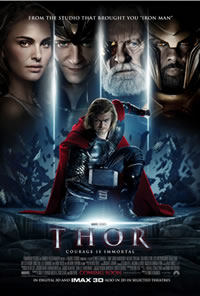
Thor – You’ve Been Expecting It, Haven’t You?

Frankly speaking, the best 3D viewing experience thus far.  I was about to give up on 3D technology wondering why I would want to spend extra dollars to watch a show with color less than vivid, edges at times blurry.  Thor has restored my faith on 3D movies.  They have done right this time.

I vaguely remember some of the audiences upon watching the promotional clip at the end of Iron Man 2 screamed “Thor!”  It was a hammer discovered on a dessert.  Now that I have watched Thor, the hammer is called Mjolnir.  And my geek-o-meter in the universe of Marvel has just shot up by one knot.  At the end of this movie, there too was another promotional clip.  This time, the audiences screamed “Avenger!”  I have been watching Avenger’s promotional clips for what seems like ages.  I wonder when Avenger will be out.

Thor is the god of thunder (played by Hemsworth), cast down from his celestial realm to our world due to some classic family politics.  The fantasy realm is a beauty to look at, especially with those 3D glasses.  And to help us to connect to to these celestial beings, we have Natalie Portman and her two science team members who witness Thor falling from the sky.  The encounters between them are lighthearted and hilarious.  And it was fun to see Natalie and her girl friend swooning towards Chris Hemsorth’s look and body.  Gosh, I so want to have a body like that!

Girlfriends (or love subjects?) of the superheroes are usually quite useless or powerless in the stories.  Thor is no exception.  I really wish that something could have happened between Thor and that warrior princess lookalike character.  If I was the story writer, I would find a way, one way or another, to let the girl wields some massive power towards the end, to save the dude who saves the world or to save the world herself.  Better still, sacrifice herself in the process.

I like it that in Thor, the story flips between the celestial realm and our present realm.  I am unsure if there will be a sequel.  Judging at the positive reception, I reckon there should be one.