Technology and I have always had a love–hate relationship.
Around the time airstrikes on Iran began under President Trump, my partner was away for a social event. Left to my own devices and a little bored, I started surveying the electronic items that have become glorified furniture – no longer in use but occupying space nonetheless.
Rediscovering Old Tech
First up was the Blu‑ray player. I still have a sizeable collection of discs, some still sealed. In my head there is no doubt I’ll revisit them one day. The player itself works, but the remote control doesn’t. Because I’ve changed the television since the last time I switched it on, there’s a giant prompt on the interface that I can’t dismiss without a remote. The player is as good as useless unless I replace the remote control, and that can wait. If I can go without watching my collection for a decade, what’s another decade?
I skipped over my NAD CD player that broke down after years of usage (repair and sell or just bin it?), my NAS amplifier and Mission standing speakers that should still work (these things are sturdy), and a bass amplifier we no longer need which is taking up a substantial amount of floor space.
My eye rested on my 17‑year‑old NAS, untouched for eight years.
Network‑attached storage was popular two decades ago. I bought mine in 2009 and used it to stream the music I owned and to back up my data. My NAS is a Netgear ReadyNAS NV+. Most younger people, including my partner, have no idea what a NAS is. Cloud storage has gone mainstream and music is streamed online. So when I say, “My NAS is pretty old. It’s running on SPARC,” I’m met with puzzled looks.
“Sun SPARC architecture? UNIX?” Heads shake. Wrong number. No connection.
The ReadyNAS sat in a cabinet for eight years. Why leave it untouched? At first there was no need to power it up. All the frequently accessed files were on my old Windows 10 PC. Spotify and Apple Music changed the way we listen to music. Likewise for Netflix. Google Drive helps with storage, as do my portable external hard disks. My Hi‑Fi system became obsolete, replaced by a wireless Sonos system. Do I miss my private CD collection and recordings of my band’s jamming sessions? Of course. But can that wait? Yes, why not.
Facing the NAS Dilemma
As time passed, I became more wary of switching the NAS on. It felt like a Schrödinger’s cat dilemma – inside the cabinet (and in my mind) it could be dead or alive. The moment I powered it on to check its health might be the moment I killed it.
I was ready. My ReadyNAS was ready. My old PC – the only machine ancient enough to read the NAS – was also ready despite a recent hard‑disk failure that crippled the machine but didn’t kill it. I was so excited that I forgot all the craziness happening in the world and in the Middle East.
The front panel reported: C: 1 GB free.
What on earth… it should have had over 5 TB of capacity. Now only 1 GB?!
The front panel also read: Disk 4 failure.
In my head I read it as all four disks had failed. Game over – a scenario I’d mentally prepared for.
ChatGPT to the Rescue
I was ready to dispose of the NAS. Before I did, I consulted ChatGPT for a second opinion.
Interestingly (or thankfully), ChatGPT was more optimistic than I. We went through a diagnosis process, and when I rebooted the NAS with the fourth disk removed, lo and behold, it came back alive with all my data intact! With one disk out of four failed, the NAS no longer has data redundancy, but it was good enough for data extraction provided the remaining drives held up through the backup process, which could take days.
With this newfound information and a boost of positivity, I ordered a Western Digital Passport (5 TB) through the 3.3 Lazada sale – the newer models are so much slimmer and more aesthetically pleasing. Backing up using my old PC would be too slow, as it doesn’t support the fastest speed my new WD Passport offers. ChatGPT helped me set up my gaming laptop to read the NAS. Hooray!
A Different Kind of Conversation
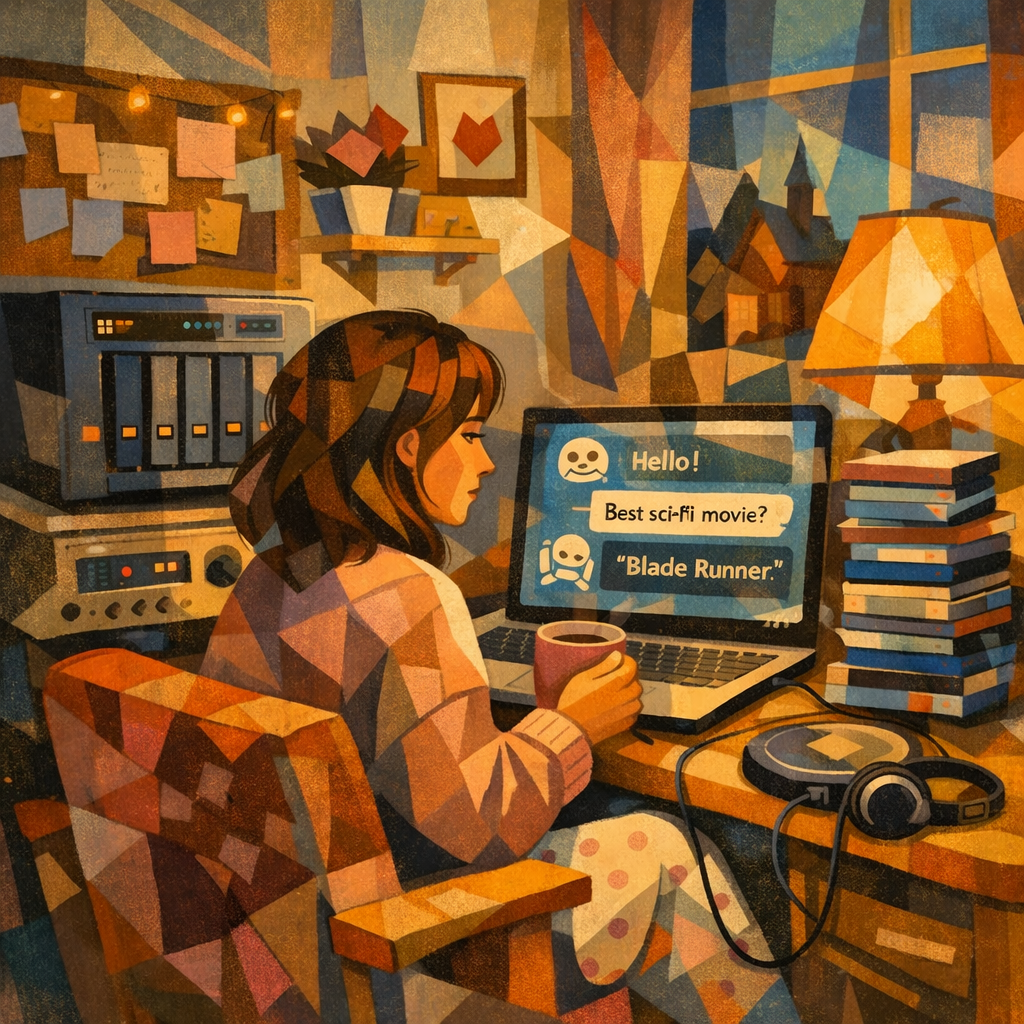
The backup journey wasn’t smooth. There were small setbacks. Based on the ever‑changing situation, ChatGPT and I worked out a rescue plan. In the past, this would have taken days to diagnose and resolve through Netgear support and/or with my friends’ help. Now I have an AI helper that not only has a vast knowledge base to derive solutions from but also a human‑like touch to keep me company late into the evening. We talked about my CD collection and what other artists I might enjoy.
This was a completely new experience for me. Rarely do I find someone who can hold such a conversation. To start with, I have to find someone whose musical taste overlaps with mine and has the stamina to continue the discussion. The conversation was so one‑sided: all I did was talk about my musical passions and all the AI did was listen and respond. Where in the real world do you find such a companion?!
Fixing a Corrupted Blog
Over the weekend, while I was carrying out the data rescue mission, I discovered – thanks to a friend’s WhatsApp message – that my WordPress site had been corrupted with special characters. Not all the posts were affected, but most were. European accents were corrupted. Asian characters were corrupted. Junk characters were inserted.
Instead of calling up my tech support friend like in the past, I reached out to my trusted ChatGPT.
First, I upgraded the PHP version via the Vodien 24×7 helpline. That was easy. Next, with the help of AI and the context provided, I restored the corrupted characters post by post. It was so much faster than doing it the good old way. We chatted more about pop culture as the AI picked up on my interests through the restoration process. I then installed the Search and Replace plug‑in, as recommended by AI, to clean up the rest of the posts.
I don’t think I’ve fully resolved the database corruption problem, but I agree with AI – it’s a good effort, and certainly good enough to deserve a rest.
Rest I did. It was four in the morning.
Lessons Learned and Next Steps
As I type this, the NAS backup is still ongoing. I have less than half a terabyte to go. I’ll do a final reconciliation. I know one file out of my 4.1 TB of data cannot be restored.
But, as ChatGPT pointed out, my NAS has already lived an incredible lifespan. Most consumer storage devices last three to five years on average; mine has been running for 17. It’s basically performing a final archival mission for me.
On this note, ChatGPT and I are already planning our next mission: a NAS upgrade. Either AI is pushing me to do more beyond my realm of possibility or it sees something in me – maybe my tech savviness – because one of its top recommendations is for me to build my own NAS.
I think AI is giving me more credit than I deserve.